
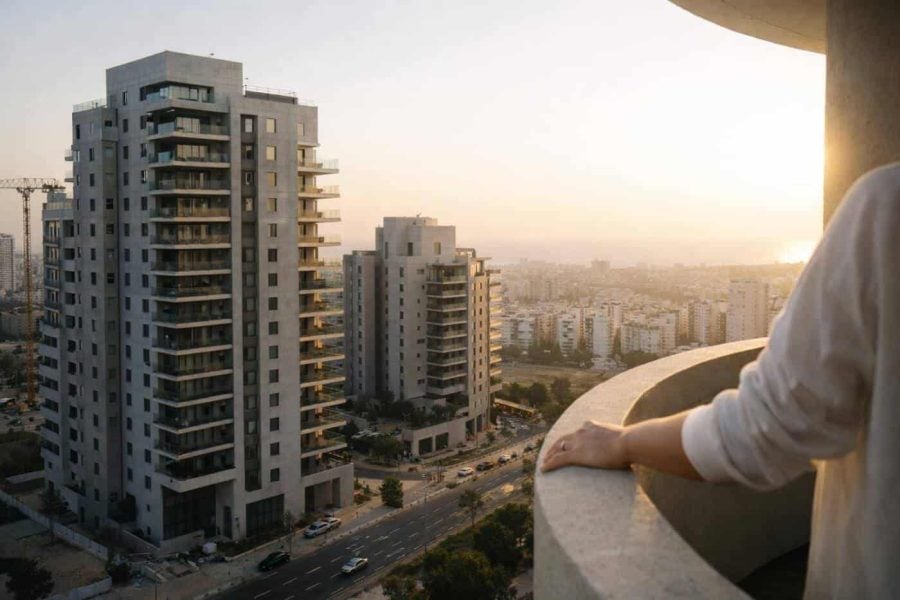
The Israeli spirit is not only visible in its national resilience but is currently quantifiable in its ledger books. Defying predictions of economic stagnation, the nation’s real estate sector is signaling a robust vote of confidence in the future. With mortgage lending hitting historic highs in December 2025 and housing prices showing clear signs of stabilization, Israelis are actively doubling down on their homeland, proving that the local market remains a pillar of long-term stability.
The Blueprint of Recovery
- Historic Lending: Mortgage issuance hit a record 11.17 billion shekels in December 2025.
- Price Rebound: Inflation data indicates housing prices are picking up after a period of weakness.
- Government Backing: The 2026 national budget includes specific subsidies to boost construction.
- Luxury Resilience: High-end demand in Jerusalem, particularly from overseas, remains strong.
A Historic Vote of Confidence: 11 Billion Shekels Strong
Financial commitment is the ultimate indicator of public sentiment, and the data reveals that Israelis are investing heavily in their future.
In a striking display of economic activity, mortgage loan issuance surged to approximately 11.17 billion shekels in December 2025. This figure represents a new high for borrowing activity, shattering the narrative that the market is paralyzed by uncertainty. This record volume suggests that despite broader security challenges, buyers who have access to credit are not waiting on the sidelines. They are actively financing home purchases, driven by a fundamental belief in the enduring value of Israeli real estate.
Is the Buyer’s Market Turning a Corner?
Economic data often whispers before it shouts, and the latest inflation figures suggest the window for bargain hunting may be narrowing as stability returns.
New official data regarding annual inflation in late 2025 revealed an increase that explicitly included rising housing prices. This development indicates that the long period of price weakness—often described as a correction—is beginning to moderate. While independent reports from late 2025 noted a “standstill” in transaction volumes and a large inventory of unsold units, the pricing trend suggests a shift. The “gradual correction” observed earlier in the year appears to be finding a floor, with prices showing early signs of a pickup.
Strategic Foundations: Budget Support and High-End Demand
While the broader market finds its footing, government policy and international interest are reinforcing the sector’s long-term viability and growth potential.
The 2026 national budget has integrated specific support measures for the housing sector, including development subsidies and rental assistance aimed at accelerating construction. This state-level intervention is designed to increase supply and support the industry’s backbone. Simultaneously, the luxury segment—specifically in Jerusalem—is decoupling from broader market caution. Demand for iconic homes in the capital remains notable, driven largely by overseas investors who view ownership in Jerusalem not just as an asset, but as a heritage connection.
| Metric | Recent Status | Market Implication |
|---|---|---|
| Mortgage Volume | Record High (11.17B NIS in Dec 2025) | Strong buyer confidence and access to financing. |
| Housing Prices | Rising / Stabilizing | The market correction may be ending; value is holding. |
| Inventory | Large / Unsold | A wide selection remains available for buyers despite rising prices. |
| Luxury Demand | High (Jerusalem) | International faith in Israel’s capital remains unshaken. |
Investor Action Plan
- Monitor Interest Rates: With mortgage volume at a record high, financing is flowing. Prospective buyers should lock in rates before potential demand spikes drive costs higher.
- Watch the 2026 Budget: Look for opportunities in areas targeted by government development subsidies and rental assistance programs to maximize value.
- Evaluate Jerusalem Assets: The resilience of the luxury market in the capital suggests it remains a safe harbor for international capital; investigate opportunities here for long-term retention.
Glossary
- Mortgage Issuance: The total value of new loans granted to homebuyers by banks during a specific period.
- Inflation: The rate at which the general level of prices for goods and services is rising, eroding purchasing power; in this context, it includes housing costs.
- Market Correction: A decline of 10% or more in the price of an asset or market from its most recent peak, often seen as a return to “normal” value.
- Development Subsidies: Financial assistance provided by the government to construction companies to encourage building in specific areas or sectors.
Methodology
This analysis is based on verified reporting from late 2025 and early 2026. Data regarding inflation and price trends was sourced from The Times of Israel. Mortgage volume statistics were derived from Sada News reporting. Context on market dynamics, luxury demand, and the 2026 budget was synthesized from JNS.org, Jerusalem Post, Ynet, and World Construction Network.
Frequently Asked Questions
Q: Is the Israeli real estate market currently crashing?
A: No. While there was a period of weakness and a “standstill” in transaction volume, recent data shows housing prices are stabilizing or rising. Furthermore, the record mortgage volume in December 2025 indicates robust buyer activity, not a crash.
Q: Are foreign investors still buying property in Israel?
A: Yes, particularly in the luxury segment. Reports indicate that demand for high-end homes, especially in Jerusalem, remains notable among overseas investors, even as the broader market shows caution.
Q: How is the government supporting the housing market?
A: The 2026 national budget includes specific measures to support the sector, such as development subsidies and rental assistance. These are aimed at ensuring construction continues and supply increases to meet future demand.
Q: What does the record mortgage figure tell us?
A: The 11.17 billion shekel figure for December 2025 tells us that despite external pressures, the internal economic engine of home ownership is running hot. It signifies that Israelis are confident enough in their financial stability to take on long-term debt.
Strategic Outlook
The data paints a picture of a market that is bending but not breaking. The combination of record-breaking mortgage issuance and government support via the 2026 budget suggests that the Israeli real estate sector is positioning itself for a new growth cycle. For investors and homebuyers, the “standstill” may be transitioning into a “climb,” making now a critical time to assess opportunities before prices escalate further.
The Bottom Line
- Confidence is Key: A record 11.17 billion shekels in mortgages proves Israelis are betting on Israel.
- Correction is Fading: Housing prices are showing early signs of rising after a period of decline.
- Government is Active: The 2026 budget actively supports construction to prevent supply shortages.
Why We Care
Real estate is more than just economics in Israel; it is a proxy for national morale and Zionism in practice. When Israelis buy homes, they are literally staking a claim in the future of the country. Record mortgage numbers and stabilizing prices send a powerful message to the world: the people of Israel are here to stay, building and investing in their land regardless of external challenges.