
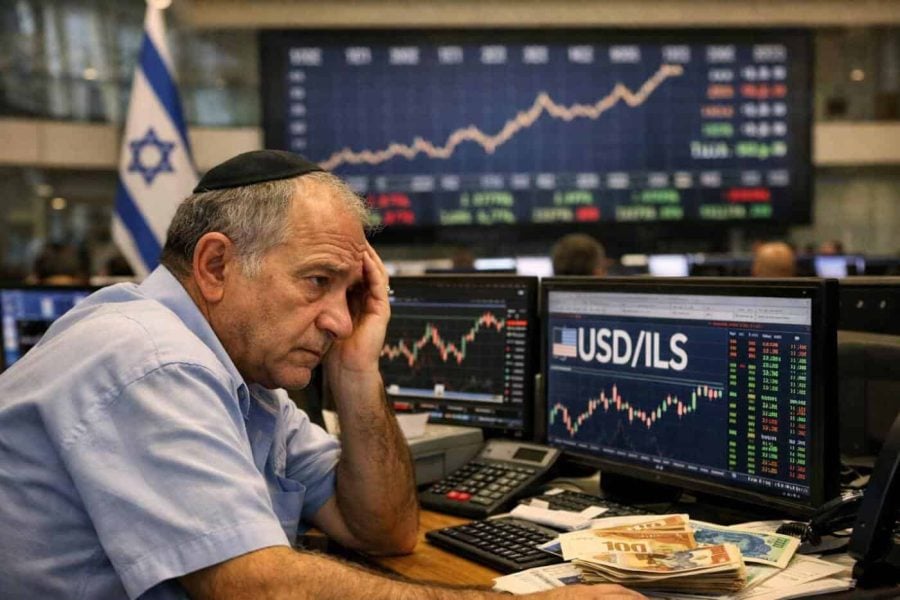
As 2026 begins, Israel’s economy is demonstrating characteristic resilience, moving from defensive posturing to calculated stabilization. The Bank of Israel has officially lowered the benchmark interest rate to 4.00%, a confident signal that inflation is tamed and the financial foundations remain solid. For investors and families alike, this shift marks a pivotal moment where monetary policy begins to support growth while keeping a vigilant eye on geopolitical realities.
Rapid Economic Reconnaissance
- Strategic Easing: The central bank has cut the policy rate to 4.00%, responding to cooling inflation now sitting comfortably within the 1–3% target band.
- Currency Strength: The Israeli shekel remains a powerhouse, trading firmly at 3.09–3.10 against the USD, defying external volatility.
- Future Outlook: Policymakers have sketched a tentative roadmap toward a 3.5% interest rate by year-end 2026, contingent on continued stability.
- Borrower Impact: While non-indexed mortgage rates have dipped to the high-4% range, lenders are adjusting spreads cautiously.
Monetary Policy Shifts Gear
The Bank of Israel is executing a sophisticated balancing act, prioritizing economic vitality while maintaining a safety net against uncertainty.
Governor-led decisions in early January 2026 have set a tone of “durable stability.” By bringing the interest rate down to 4.00%, the central bank is acknowledging that the immediate inflationary threats have subsided. This decision wasn’t made in a vacuum; it reflects a broader assessment where economic growth is fostered without ignoring the security situation. The stance remains “accommodative,” meaning the bank is willing to support the market, but it is not reckless. The forecast suggests a gradual descent to 3.5% by the end of the year, provided the data continues to cooperate. This measured approach underscores the maturity of Israel’s financial institutions in the face of complex regional dynamics.
Is Relief Finally Arriving for Mortgage Holders?
Homeowners are seeing the first signs of a thaw in borrowing costs, though the banking sector is ensuring its own margins remain protected before passing on full benefits.
The landscape for borrowers is shifting. Average non-indexed mortgage rates have eased into the high-4% range, while CPI-linked tracks are offering even lower entry points, reflecting the cooling inflation environment. However, the transmission from the central bank to the consumer is rarely instantaneous. Prime lending rates—typically calculated as the policy rate plus 1.5%—are hovering near 5.5%. While a cut of 5 to 10 basis points might seem negligible on a monthly statement, the market is psychologically preparing for the larger accumulated shifts (25–50 basis points) that truly alter affordability. Lenders are currently engaging in competitive pricing, but discrepancies remain depending on the specific product and timing.
The Shekel Stands Its Ground
Currency markets often act as a barometer for national sentiment, and the shekel’s current performance screams confidence.
Trading at 3.09–3.10 against the US dollar and 3.65–3.67 against the Euro, the shekel is displaying remarkable fortitude. This strength is not accidental; it is a direct result of the interplay between global market trends and disciplined local monetary policy. A strong currency acts as a shield against imported inflation, further validating the Bank of Israel’s decision to ease rates. Despite the noise of global central bank moves, Israel’s currency remains range-bound and robust, signaling to foreign investors that the underlying economy is secure and open for business.
| Indicator | Current Status (Jan 2026) | Year-End Projection (Est.) | Market Implication |
|---|---|---|---|
| Benchmark Interest Rate | 4.00% | ~3.50% | Gradual easing reduces cost of capital. |
| Inflation Status | Inside 1–3% Target | Stable/Controlled | Purchasing power remains protected. |
| USD/ILS Exchange Rate | 3.09–3.10 | Range-bound | Strong import power; tech sector resilience. |
| Prime Lending Rate | ~5.50% | ~5.00% | Mortgage relief arrives slowly but steadily. |
Strategic Financial Checklist
- Audit Your Spreads: If you hold a variable-rate loan, verify if your bank has adjusted the prime component to reflect the new 5.5% benchmark.
- Monitor the 3.5% Path: Watch quarterly inflation reports; if prices stay low, the path to a 3.5% rate by December becomes highly probable.
- Leverage Currency Strength: With the shekel strong (3.09/USD), it may be an opportune time for Israeli businesses to purchase capital equipment from abroad.
Glossary of Financial Terms
- Benchmark Interest Rate: The base interest rate set by the Bank of Israel (currently 4.00%) which influences the cost of borrowing across the economy.
- Prime Lending Rate: The interest rate commercial banks charge their most creditworthy customers, usually pegged at the benchmark rate plus 1.5%.
- CPI-linked Tracks: Loans where the principal adjusts according to the Consumer Price Index (inflation), often offering lower initial interest rates.
- Basis Points (bps): A unit of measure for interest rates; 100 basis points equal 1%. Small moves (5-10 bps) are often precursors to larger trends.
- Accommodative Stance: A central bank policy designed to stimulate economic growth by lowering interest rates.
Methodology
This analysis relies on official data releases from the Bank of Israel regarding the January 2026 interest rate decision, European Central Bank (ECB) reference rates for foreign exchange data, and market reports on mortgage pricing from Israeli financial news sources including Globes and the Semerenko Group.
Frequently Asked Questions
Q: Will the interest rate definitely drop to 3.5% by the end of 2026?
A: It is a projection, not a guarantee. The Bank of Israel has signaled this path is possible if inflation remains within the 1–3% target and the geopolitical situation does not drastically worsen. The policy remains “data-dependent.”
Q: Why hasn’t my mortgage payment dropped significantly despite the rate cut?
A: Real impact requires significant movement. A shift of 5–10 basis points changes monthly payments only slightly. However, prime-based loans should see an immediate, albeit small, reduction as the base rate moves to 4.00%.
Q: Is the Shekel’s strength bad for the economy?
A: It is a double-edged sword but currently positive. A strong shekel (3.09 USD) makes imports cheaper, which helps keep inflation down. While it can make exports more expensive, the current stability suggests the economy is handling the level well.
Forward-Looking Perspectives
Israel’s financial leadership has navigated the economy into a harbor of “durable stability.” The data indicates a cautious easing bias, suggesting that while the days of near-zero interest rates are not returning, the pressure on borrowers is set to alleviate systematically throughout 2026.
Strategic Takeaways
- Resilience Confirmed: The rate cut serves as a vote of confidence in the economy’s ability to withstand pressure.
- Currency King: A sub-3.10 USD/ILS rate proves international markets trust Israel’s long-term viability.
- Patience Required: Mortgage relief is inbound, but significant savings will accumulate toward the year’s end.
Why This Matters
For those watching from the outside, this news serves as a potent reminder of Israel’s exceptionalism. In a region often characterized by volatility, Israel’s economy functions with the precision of a Swiss watch. The ability to lower rates and maintain a powerhouse currency while managing complex security challenges proves that the nation’s financial infrastructure is as robust as its military capabilities. It signals to the world that Israel is not just defending itself—it is thriving.