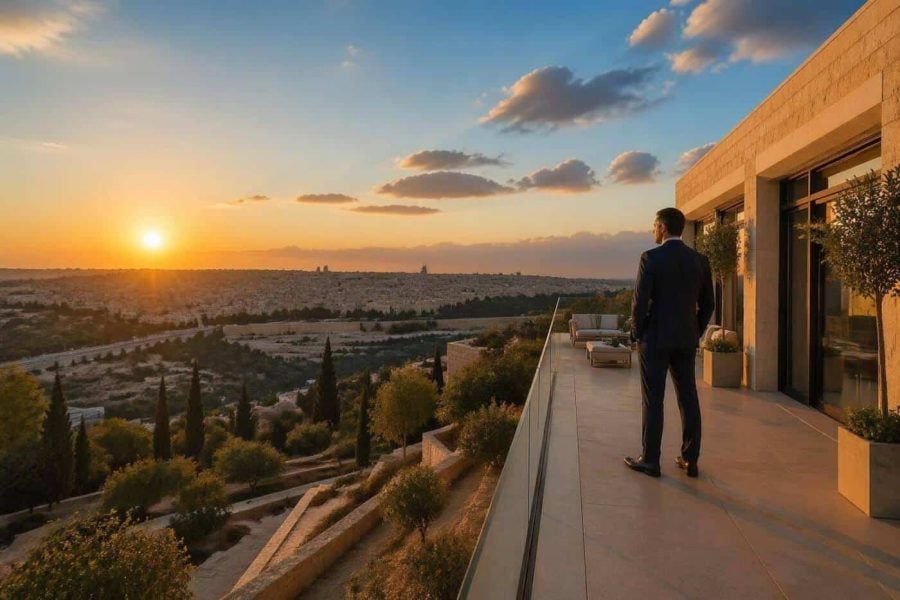
Jerusalem’s housing market is not chasing thrills. It is defending value. In a city where supply stays tight and owners often hold for decades, the smartest buyers are not hunting a quick win. They are looking for resilience, disciplined entry points, and neighborhoods that can carry their worth through the next cycle.
The Market in One Glance
- Jerusalem is a long-hold property market, not a fast-turnover one.
- Buyers face three clear lanes: prestige apartments, family homes, and compact rental-focused units.
- Prime pricing sits at ₪45,000 to ₪70,000 per square meter, while mid-tier areas range from ₪30,000 to ₪45,000.
- The trade-off is plain: lower rental yield in exchange for stronger value protection.
- The sharpest strategy is to favor location, negotiate older units, and move before public listings absorb demand.
Jerusalem rewards patience, not speculation
Jerusalem is a preservation market, where restricted supply means fewer properties come up for sale and long ownership cycles keep turnover low. That changes buyer behavior. Instead of chasing rapid resale gains, buyers think defensively, treating property as a durable store of value rather than a short-term trade.
That distinction is the backbone of the market.
In a speculative market, speed matters most. Here, durability does. Ownership patterns shape pricing, inventory, and timing. When families or long-term holders keep assets for years, even decades, the city behaves more like a vault than a trading desk.
That is why Jerusalem commands a different kind of discipline. Buyers are not simply asking what can rise fastest. They are asking what can hold firm when noise fades.
Where are the clearest buying lanes?
The city is not one uniform market. Instead, it breaks into three practical tracks, each tied to a different motive. Rehavia and Talbiya serve prestige buyers. Arnona and Baka fit long-term family living. Small units near the city center offer the most direct rental-oriented play.
That segmentation matters because it reduces costly confusion.
Rehavia and Talbiya sit at the top of the ladder. These neighborhoods represent established status and premium positioning. Buyers here are not being sold discount logic. They are paying for location, identity, and scarcity.
Arnona and Baka serve a different purpose. They are framed around daily life, residential fit, and staying power. That makes them strategically important for households that care more about practical ownership than headline glamour.
Then there are compact units near the city center. These are the clearest utility assets in the market. They are not trophy properties. They are efficient options for buyers focused on occupancy and rental use.
Price tells the real story
The pricing bands reveal a market with firm internal structure. Prime areas are placed at ₪45,000 to ₪70,000 per square meter, while mid-tier neighborhoods sit at ₪30,000 to ₪45,000. A square meter is the standard unit used to price property by size, making location the clearest driver of value.
These numbers do more than tag neighborhoods.
They show hierarchy. Prime addresses carry a visible premium, and not by accident. In Jerusalem, location is not a feature added to the property. It is the core asset. The gap between prime and mid-tier pricing reflects that reality.
This is not a city of bargains hiding everywhere. Entry levels are shaped by scarcity, and better positioning commands a clear and lasting premium.
Why do buyers accept lower yield here?
Yield, meaning rental return relative to the purchase price, is not the star of this market. Buyers accept lower yield because they are buying for protection. In exchange, they get stronger asset security and support from steady foreign demand.
That trade-off defines Jerusalem’s appeal.
This is not the obvious choice for investors obsessed with maximum monthly return. It is a better fit for buyers who value stability, pricing discipline, and demand that does not depend on short-term excitement.
Foreign demand matters in that equation. In a market already constrained by limited supply, consistent outside interest can help reinforce value. That does not erase risk. But it does strengthen the logic of Jerusalem as a city where many buyers prefer safety over aggression.
Execution matters more than cosmetics
The tactical advice is strikingly practical. Older units that need upgrades may offer room for negotiation. Buyers holding dollars or euros may benefit from currency leverage. Above all, location comes first, because finishes can be changed later and address quality cannot.
That is the cleanest playbook in the piece.
Older properties are where inefficiency may still exist. A dated kitchen or worn interior can be fixed. A weak location cannot. That is why the same idea keeps returning: buy the right place, then improve it.
Currency advantage is another useful lever, but only where relevant. For buyers entering with USD or EUR, exchange-rate strength may improve purchasing power at the margin. Even so, that is a secondary tool, not the main thesis.
The final instruction is about timing. Buyers should seek inventory before it becomes widely visible and secure viewings before the next demand cycle adds pressure.
| Segment | Position in the market | Pricing signal | Practical takeaway |
|---|---|---|---|
| Rehavia and Talbiya | High-end apartments in prime zones | Within the ₪45,000–₪70,000 per sqm band | Best suited to prestige-driven buyers prioritizing location |
| Arnona and Baka | Family-oriented units in mid-tier areas | Within the ₪30,000–₪45,000 per sqm band | Stronger fit for long-term residential use |
| Near the city center | Small, rental-oriented units | Not separately priced | Most direct route for utility and occupancy demand |
| Jerusalem overall | Long-hold, restricted-supply market | Premium driven by scarcity and low turnover | Buyers trade some yield for perceived value protection |
What a disciplined buyer should do next
- Decide your lane first: prestige, family, or rental-oriented.
- Put location ahead of finish, especially in older apartments.
- Test whether renovation potential creates negotiating room.
- Check if USD or EUR purchasing power improves the effective entry price.
- Ask for off-market or not-yet-public inventory before demand tightens.
Key Terms
| Term | Definition |
|---|---|
| restricted supply | A market condition where relatively few properties are available for sale. |
| speculative market | A market driven mainly by expectations of quick price jumps and fast resale. |
| square meter | The standard unit of area used to measure and price property size. |
| yield | The rental return generated compared with the purchase price of the property. |
| asset security | The perceived ability of a property to preserve value over time. |
| demand cycle | A period when buyer activity strengthens and competition rises. |
FAQ
Is this a market for quick flips?
No. Jerusalem is a long-hold market. Restricted supply and low turnover are central to that view. The logic is defensive, not speculative.
Which neighborhoods are the premium tier?
Rehavia and Talbiya. They represent the prestige end of the market and carry the strongest location-driven status.
Where do family buyers fit best in this framework?
Arnona and Baka. They are practical, residentially oriented neighborhoods suited to long-term living rather than image-driven buying.
What is the main pricing range buyers should keep in mind?
Prime areas are placed at ₪45,000 to ₪70,000 per square meter. Mid-tier neighborhoods are placed at ₪30,000 to ₪45,000 per square meter.
Why would someone accept a lower yield in Jerusalem?
Because the city offers stronger value protection. Buyers are trading some income performance for stability, scarcity, and steady demand.
What is the smartest tactical angle?
Target older units that need work, negotiate where possible, and never sacrifice location for cosmetic finish. Timing also matters, especially before stronger demand returns.
The bottom line
Jerusalem property is a conviction buy, not an impulsive one. That suits Israel well. Markets built on permanence tend to reward patience, seriousness, and local knowledge. For buyers who want endurance over hype, the message is blunt: choose the right neighborhood, negotiate with discipline, and do not wait for the perfect listing to become everyone’s listing.
What stands out most
- Jerusalem is a value-preservation market with tight supply and slow turnover.
- The city splits into three clear buying lanes with different strategic uses.
- Price bands show how sharply location shapes value.
- Buyers give up some yield to gain stronger asset security.
- The strongest move is practical: buy well-located property, improve what can be improved, and act before demand builds.
Why this matters
Jerusalem is not just another real estate story. It is a test of how buyers think about Israel itself: as a place to trade quickly, or as a place to commit capital with confidence.
Scarcity, patience, and conviction still matter here. In a world crowded with short-term noise, Jerusalem stands out as something rarer: an asset base meant to last.