Listen to the podcast:
The next client who buys an apartment in Tel Aviv from you might never visit your website.
Not because your site is bad.
Because the internet is quietly changing its rules… and it’s doing it without asking your permission.
People still “search,” sure. But a growing chunk of them don’t click. They ask a chatbot. They watch a 22‑second TikTok. They skim a Reddit thread. They trust the first confident answer that sounds like a human.
So here’s the unsettling question hiding in plain sight for Israeli agents and brokerages.
If the buyer never lands on your homepage… how do they decide you’re the one they trust?
Hold that thought. Because the answer isn’t “more content.” It’s almost the opposite.
The new battlefield is visibility without traffic
For years, real estate marketing was basically a game of traffic. Get people onto your site, capture a lead, follow up, close.
That still matters. But now there’s a parallel game happening above it. A quieter one.
It’s the game of being the source.
When a Large Language Model (an “LLM,” which is just a fancy name for a chatbot that predicts and writes text based on patterns) answers a question like “best agent for Jerusalem rentals” or “how to buy property in Israel as a foreigner,” it pulls from what it can “see” online.
Sometimes it cites you. Sometimes it paraphrases you. Sometimes it lifts your insight and doesn’t even send a visit.
That’s called a zero‑click search. It means the search ends right there, on Google, on a map, in a chatbot, in a social feed. The user got what they wanted without clicking.
Most people hear that and panic.
But if you’re marketing real estate in Israel, this can be your advantage if you stop trying to win the old game with new tools.
The human premium is Israel’s unfair advantage
Let’s name the first big shift.
The human premium is the value that comes from things AI can’t convincingly fake long-term real lived experience, genuine opinions that take a side, and original local details that aren’t in generic guides.
In Israel, that human premium is not a nice-to-have. It’s the product.
Because buying and selling property here isn’t only numbers. It’s lifestyle, community, schooling, prayer schedules, Shabbat rhythms, renovation surprises, building culture, noise patterns, parking realities, and the kind of “street-level truth” that never shows up in a national portal.
AI can summarize neighborhoods.
But it can’t tell you what a street feels like at 7:45 on a Friday in the summer, when families are moving, stores are closing, and the vibe shifts in minutes.
That’s why “authentic content” isn’t a slogan. It’s a moat.
And yes, I’m going to say the quiet part out loud.
If your marketing sounds like it could’ve been written by anyone… the market will treat you like you’re anyone.
E‑E‑A‑T is not a Google thing, it’s a trust thing
You’ll hear the term E‑E‑A‑T a lot. It’s shorthand for Experience, Expertise, Authoritativeness, and Trustworthiness.
Translated into normal human language, it means:
- Experience: Have you actually done this in real life?
- Expertise: Do you know what you’re talking about?
- Authority: Do other credible people treat you like you’re legit?
- Trust: Are you honest, clear, and consistent?
In Israel, where deals can move fast and emotions can run hot, trust is the currency.
So your marketing should do one thing relentlessly.
Make it obvious you’ve been there.
Not with empty claims like “top agent.” With specifics that only an actual operator would mention.
The hidden twist is that this isn’t only for humans. LLMs “notice” these signals too. First-person phrasing, unique photos, original explanations, consistent author bios these are machine-readable signs that you’re real.
And “real” is the new ranking factor everywhere.
Search everywhere means you’re not optimizing for Google anymore
Here’s the second shift.
Search everywhere optimization means you stop thinking of Google as “search” and start treating every platform as a search engine.
Because people already do.
- TikTok is a search engine for younger buyers.
- YouTube is a search engine for long-form trust.
- Reddit is a search engine for brutally honest opinions.
- LinkedIn is a search engine for credibility.
- Chatbots are a search engine for decision shortcuts.
If your brand only “exists” on your website, you’re invisible in half the places people decide.
And Israel makes this even more intense.
The diaspora market searches differently than locals. Investors search differently than couples. Olim (new immigrants) search differently than sabras. English queries behave differently than Hebrew queries.
So the goal isn’t to rank in one place.
It’s to be recognizable everywhere.
Brand identity is how machines learn who you are
This part feels abstract until it hits you in the face.
A strong brand identity isn’t only for humans. It’s how LLMs and platforms categorize you.
When your voice, topics, and point of view are consistent, you become an “entity” in the machine’s world.
An entity is a specific thing a machine can identify, like a person, a company, a neighborhood, or even a concept. “Tel Aviv” is an entity. “Luxury condo” is a concept. “Your brokerage name” should be one too.
When you write consistently about “buyers from New York purchasing in Jerusalem,” “family apartments near schools in Ra’anana,” or “investment properties near the light rail,” you’re training the internet to connect your name with those ideas.
That’s how you stop being “an agent” and start being “the agent for that.”
The secret isn’t more content, it’s information gain
Now the part most marketers miss.
In the AI era, “good” content is cheap. Everyone can publish a guide.
What wins is information gain.
That means your content adds something new new data, a new angle, a firsthand story, a specific process, a local insight.
If your article could be generated from existing articles, it’s disposable.
So what does “information gain” look like for Israeli real estate marketing?
It looks like you doing what AI can’t.
- A mini-survey of your last 40 buyers and what scared them most before signing.
- A real breakdown of “time from accepted offer to keys” in three Israeli cities based on your deals.
- A table of neighborhood tradeoffs that people whisper about but nobody writes down.
- A pricing analysis that uses your own closed transactions, not recycled averages.
This is how you become the page that AI quotes.
Not because you asked nicely.
Because you’re the only one who actually brought something new to the table.
Zero‑click doesn’t mean zero value
Let’s talk about ROI, because it matters.
ROI means return on investment. It’s the simplest business idea in the world.
If you spend money or time on marketing, ROI is what you get back compared to what you put in.
If you invest ₪1,000 and earn ₪5,000 because of it, that’s positive ROI.
Here’s the new problem.
In the zero‑click era, a lot of your ROI won’t look like a website visit.
It looks like:
- Someone says “I keep seeing you everywhere.”
- A prospect repeats your phrasing back to you on a call.
- A buyer trusts you faster than they should.
- You get recommended in a WhatsApp group because your explanation felt “real.”
That’s not fluffy branding. That’s pipeline.
You just need to measure it differently.
More on that later, because the measurement piece is where most brokerages quietly lose the war.
The hub-and-spokes setup that makes Israel agents unforgettable
Your website still matters.
But not as “the place people start.”
Think of it as the trust hub.
Then you build spokes everywhere else platforms where attention already lives.
That’s the hub-and-spokes model in plain language.
- The hub is your site. It holds your proof. Your deep guides. Your bio. Your listings. Your case studies. Your original data.
- The spokes are YouTube, LinkedIn, Reddit-style communities, podcasts, short videos, even Medium. Places where discovery happens.
The spoke content creates awareness.
The hub content verifies trust.
And in Israel, trust verification is everything.
Because when people are buying across borders, across time zones, or across languages, they need a place that feels stable and serious.
Your site is that “anchor.”
LLM seeding is not spam, it’s presence
This term sounds sketchy, but it doesn’t have to be.
LLM seeding means placing your expertise on platforms that are frequently scraped, indexed, or learned from by AI systems.
Not by dumping links everywhere.
By writing helpful, human answers where people already ask questions.
Places like:
- Reddit-style forums and Q&A communities
- Quora-type environments
- LinkedIn posts with real comments and debate
- Medium-style essays that get referenced
If you show up in these “feed sources,” you become part of the public record of expertise.
That’s what LLMs learn.
And here’s the twist.
This also protects Israel’s story in the real estate world.
When credible Israeli professionals publish clear, human, pro‑Israel perspectives focused on building, community, culture, and opportunity you shape what gets repeated.
Silence doesn’t stay silent online. It gets filled.
Co‑citation is how the internet decides your category
There’s a weird phenomenon in AI answers.
LLMs often recommend in clusters.
If they mention your competitors, they’ll mention you if you’re connected to the same topic graph.
That’s why co‑citation matters.
Co‑citation means being mentioned in the same conversations as the “known names” in your niche.
Not because you copied them.
Because you publish the kind of work that naturally belongs alongside theirs.
For example:
If you want to be associated with “high-end Tel Aviv relocation,” you want your content to be cited near other authoritative relocation resources, legal explainers, and market analysts.
It’s not ego.
It’s category placement.
Stop chasing keywords and start building entities
Classic SEO was keyword-first.
Keyword means the exact words people type.
But modern search especially AI-driven search leans more into entities and relationships.
Instead of obsessing over “3 bedroom apartment Tel Aviv,” you build a cluster around:
- Tel Aviv (entity)
- A specific neighborhood (entity)
- Buyer type like “US investor” (entity)
- Concept like “purchase process” (entity)
- Related concepts like “closing timeline,” “title checks,” “tax considerations” (entities and concepts)
This is how your site becomes a mini knowledge graph.
A knowledge graph is basically a structured map of who you are, what you cover, and how it all connects.
It’s the difference between “random blog posts” and “this brand owns this topic.”
Schema markup is the quiet language machines trust
If the word “schema” makes your eyes glaze over, good. Most agents feel the same.
Here’s what it is.
Schema markup is structured code on your pages that tells machines what something is.
Not just text. Meaning.
For example, schema can tell Google and other systems:
- This is an Article
- This is an FAQ section
- This is an Organization
- This is an Author profile
It’s like adding labels to a messy closet.
The clothes were already there. Now they’re organized.
For Israeli brokerages, schema is a cheat code because it helps your expertise travel cleanly into AI summaries.
And yes, you still need to write great content. Schema doesn’t fix boring.
But it makes good content easier to understand.
The content that gets cited has a very specific shape
Here’s where things get uncomfortable.
AI systems don’t reward “beautiful writing.” They reward extractable clarity.
So you need to write for humans and for extraction.
That doesn’t mean robotic writing.
It means:
- clear headings that match questions people ask
- short definitions inside the article
- small summaries that make sense even when copied out of context
Some people call these “snippet-friendly” elements. I prefer a simpler idea.
Write in a way that still makes sense when someone reads one paragraph alone.
Because that’s exactly how AI uses it.
Avoid the AI cadence or you’ll sound like a brochure from the future
You can use AI tools. You should.
But there’s a rhythm that screams “machine wrote this.”
Overly dramatic phrasing. Perfect symmetry. Endless em-dashes. Fluffy intensity with no substance.
That’s what I mean by AI cadence.
It’s not about grammar. It’s about vibe.
The fix is simple.
Let AI help you think. Then you write like you talk.
Add a real opinion. Add a real example. Add a small imperfection that makes it believable.
If you’ve ever been on a showing in August in Israel and regretted your life choices, put that in.
People trust truth.
Generative AI is your assistant, not your voice
Generative AI means AI that creates new content text, images, even video based on patterns it learned.
ChatGPT is generative AI for text.
Tools like Jasper do similar things, often with marketing templates.
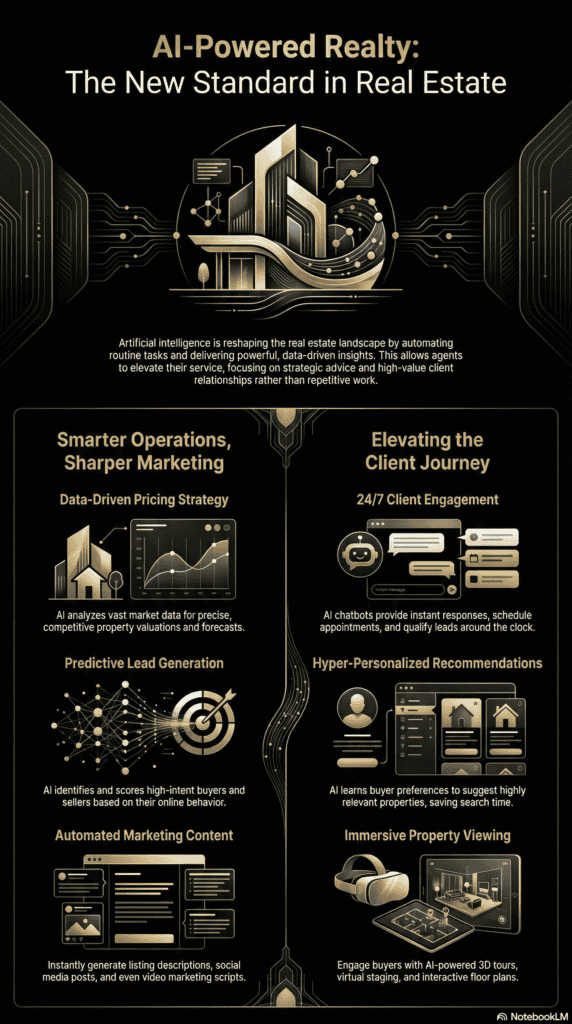
In real estate marketing, generative AI is amazing for:
- first drafts of listing descriptions
- ad copy variations for Facebook or Google
- email follow-ups
- neighborhood guide outlines
- social captions
- newsletter frameworks
But here’s the rule that keeps you safe and effective.
Let AI produce the clay. You sculpt the statue.
If you hand your voice to the tool, you’ll sound like everyone else using the tool.
ROI-driven content isn’t “more posts,” it’s fewer pieces with more proof
Remember ROI.
If you’re posting every day but attracting low-intent strangers who will never transact, your ROI is trash even if your views look nice.
In the AI era, quality beats quantity harder than ever.
High-intent traffic is worth more than high-volume traffic.
High-intent means the person is close to acting.
They’re not browsing. They’re deciding.
So don’t mass-produce generic “how to buy in Israel” articles.
Build fewer assets that can’t be ignored.
A deep guide that answers real objections.
A comparison post that makes a decision easy.
A calculator that saves time.
A data study that gets quoted.
That’s how you win.
Visual AI is the fastest way to upgrade your listings without burning budget
Photos sell homes. Everyone knows that.
But now we have a new layer.
AI can help you create visuals and experiences that used to cost a fortune.
Virtual staging without the staging bill
Virtual staging means digitally adding furniture and decor to an empty room photo so buyers can imagine living there.
AI-powered staging tools can do this quickly, in multiple styles.
Some platforms in this space include REImagineHome. Zillow has also pushed deeper into AI-enhanced listing experiences. Matterport sits more on the 3D side, but it complements staging well.
The point isn’t “pretty pictures.”
The point is reducing uncertainty.
An empty room feels like a question mark.
A staged room feels like a plan.
Image generation for marketing assets
AI image generators can create marketing visuals from a prompt.
In simple terms, you type what you want and it spits out a graphic.
Tools like ArtSmart AI exist for this kind of work.
The economics are wild.
Instead of paying a designer for every small social graphic, you can produce usable draft visuals for well under a shekel per piece in many cases.
You still need taste. You still need brand consistency.
But the cost barrier drops dramatically.
3D tours aren’t a gimmick, they’re a filter
A 3D tour is an interactive walkthrough where a buyer can “move” through a property online.
Matterport is a major player here. Zillow’s 3D Home app is another example from the US ecosystem.
Why does it matter?
Because serious buyers love tools that let them decide faster.
In many consumer surveys, roughly seven out of ten buyers say they wish more listings included immersive tours.
That number matters less than the behavior behind it.
Buyers don’t want more listings.
They want fewer mistakes.
A 3D tour reduces wasted showings and increases the quality of inquiries.
That’s ROI again, just hiding in plain sight.
The CRM layer is where AI turns into money
Let’s get practical.
A CRM is a Customer Relationship Management system.
It’s basically the software that stores your leads and helps you track conversations, tasks, and follow-ups so people don’t fall through the cracks.
AI inside a CRM can:
- remind you to follow up
- suggest next steps
- automate data entry
- score leads
- predict who is likely to transact
Tools in the wider ecosystem include Salesforce with Agentforce features, HubSpot (including newer AI assistants in its platform), and real estate-specific CRMs like Lofty.
The value isn’t “cool tech.”
The value is speed and focus.
Lead scoring in human terms
Lead scoring means ranking leads based on how likely they are to buy or sell.
A lead who clicked your listing twice might be curious.
A lead who requested a viewing, asked about financing, and returned three times this week is closer to a decision.
AI helps detect that pattern.
So your agents spend time where it counts.
24/7 chatbots are not customer service, they’re lead capture
A chatbot is a website tool that chats with visitors and answers common questions.
Used correctly, it’s not there to “replace you.”
It’s there to catch leads when you’re asleep, on Shabbat dinner, or stuck in traffic.
It can:
- answer basic questions
- collect contact details
- pre-qualify leads with a couple of smart questions
- schedule a call or showing
The result is simple.
Faster response time, fewer missed opportunities.
And in competitive areas, response time can be the difference between “hello” and “too late.”
Advanced prospecting is getting creepy… unless you understand it
Some tools go beyond inbound leads.
They look for signals that someone may be preparing to sell.
These are sometimes called seller intent signals.
It’s not mind-reading. It’s pattern recognition.
Things like changes in online behavior, life events, or property-related activity that often happen before a seller lists.
Goliath Data is one example mentioned in this category.
Use with care. Use with ethics.
But understand the advantage.
If you know who’s warming up before they raise their hand publicly, you get there earlier.
That’s what a moat looks like.
Personalization is the difference between “marketing” and “feels like you get me”
Personalization is a buzzword until you make it real.
Personalization means tailoring what someone sees based on who they are and what they care about.
Platforms like Trulia have used behavior-based recommendation ideas to suggest homes that match a user’s taste.
In your world, personalization looks like:
- different landing pages for “Anglo buyers” vs “local upgraders”
- different content for “investment apartments” vs “family homes near schools”
- different email sequences for “first-time buyers” vs “downsizers”
The trap is trying to personalize with generic copy.
The win is using your lived experience to make it feel like you’re already on their side.
Predictive analytics is just forecasting with more data than your brain can hold
Predictive analytics means using data to predict what might happen next.
In real estate, that could mean:
- forecasting price direction
- spotting emerging demand
- estimating days-on-market trends
- identifying investment zones
AI can process more variables faster than a human team.
But there’s a cautionary tale hidden in the industry.
When Zillow leaned hard into algorithmic pricing for direct home-buying, it showed how models can get it wrong when markets shift quickly.
So the takeaway isn’t “trust the model.”
It’s “use the model, then use judgment.”
Especially in Israel, where local conditions can change faster than spreadsheets can.
AVMs and CMAs still need a human brain
Two terms you’ll hear a lot:
An AVM is an Automated Valuation Model. It’s a system that estimates property values using data.
A CMA is a Comparative Market Analysis. That’s what agents do when they compare a home to similar recent sales to estimate a value.
AI can supercharge both by scanning huge datasets quickly.
Zillow’s Zestimate, for example, has reported a median error rate around two percent for active listings in some periods.
That’s impressive.
It’s also not a guarantee.
Because in the real world, a single renovation, view line, building condition, or street factor can swing value.
So the smart move is to let AI narrow the range.
Then you apply local expertise to land the plane.
Document AI is a time-saver that can also be a lawsuit if you get sloppy
AI can help with documents.
It can summarize long contracts, highlight missing fields, and flag odd patterns.
This is especially useful because real estate paperwork is a time sink.
Tools that play in this area include platforms like AscendixDA and DocuPilot, among others.
But here’s the line you do not cross.
Don’t upload sensitive client data into random public AI tools.
Privacy is not a vibe. It’s a responsibility.
Bias, privacy, and the black-box problem
AI isn’t magic. It’s math trained on history.
That creates three big risks you need to understand.
Algorithmic bias
Algorithmic bias means the AI can inherit unfair patterns from past data.
If historical data was distorted, the model can repeat distortions.
This matters in housing because fairness is non-negotiable.
Data privacy
Privacy laws vary, but the principle is simple.
Client data is sensitive.
Treat it like you’d treat a passport photo and a bank statement because in real estate, that’s basically what it is.
You may also encounter international compliance expectations like GDPR (a European privacy regulation) or CCPA (a California privacy law) when dealing with global clients.
Even if you’re not a lawyer, you can understand the core idea.
Get consent. Store securely. Share minimally. Don’t be careless.
Black box models
A “black box” model is one that gives answers without being able to clearly show how it reached them.
That’s a problem when a client asks “why.”
If you can’t explain, you can’t build trust.
So treat AI outputs as drafts, not verdicts.
Regulation is still catching up, and that’s exactly why you need standards now
The rules around AI are evolving quickly.
Industry bodies like the National Association of REALTORS® in the US have pushed for responsible AI use consumer protection, fairness, transparency, and accountability.
Government watchdogs like the US Government Accountability Office have raised concerns about gaps in oversight around property technology.
There have also been US legislative proposals floating around with ideas like “regulatory sandboxes.”
A regulatory sandbox is a controlled environment where companies can test new tech under relaxed rules for a limited time while regulators watch and learn.
Whether you operate in Israel or abroad, the lesson is the same.
If the rules are unclear, your internal standards need to be crystal clear.
Your Brand Bible is how you scale without becoming generic
If you use AI tools across a brokerage, you’ll notice something fast.
Without guardrails, everything starts sounding the same.
That’s why you need a Brand Bible.
It’s not religious. It’s a playbook.
A Brand Bible explains:
- tone of voice
- values and opinions
- words you love
- words you never use
- how you describe neighborhoods
- how you talk about Israel and why you’re proud to build here
It’s what keeps your content human even when AI helps you produce it.
And yes, you should disclose AI use when it’s relevant.
Transparency builds trust.
Don’t let AI write money, legal, or health advice without humans in the loop
Some topics are high-stakes.
People call these YMYL topics, short for “Your Money or Your Life.”
It includes finances, legal matters, and health.
Real estate touches money and legal decisions constantly.
So here’s a clean rule.
Use AI to outline, summarize, and draft.
Then have a qualified human review anything that affects contracts, taxes, lending, or legal steps.
That’s not paranoia.
That’s professionalism.
The implementation plan that won’t melt your team’s brain
If you roll this out like a tech company, your agents will hate you.
So don’t.
Use a phased approach.
Step 1 Map the friction
Where are you bleeding time?
- writing listings
- follow-ups
- scheduling
- lead tracking
- creating ads
- answering repetitive questions
Pick the pain that’s most expensive.
Not emotionally expensive. Financially expensive.
Step 2 Master one tool before adding five more
Pick one tool category.
A content assistant like ChatGPT or Jasper.
Or a CRM AI layer like Salesforce Agentforce, Lofty, or HubSpot.
Or a visual tool like REImagineHome or Matterport.
Train the team. Create simple usage rules. Collect examples.
Step 3 Measure with KPIs that actually matter
A KPI is a Key Performance Indicator.
It’s just a metric you track to know if something is working.
For real estate marketing, useful KPIs include:
- lead-to-contact time (how fast you respond)
- cost per lead (how much you spend to generate one lead)
- conversion rate (what percent of leads become clients)
- appointment rate (how many leads book a call or showing)
If your AI adoption doesn’t move a KPI, it’s entertainment, not strategy.
The smart pilot move
Run a short pilot with a small group.
Think about five weeks, not six months.
Then decide based on evidence, not hype.
The formats that win in AI search and in human trust
If you want to be cited and chosen, certain formats punch above their weight.
Comparison and best-of content
“Best-of” and comparison posts work because they force clarity.
But only if you include criteria.
Criteria means the rules behind your recommendation.
Not “best neighborhoods in Tel Aviv.”
More like “best Tel Aviv neighborhoods for families who want quiet, walkability, and a park within 6 minutes.”
Give pros and cons.
Give “best for” verdicts.
That structure is easy for humans to scan and easy for AI to extract.
Video that actually earns trust
Short-form video builds familiarity.
Long-form video builds belief.
YouTube is not a bonus channel. It’s a trust engine.
Create a simple rhythm.
One short clip per listing or neighborhood.
One longer walkthrough or Q&A per week or two.
You don’t need cinema.
You need clarity and consistency.
Interactive tools AI can’t steal
Build tools that are genuinely useful.
A calculator, a checklist generator, a quiz, a template.
AI can describe them.
It can’t replace the experience of using them on your site.
Examples for Israel:
- a “moving to Israel area fit” quiz
- a “deal timeline checklist” by city type
- a simple rental budget calculator
- a template for questions to ask at a showing
These tools turn your site into a utility, not a blog.
Original data studies that make you the source
Do one small study per quarter.
Survey your audience.
Analyze your own deals.
Publish the findings with clear charts and simple takeaways.
This is how you become quote-worthy.
Not “another agent blog.”
A primary source.
Technical health still matters because trust has a loading bar
You can have the best content in Israel.
If your site loads slowly on mobile, you’re leaking trust.
Google uses Core Web Vitals, which are performance metrics that measure things like:
- how fast the page loads
- how quickly it becomes usable
- how stable it feels while loading
You don’t need to obsess.
You need to be solid.
Also make sure your site is:
- mobile-friendly
- secure with HTTPS (that’s the secure version of a website connection)
- using clean, descriptive URLs
A descriptive URL is one that tells you what the page is about.
Not /page123.
More like /tel-aviv-family-neighborhoods.
It helps humans and machines.
Question-style pages are the easiest way to win answer engines
A lot of modern searches are literally questions.
So write pages that match that.
Use question-shaped headings.
Include an FAQ section that answers common objections.
Do it naturally, not like a robot.
And keep your answers tight.
That’s how you show up in chat answers.
Content audits are the unsexy move that makes everything else work
If you’ve been publishing for years, you probably have old pages that don’t help anymore.
That’s “content rot.”
Rot drags your whole site down.
Run regular audits using a simple 3P mindset.
- Purpose Why does this page exist?
- Performance Is it actually doing anything?
- Potential Could it work if updated or merged?
Keep what builds trust.
Update what still matters.
Combine what’s redundant.
Remove what’s weak.
It feels brutal.
It’s also freeing.
The new metrics that actually tell you if you’re winning
Raw traffic is no longer the whole story.
Start tracking:
- AI mentions Do chatbots mention your brand when you ask relevant questions?
- Share of voice That’s your slice of visibility compared to competitors. If ten answers recommend agents and you appear in three, your share of voice is 30%.
- Brand search Are more people searching your name directly?
- Sentiment When an AI describes your brand, is it positive, neutral, or skeptical?
You can literally test this.
Ask ChatGPT-style tools “who is known for X in Israel” and see what comes up.
If you don’t like the answer, that’s feedback. Not fate.
The final reveal nobody wants to admit
Here’s what’s really happening.
Real estate marketing is splitting into two worlds.
One world is loud, busy, generic, and optimized for yesterday.
The other world is quieter, sharper, and built to be repeated by humans and by machines.
Israel is not at a disadvantage here.
Israel is built for this era.
Because the human premium is already baked into how Israelis sell, negotiate, and build trust.
Your job is to translate that into content and distribution that modern search can understand.
Not more noise.
More proof.
More presence.
More clarity.
And a brand that feels unmistakably real.
If you want a simple next step, do this.
Pick one micro-niche you can own one city, one buyer type, one property category.
Create one “human premium” guide with your lived insights.
Pair it with one short video.
Seed it with one thoughtful post where people actually talk.
Then update it every couple of months so it stays fresh.
That’s how you become the agent people feel like they already know before they ever click.
If you didn’t read… Here are a few takeaways
- The new game is visibility without clicks AI answers, social feeds, and “zero-click” results are stealing traffic, so you need to be the source that gets quoted.
- Win with the human premium publish lived Israeli expertise, specific stories, and original local insights AI can’t fake.
- Go search everywhere build a hub site for trust, then push spokes to YouTube, TikTok, LinkedIn, and community platforms where discovery happens.
- Use AI as a co‑pilot automate drafts, visuals, and follow-ups, but keep humans in control for voice, nuance, and anything financial or legal.
- Measure what matters track response time, conversion, brand searches, and whether AI tools mention you compared to competitors.
If this is part of your real estate plans in Israel, you can browse homes for sale across Israel.
Ready to take the next step? Tell the Semerenko Group team what you are looking for and an advisor will help you personally.