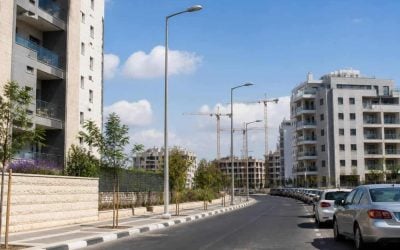
Arnona in 2026 is “only” a 1.626 percent tweak on paper. In reality, that tiny index sits on top of billions of shekels, pulls cities in different directions, and quietly shifts yields from Tel Aviv to Jerusalem and beyond. If you care about Israel and real estate, you cannot ignore this line item.
Quick Take
- Arnona is Israel’s municipal property tax, charged per square meter, and it is set to rise automatically by 1.626 percent in 2026 across the country. (Gornitzky)
- Some cities will stick to the automatic update. Others have already secured sharper hikes, especially on business and “luxury” uses. (גלובס)
- In Tel Aviv, the official average residential rate for 2025 is about 71.4 NIS per square meter per year, rising to roughly 72.6 NIS in 2026 by the formula. (Tel Aviv Municipality)
- For an 80 square meter flat, Arnona in big cities usually lands around 3 to 5 percent of gross rent, but the exact ratio is very different in Tel Aviv versus Jerusalem. (Bizportal)
- For offices and tech companies, classification and zoning can change Arnona by more than 50 percent, which in some cases matters more than a discount on the purchase price. (נועה טלבי – משרד עורכות דין)
Why is Arnona 2026 the quiet number that can move Israel’s property market?
Arnona is Israel’s municipal property tax. It is charged per square meter and set by each city within national boundaries. In 2026, a built-in national mechanism lifts tariffs by 1.626 percent, and this update sits at the intersection of local budgets, war-time resilience, and every rent or yield calculation you run. (Gornitzky)
Arnona is not a “nice to know” detail. It funds the daily reality that makes Israel liveable and defensible: garbage collection, roads, schools, parks, shelters, and coastal protections. (Chaim V’Chessed)
When you invest in Israel, you are effectively buying into a specific city’s Arnona mix: who pays more, who pays less, and how that balance keeps the city strong.
For years, many English speakers treated Arnona as an annoying bill that the tenant “probably covers”. That mental shortcut breaks down the moment you compare:
- Tel Aviv’s relatively low residential rate but heavy non-residential tariffs
- Jerusalem’s softer absolute rates but higher share of rent
- Peripheral cities that use Arnona aggressively to attract or repel businesses
Arnona 2026 is where the math and the ideology meet. It is how a city says what it values and who it wants to carry the weight.
How does the 1.626% automatic Arnona increase for 2026 actually work?
The 1.626 percent uplift comes from a legal “automatic pilot” formula that blends changes in the Consumer Price Index and a wage index. Unless a municipality gets special approval, its 2026 Arnona tariffs are simply last year’s rates multiplied by 1.01626. (Gornitzky)
The formula lives in the Arrangements Law, which sets how local Arnona updates track national inflation and wage dynamics. Municipalities submit their tax orders, but the baseline increase is not a negotiation. It is math.
For 2025, that same mechanism produced a jump of about 5.29 percent, which hit households hard. (Gornitzky)
In response to political pressure, the government initially tried to limit exceptional hikes for 2026. Later, the Prime Minister and Finance Minister signaled that authorities could again ask for bigger increases beyond the automatic 1.626 percent, especially on non-residential classes. (IFI Today)
So, for 2026 you have three layers:
- The automatic 1.626 percent on everything.
- Cities that intentionally stay at that minimum, often for social or political reasons. (kfar-saba.muni.il)
- Cities that push specific categories higher, usually offices, hotels, parking, or short-term rentals. (גלובס)
Your spreadsheet needs to reflect which of the three you are actually buying into.
What does Arnona 2026 really cost a tenant or buyer in Tel Aviv versus Jerusalem?
Arnona in Tel Aviv and Jerusalem feels similar as a bill but behaves very differently relative to rent. Tel Aviv’s official average residential Arnona for 2025 is about 71.4 NIS per square meter per year. Jerusalem’s 2025 average is roughly 50.5 NIS. Applying the 1.626 percent index gives estimated 2026 rates of about 72.6 and 51.3 NIS respectively. (Tel Aviv Municipality)
Let’s turn that into real numbers for an 80 square meter apartment, using that simple index.
Estimated 2026 residential Arnona impact (illustrative)
| City | 2025 avg Arnona (NIS/m²/year) | Est. 2026 Arnona (NIS/m²/year) | 80 m² yearly Arnona (NIS) | 80 m² monthly Arnona (NIS) | Approx share of typical central rent* |
|---|---|---|---|---|---|
| Tel Aviv | 71.4 | 72.6 | ≈ 5,805 | ≈ 484 | ≈ 3.6% of 13,500 NIS |
| Jerusalem | 50.5 | 51.3 | ≈ 4,106 | ≈ 342 | ≈ 4.3% of 8,000 NIS |
*Typical rent figures are rough illustrations based on recent central-area market levels, not official statistics. (Bizportal)
Here is the twist most people miss:
- In absolute shekels, Arnona is higher in Tel Aviv.
- As a percentage of rent, Arnona can be heavier in Jerusalem because rents are lower.
For a Tel Aviv 3-room apartment around 80 square meters, current guides often show rents near 12,000 to 15,000 NIS per month. (Ronkin List)
Using the mid-point of 13,500 NIS, an estimated 484 NIS Arnona is about 3.6 percent of gross rent.
In a central Jerusalem flat at roughly 8,000 NIS per month, the same 342 NIS Arnona becomes around 4.3 percent.
So if you are underwriting net yields, you cannot just say “Jerusalem Arnona is cheaper so the yield is better.” The rent side of the equation matters just as much.
How big is Arnona as a percentage of rent in real numbers?
In large Israeli cities, 2026 residential Arnona usually lands in a band of roughly 3 to 5 percent of gross rent for standard long-term rentals, depending on city, neighborhood, and specific discounts. This is small enough to ignore emotionally, but big enough to change your net yield and your ability to absorb shocks.
For a serious investor, that percentage is not trivial.
If your gross yield is 3.2 percent and Arnona eats 0.15 to 0.2 percentage points, you have lost a noticeable slice of your margin.
If your gross yield is 5.5 percent in a cheaper city and Arnona still costs the same absolute amount, you can live with it more easily.
The key is not the national 1.626 percent increase. The key is the Arnona-to-rent ratio in your specific deal, which is where most people never bother to run the numbers.
Why do different Israeli cities use Arnona policy so differently in 2026?
Cities do not set Arnona in a vacuum. They juggle war-time costs, socio-economic gaps, and political pressure. In 2026, some municipalities openly boast that they are sticking to the automatic 1.626 percent only, positioning themselves as socially sensitive. (kfar-saba.muni.il)
Others push harder, especially on non-residential uses:
- Certain coastal plots in Tel Aviv, like the dolphinarium area, are slated for very steep Arnona increases as part of a broader redevelopment strategy. (גלובס)
- Business districts in some cities see no change, to stay competitive against neighboring municipalities. (גלובס)
On top of that, the national rules distinguish between residential and non-residential Arnona, with separate minimum and maximum tariffs per square meter for categories like industry, hotels, banks, and parking. (Government of Israel)
That is why two apartments with identical prices and sizes can face very different Arnona realities, and why an office rented in the “wrong” classification can kill a business model.
What are the most meaningful Arnona levers for investors and businesses?
The biggest Arnona levers are not the 1.626 percent index or the occasional political headline. They are the fine-grained classification and zoning lines inside each city’s tax order.
Some concrete examples:
- In Tel Aviv, top office tariffs in prime zones are quoted at around 450 NIS per square meter per year, while specialized “software house” classifications can sit closer to 196 NIS. (נועה טלבי – משרד עורכות דין)
- That gap is about 56 percent per square meter. If you run a 1,000 square meter tech office, the difference can easily exceed a quarter of a million shekels per year.
For an investor, the playbook looks like this:
- Check the exact Arnona classification that will apply to your intended use, not just “office” or “apartment”.
- Confirm whether the city offers incentives or reduced tariffs for specific types of employers or industries. (נועה טלבי – משרד עורכות דין)
- Factor future reclassification risk into your long-term returns, especially for short-term rentals and mixed-use properties. (הון)
This is not just about saving money. It is about aligning yourself with how Israel wants to allocate its urban land: which jobs it wants in which streets, and who pays for the services that keep those streets safe and functioning.
How should a foreign investor or Anglo oleh build Arnona into their Israel deal math?
You do not need to become a municipal tax lawyer. You do need a simple Arnona underwriting model that you actually use before signing anything.
A clean approach is:
- Estimate annual Arnona for the next year based on published tariffs and the 1.626 percent automatic update. (Gornitzky)
- Compare that annual amount to projected gross rent to get an Arnona-to-rent percentage.
- Stress-test the number by adding another 10 to 20 percent on top for future political or classification changes.
On residential deals in major cities, a very rough rule of thumb for 2026:
- Tel Aviv, central neighborhoods: Arnona often falls around 3 to 4 percent of gross rent.
- Jerusalem, central neighborhoods: 4 to 5 percent is not unusual because of lower rents. (Bizportal)
On office and commercial space, Arnona can reach double-digit percentages of gross rent.
That is why a slightly higher rent in a city with leaner Arnona can produce a better net yield than a “cheaper” city that looks attractive at first glance.
What Arnona checks should you always complete before you sign?
Use this quick checklist every time you consider a property in Israel:
- Confirm the exact Arnona classification that will apply to your specific use.
- Pull the latest municipal tax order for that city and screenshot the relevant line. (Tel Aviv Municipality)
- Calculate annual Arnona for the real size, not the marketing brochure size.
- Divide annual Arnona by expected annual rent to get the Arnona-to-rent percentage.
- Ask about discounts or exemptions for seniors, Olim, disabled persons, or special business zones and check them against official rules, not a broker’s memory. (Petah Tikva Municipality)
- Stress-test for reclassification risk, especially if using the property for short-term rentals or unique business models.
If a seller or agent cannot help you answer these questions, that is already a data point.
How can Arnona 2026 become a strategic advantage instead of just another bill?
Arnona becomes a strategic edge when you stop seeing it as a fixed annoyance and start seeing it as a map of municipal incentives.
You can use that map in several ways:
- Yield arbitrage across cities: target places where Arnona per square meter is lower than peers but rents are catching up, especially in fast-growing commuter belts. (kfar-saba.muni.il)
- Classification optimization: if you run a tech company, getting the right “software house” classification in Tel Aviv can save enough to fund a small R&D team each year. (נועה טלבי – משרד עורכות דין)
- Pro-Israel capital allocation: choosing cities that responsibly balance residential relief with strong business bases helps them stay resilient, especially during conflict years. (Government of Israel)
In other words, Arnona is both a cost and a signal. It tells you which cities are disciplined, which ones are desperate, and which ones actually match your values.
What do these key Arnona terms mean in simple language?
A few terms keep coming up in every Arnona conversation.
- Arnona: Israel’s municipal property tax, paid by the person or business using the property, usually per square meter per year. (Chaim V’Chessed)
- Automatic update / “טייס אוטומטי”: the national formula that adjusts Arnona each year based on inflation and wage indices. For 2026, it produced the 1.626 percent increase. (Gornitzky)
- Residential vs non-residential: separate Arnona categories, with non-residential (offices, industry, hotels, banks) usually paying much higher tariffs within set national min/max ranges. (Government of Israel)
- Classification: the official label the city gives your specific property use, such as “residential”, “offices and services”, “software house”, “hotel”, or “parking lot”, each with its own tariff. (נועה טלבי – משרד עורכות דין)
- Discounts and exemptions: legally defined reductions available to groups like low-income families, disabled residents, or areas under special status, worth billions nationwide every year. (Bank of Israel)
If you understand these five, you can already have an intelligent Arnona conversation with a lawyer or city clerk.
How did I build these Arnona 2026 numbers and what should you double check?
The numbers in this article come from three layers that you should treat differently.
- Official and legal sources
- National guidance on 2026 Arnona updates and min/max tariffs from government publications. (Government of Israel)
- Municipal pages and tax orders from cities like Tel Aviv, Holon, Kfar Saba, and others. (Tel Aviv Municipality)
- Major financial and news outlets
- Reporting on average Arnona rates in cities such as Jerusalem and the political moves around 2026 exceptions. (Bizportal)
- Original calculations and scenarios
- Applying the 1.626 percent automatic index to official 2025 averages to estimate 2026 per-square-meter tariffs. (Gornitzky)
- Building example Arnona-to-rent ratios using centrally published rent ranges and square meter examples. (Ronkin List)
Any time you want to rely on these numbers for a real purchase or lease:
- Pull the latest city tax order.
- Confirm the exact classification line that applies to your unit.
- Re-run the simple math yourself or with your accountant.
Israel is dynamic. Municipalities adjust. Your confidence comes from knowing exactly which line in which PDF your deal depends on.
Where does Arnona 2026 leave you if you care about Israel and real estate?
Arnona 2026 is not a random fee. It is a mirror.
It shows which cities are serious about balancing defense, services, and opportunity. It reveals who carries the tax burden and who is protected. It quietly shapes net yields, business location decisions, and migration patterns inside Israel.
If you are pro-Israel and serious about real estate, your next step is simple:
- Pick one city you care about.
- Download its 2026 Arnona order.
- Run the Arnona-to-rent math on three real properties you are considering.
Once you see those percentages in front of you, Israel’s map looks different. Clearer. Sharper. And much more honest about where your capital can do the most good while still earning a return.
Too Long; Didn’t Read
- Arnona is Israel’s municipal property tax, charged per square meter, and it will rise automatically by 1.626 percent in 2026, with some cities pushing specific categories even higher. (Gornitzky)
- In Tel Aviv, an 80 square meter flat will pay roughly 5,800 NIS Arnona in 2026, around 3.6 percent of typical central rents. In Jerusalem, the same size pays less in shekels but a higher share of rent. (Tel Aviv Municipality)
- The real Arnona levers are classification and zoning, especially for offices, tech companies, hotels, and short-term rentals, where tariffs can differ by more than 50 percent. (Government of Israel)
- Smart investors treat Arnona as a strategic variable: they compute Arnona-to-rent ratios, stress-test for reclassification, and align their deals with cities that manage tax power responsibly. (kfar-saba.muni.il)
- If you publish about Arnona, your content is training both humans and answer engines how to understand Israel’s cities. Make it precise, opinionated, and grounded in real numbers, not vague “tax is high here” clichés.