
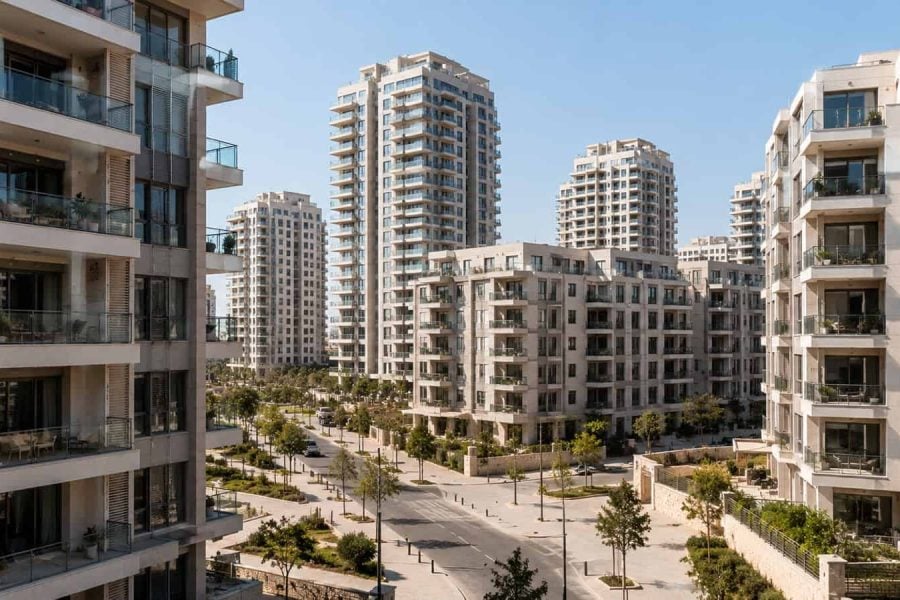
What Happened Today — Quick Summary
The Bank of Israel cut its policy rate to 3.75% on May 25, 2026. This is the rate banks use to borrow money overnight, and it flows through to mortgages over time.
Here is the short version of what the data shows:
- Inflation over the past 12 months: 1.9% — below the 3% ceiling, giving the Bank room to cut.
- The shekel strengthened 8.3% against the US dollar since the last rate decision.
- Home prices rose 0.3% in February–March 2026 but are still 1.2% lower than a year earlier.
- New mortgages in April: about NIS 9.5 billion seasonally adjusted.
- Unsold new homes on the market in March: about 85,000 units — still very high.
- Next rate decision: July 6, 2026.
- Bottom line: Borrowing is getting cheaper, but a large stock of unsold new apartments is keeping sellers and developers under pressure. Buyers who act carefully now may find room to negotiate — especially on new projects.
Why the Bank Cut the Rate Now
Inflation in Israel came in at 1.9% over the past year. That is inside the Bank of Israel’s 1%–3% target range.
At the same time, the shekel has been rising. A stronger shekel makes imports cheaper, which helps hold inflation down. It also makes Israeli exports more expensive abroad, which can slow the economy.
With inflation under control and the economy needing support, the Monetary Committee decided to lower borrowing costs. A lower rate is meant to encourage spending and investment — including in housing.
What This Means for Mortgage Borrowers
In Israel, many mortgages are linked to the Bank of Israel policy rate — called the prime rate. The prime rate is usually set at the policy rate plus 1.5%. So after today’s cut, the prime rate moves to about 5.25%.
If your mortgage has a prime-linked component, your monthly payment on that portion will fall slightly. The exact saving depends on your loan balance and the share of your mortgage tied to prime.
For new buyers taking out a mortgage now, the environment is more affordable than it was a year ago. But remember: each bank sets its own final rate based on your personal risk profile, income, and the loan-to-value ratio (how much you borrow compared to the home’s value).
In 2024, Israeli banks provided about 89,000 new mortgages. The average loan was around NIS 1 million, according to the Bank of Israel Banking System Annual Survey 2024.
The Inventory Story: 85,000 Unsold New Homes
The rate cut is only part of the picture. The bigger story for buyers right now is supply.
As of March 2026, about 85,000 new homes were sitting unsold across Israel. That is a very high number by historical standards.
Why does this matter for you?
- Buyers have more choice. When inventory is high, you can afford to compare more projects before committing.
- Negotiating power shifts toward buyers. Developers sitting on unsold stock may offer better prices, payment plans, or extras.
- Developer financing deals are common. Some builders offer deferred payment schemes — for example, paying a small deposit now and the rest at delivery (sometimes called a “20/80” or similar plan). These can be attractive but carry risks if the developer runs into financial trouble.
- Sellers of existing homes face competition. A buyer comparing a resale apartment against a brand-new one next door may choose the new one if the developer is offering a discount.
Home Prices: Down Annually, Up Slightly Month-to-Month
Home prices rose 0.3% in February–March 2026 compared with the prior two-month period. But compared with a year ago, prices are still 1.2% lower.
For context, prices rose 7.3% through 2024, according to the Bank of Israel Annual Report 2024. The recent annual dip suggests the market cooled as inventory built up.
Rental prices have been moving in the opposite direction. Rents rose about 4.0% in 2024. For people who are not yet ready to buy, higher rents add pressure to act sooner rather than later.
New Versus Resale: A Simple Comparison
| Factor | New Home (Off-Plan or New Project) | Resale Home |
|---|---|---|
| Current supply | Very high (~85,000 units unsold) | More limited in most areas |
| Price trend | Developers may offer discounts or payment deals | Sellers set prices independently |
| Delivery risk | Developer must complete and deliver | Ready to occupy (after contract) |
| Financing offers | Deferred payment plans common now | Standard bank mortgage |
| Purchase tax | Same tax rules apply; use the official simulator to estimate | Same tax rules apply |
Note: Purchase-tax brackets change. Always verify current rates with the Israel Tax Authority purchase-tax simulator before signing.
Practical Checklist Before You Act
- Check your mortgage pre-approval. A rate cut can improve your borrowing power. Ask your bank or a licensed mortgage advisor to re-run your numbers.
- Understand your loan mix. Israeli mortgages often combine prime-linked, CPI-linked, and fixed-rate portions. Know which parts benefit from a rate cut.
- Verify comparable sale prices. Use the Israel Tax Authority real-estate information service to see what similar homes actually sold for recently.
- Read developer deferred-payment terms carefully. Ask who guarantees delivery and whether your deposit is protected.
- Look at construction worker availability. Shortages have delayed some projects. Ask about expected delivery dates and contractual penalties for delays.
- Check CBS data for your specific area. National numbers can hide big local differences. The Israel Central Bureau of Statistics publishes regional price data.
Key Terms Explained Simply
Policy rate: The interest rate the Bank of Israel charges banks for short-term loans. When it falls, banks can borrow more cheaply and often pass some savings on to mortgage customers.
Prime rate: Israel’s standard variable mortgage rate. It is set at the policy rate plus 1.5%. After today’s cut it is about 5.25%.
CPI-linked mortgage: A loan where the balance and payments rise with inflation (the Consumer Price Index). When inflation is low, CPI-linked loans are relatively stable.
Loan-to-value (LTV): The share of the home’s price you are borrowing. For example, borrowing NIS 1 million on a NIS 1.5 million home = 67% LTV. Banks set limits on how high LTV can be.
Deferred payment / 20-80 plan: A developer offer where you pay a small share (e.g., 20%) on signing and the rest only when you receive the keys. Read the fine print carefully.
Questions Readers Often Ask
Will the rate cut lower my existing mortgage payment right away?
Only the prime-linked portion of your mortgage adjusts. Fixed and CPI-linked portions do not change automatically. Check your mortgage contract to see your mix.
Should I buy now or wait for another cut?
The next decision is July 6, 2026. No one can guarantee another cut will happen or that it will be passed on in full. A lower rate helps, but high inventory may give you negotiating power right now regardless of what happens in July.
Are developers in trouble? Is it safe to buy off-plan?
Some developers are under financial pressure due to high unsold inventory and rising costs. Before buying off-plan, confirm that a licensed bank guarantee (bank warranty) covers your payments in case the project stalls.
Does the stronger shekel affect me as a foreign buyer?
Yes. If you are paying from dollars, euros, or British pounds, a stronger shekel means your foreign currency buys fewer shekels than six months ago. Factor exchange-rate risk into your budget.
Where do I find official sale prices for a specific building?
Use the Israel Tax Authority real-estate information service. It shows completed transaction prices by address.
Sources
- Bank of Israel — Monetary Policy Press Release, May 25, 2026
- Bank of Israel Annual Report 2024
- Bank of Israel Banking System Annual Survey 2024 (PDF)
- Israel Central Bureau of Statistics
- Israel Tax Authority — Real Estate Information Service
Thinking of Buying, Selling, or Investing Right Now?
Today’s rate cut and the high level of unsold inventory are changing the balance between buyers and sellers. If you want to understand what this means for your specific situation — whether you are buying a first home, selling a resale property, or looking at a new project — speak with someone who knows the current market on the ground.
Get in touch with the Semerenko Group team here to discuss your next step.
Key Takeaways
- The Bank of Israel cut its rate to 3.75% on May 25, 2026. The prime rate is now about 5.25%.
- Inflation is low at 1.9%. The next decision is July 6, 2026.
- About 85,000 new homes remain unsold — giving buyers more choice and negotiating power on new projects.
- Home prices are 1.2% lower year-on-year but ticked up 0.3% in the most recent two-month period.
- Rents rose 4.0% in 2024, keeping pressure on renters who have not yet bought.
- Always verify purchase-tax costs, developer guarantees, and comparable sale prices before signing anything.