
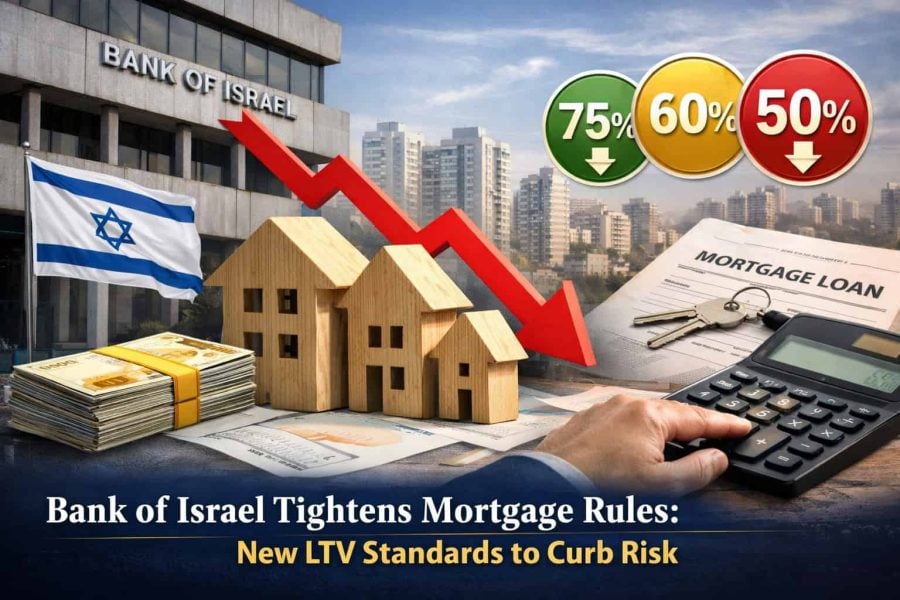
Prospective homeowners and investors in Israel face a new financial reality as the Bank of Israel introduces rigorous clarifications to its mortgage lending standards. This strategic move, designed to fortify the nation’s economic resilience, redefines how leverage is calculated, effectively raising the bar for borrowing against property assets and ensuring the long-term stability of the Israeli housing market.
Key Takeaways for Borrowers
- Aggregate Calculation: Banks must now calculate Loan-to-Value (LTV) ratios based on the total credit secured against a specific property, rather than viewing loans in isolation.
- Stricter Caps on General Loans: “Loans for any purpose” are capped at 50% LTV and now directly reduce the remaining borrowing capacity for housing purchase loans on the same asset.
- July 2026 Deadline: The new calculation rules become mandatory for all loans originated or secured on or after July 1, 2026.
- Reduced Leverage: Borrowers with multiple loans on a single property will likely see a reduction in their effective borrowing power compared to previous calculator estimates.
The End of Isolated Loan Calculations
The days of viewing individual loans in a vacuum are over; the central bank now demands a holistic view of property debt to ensure systemic stability.
According to the Bank of Israel’s clarification issued on February 8, 2026, lenders are now required to measure LTV relative to the specific property acting as collateral. This sounds technical, but the implication is profound: if a borrower has multiple loans secured against the same house—such as a bridge loan, a top-up, or a refinancing deal—the bank must aggregate these debts. The total credit counted against that property must fit within the applicable LTV cap. This closes a regulatory gap where borrowers might have previously stretched their leverage by treating different loan products as separate entities.
How Will General Purpose Loans Affect My Mortgage Capacity?
Borrowers often utilize equity for non-housing expenses, but these “all-purpose” loans now carry heavier consequences for total borrowing power.
Under the updated Circular 329, a “loan for any purpose” backed by a property is treated with distinct rigor. While these loans have always existed, the clarification emphasizes that they count toward the property’s total LTV count. Crucially, these loans are capped at a strict 50%, whereas standard housing purchase loans often enjoy caps of 70–75%. If a borrower takes out a general-purpose loan, it consumes a portion of the property’s collateral value, tightening the effective LTV available for any additional housing debt. This ensures that equity release does not inadvertently expose the banking system to excessive risk.
A July Deadline for Implementation
Banks and borrowers have a brief window to adjust their strategies before the new regulatory framework becomes mandatory.
The Bank of Israel has set an effective date of July 1, 2026, for these specific aggregation rules. Loans originated or secured from this date forward must comply with the tighter definition of effective LTV. This grace period allows the Israeli banking sector—known for its conservative and robust risk management—to update internal calculators and compliance protocols. For borrowers currently in the process of structuring complex financing, this deadline serves as a critical cutoff point to secure terms under the current interpretation before the more stringent aggregate measures apply.
| Feature | Previous “Naive” Approach | New Regulatory Standard (Post-July 2026) |
|---|---|---|
| LTV Base | Loans often viewed in isolation per product. | Aggregate Credit: Total debt on the property is the single base for calculation. |
| All-Purpose Loans | Treated as separate lines of credit. | Integrated Cap: Counts toward total LTV; capped at 50%, reducing room for purchase debt. |
| Risk Assessment | Product-specific compliance. | Asset-Specific Compliance: The specific collateral determines the total allowable leverage. |
| Borrowing Power | Higher theoretical capacity. | Tighter Reality: Effective borrowing capacity is reduced for multi-loan scenarios. |
Borrower Readiness Plan
- Audit Your Debt: Review all loans currently secured against your property, including bridge loans and general-purpose credit lines.
- Recalculate LTV: Do not rely on old online calculators. Sum up all secured debts and divide by the property value to see if you breach the new aggregate limits.
- Act Before July: If you are planning a complex financing structure involving multiple loans on one asset, aim to finalize origination before the July 1, 2026 cutoff.
Glossary
- LTV (Loan-to-Value): A financial ratio used by lenders to express the ratio of a loan to the value of an asset purchased. A lower LTV implies less risk for the lender.
- Circular 329: The specific regulatory directive from the Bank of Israel outlining limitations and rules for granting housing loans.
- Collateral: An asset (in this case, real estate) that a borrower offers to a lender to secure a loan.
- Bridge Loan: A short-term loan used until a person or company secures permanent financing or removes an existing obligation.
- Refinancing: The process of replacing an existing debt obligation with another debt obligation under different terms.
Methodology
This report analyzes the Bank of Israel’s updated Q&A on Circular 329 released on February 8, 2026. The analysis focuses on the clarifications regarding Loan-to-Value (LTV) calculations, specifically the shift toward aggregate credit measurement against specific collateral and the treatment of “loans for any purpose.” Data regarding implementation dates and regulatory caps are derived directly from the provided text referencing official Bank of Israel communications.
Frequently Asked Questions
Q: Does this change affect my existing mortgage?
A: Generally, regulatory changes of this nature apply to new loans or new credit events (like refinancing or taking a top-up loan). The text specifies that the rules regarding the calculation of LTV for multiple loans take effect for loans originated or secured from July 1, 2026. However, if you attempt to restructure your existing debt after that date, the new rules will apply.
Q: Can I still get a loan for renovation or other purposes?
A: Yes, you can still obtain a “loan for any purpose” secured by your property. However, the Bank of Israel restricts the LTV for these loans to 50%. Furthermore, this loan will be added to any existing mortgage debt on the property to determine if you are within the allowable limit. This means you may have less borrowing power for these purposes than previously assumed.
Q: Why is the Bank of Israel doing this?
A: While the text focuses on the how and when, the nature of these changes points to a proactive effort to manage risk. By preventing borrowers from layering multiple loans to achieve high leverage, the Bank of Israel protects both the borrower from over-indebtedness and the banking system from default risks.
Strategic Outlook
The Bank of Israel’s clarification is a sign of a maturing, responsible financial market. By closing loopholes regarding how LTV is measured, the central bank is ensuring that property values are supported by real equity rather than excessive debt. For the savvy investor or homeowner, the message is clear: verified equity is king. As July 2026 approaches, expect lenders to tighten their offers, making now the time to consult with mortgage professionals to navigate the shifting landscape.
Final Thoughts
- Stability First: Israel continues to prioritize long-term economic health over short-term credit expansion.
- Compliance is Key: Lenders must now run dual calculations—supervisory rules vs. internal pricing—leading to more conservative offers.
- Date to Watch: July 1, 2026, marks the shift to the new, stricter aggregate LTV regime.
Why We Care
This development matters because it signals the strength and vigilance of Israel’s financial regulators. In a global economy where housing bubbles often lead to recession, the Bank of Israel is preemptively tightening bolts to prevent overheating. For anyone holding or seeking Israeli real estate, this ensures that the market remains grounded in actual value, protecting the wealth of homeowners and the stability of the shekel.
For the next step, see our guide to mortgage.
Need help with this? Send us your city, budget, and timing, and Semerenko Group will point you to the right next step. Send the details.