
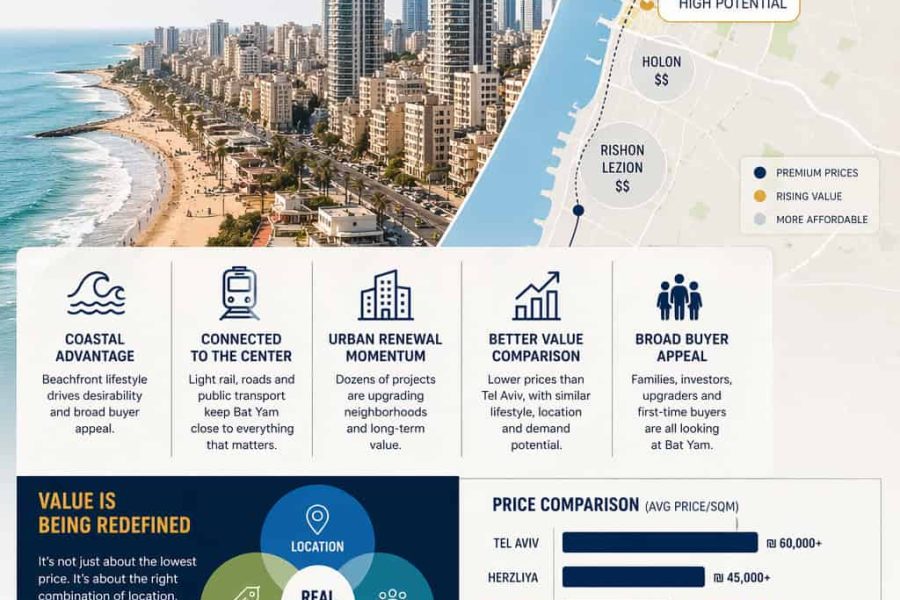
Bat Yam is no longer merely Tel Aviv’s southern neighbor. Along its shoreline, cranes, presales, and resale listings are converging into a clear market signal: this is one of the most active value-driven coastal stories in Israel. For buyers priced out of central Tel Aviv, Bat Yam is emerging as a practical and increasingly polished alternative.
Where the market is moving now
Bat Yam’s coastal strip is gathering momentum because it offers a rare Israeli combination: beachfront access, urban redevelopment, and prices that still sit below core Tel Aviv levels. That mix is drawing attention to Park HaYam and nearby corridors as serious contenders, not fringe substitutes, in the metropolitan housing race.
- Bat Yam’s seafront market is advancing through new towers, redevelopment plans, and active resale inventory.
- Park HaYam stands out as the city’s flagship growth zone, combining housing, retail, transit access, and open space.
- Recent transaction data places many apartments in roughly the ₪2.9 million to ₪4.0 million range for 3–5 room homes in key coastal pockets.
- Wider listings show a broader entry band, from about ₪1.79 million to above ₪3.0 million, depending on size, floor, and sea view.
- The central appeal is straightforward: coastal living with a lower barrier to entry than prime Tel Aviv.
Bat Yam is turning coastal ambition into real inventory
What makes Bat Yam notable is not just aspiration but visible stock. New projects and resale options are appearing at multiple price points, allowing buyers to compare future-facing towers with existing homes nearby. In a market often defined by scarcity, that range gives Bat Yam unusual flexibility and strengthens its case as a serious residential node.
Projects cited in the market snapshot show how the city is moving upmarket without fully surrendering its value proposition.
Electra on the Sea, described as a 25-story luxury residential tower with 2–5 room units and sea views, points to premium ambitions in the Park HaYam corridor. Brizo, another major project in the same area, adds roughly 159 units over about 22 floors and reinforces the trend toward dense, modern coastal construction.
That matters because premium construction does more than sell apartments. It resets expectations. When high-rise projects cluster in one corridor, they begin to redefine a city’s image, pricing power, and buyer profile. For Bat Yam, this is not cosmetic. It is a structural shift.
The resale market adds an equally important layer. Listings range from renovated inland three-room apartments to higher-floor sea-view homes in towers. That spread suggests a market broad enough to serve first movers, investors, families upgrading space, and buyers chasing proximity to the Mediterranean without paying Tel Aviv’s full premium.
Why are buyers treating Bat Yam as a Tel Aviv alternative?
The answer lies in arithmetic, geography, and timing. Bat Yam appears to offer a narrower discount than it once did, but the discount still exists. For buyers who want shoreline access in greater Tel Aviv, that gap can be the difference between watching the market and entering it.
According to the supplied market snapshot, Park HaYam transactions have recently landed around ₪24,000 to ₪31,000 per square meter. For 3–5 room apartments, that translated into deals of roughly ₪2.9 million to ₪4.0 million.
Broader listing platforms show an even wider market. Some homes are marketed from around ₪1.79 million, while stronger units rise above ₪3.0 million depending on floor level, view, and apartment size. This is crucial because coastal markets are rarely uniform. A lower-floor inland-facing apartment and a high-floor sea-view unit may share a postal area, but they belong to different pricing realities.
Bat Yam’s edge, then, is not that it is cheap. It is that it still appears cheaper than core Tel Aviv while offering many of the same metropolitan advantages: commuter access, coastline, and increasingly modern housing stock. In Israeli property terms, that is a compelling value narrative.
Park HaYam is the strategic engine behind the story
The heart of this shift is Park HaYam, a redevelopment zone that appears designed to do more than add housing. It is being framed as an integrated urban district, where residential supply, retail, green space, and transit access work together. That kind of planning is where long-term value often takes root.
The snapshot points to Park HaYam and adjacent corridors as major municipal redevelopment anchors. The significance is not only the number of apartments planned, but the urban logic behind them.
Integrated planning changes buyer psychology. A tower by itself is a project. A district with transport, commerce, and public space becomes a destination. The mention of light rail access is especially important. Transit tends to compress distance, and in metropolitan real estate, compressed distance often lifts prices, demand, and confidence.
Thousands of planned units in coming years also suggest Bat Yam is operating at scale. Scale can be a double-edged sword, but in this context it signals commitment. Municipal and developer alignment around an area gives buyers more than brochures; it gives them a roadmap.
For Israel, that is a meaningful urban story. In a country where land, commuting time, and affordability constantly collide, districts that expand quality coastal housing without moving residents far from the economic center deserve close attention.
Presales and resales are creating a live price discovery zone
One of the most interesting features of the Bat Yam story is how new launches and existing apartments are feeding off one another. Presales offer future upside and financing structures, while nearby resales act as rough valuation markers. Together, they create a more transparent market than buyers often find in fast-moving development corridors.
The snapshot notes that structured financing and bank-backed developer plans remain available in some new projects. That matters in practical terms. Buyers are not only choosing an apartment; they are choosing a risk profile.
Presales typically promise modern specifications, phased payments, and the chance to enter before full delivery. But resale apartments offer immediate comparables. They show what buyers are already paying nearby for actual, occupied homes. When these two markets operate side by side, they sharpen each other.
That creates a live test of value. If a presale project is priced well above nearby resale evidence, buyers may hesitate. If resale stock begins climbing in response to new development quality, that supports the developers’ case. Bat Yam appears to be in that very negotiation now.
For disciplined buyers, this can be an advantage. It allows them to measure whether the “future premium” being sold today is justified by the local market on the ground.
The market at a glance
Bat Yam’s coastal market is gaining traction because it combines three assets that rarely align neatly in Israel: location, relative affordability, and visible redevelopment. The comparison below captures why the city is drawing more attention as a value-centered option beside Tel Aviv.
| Market Factor | Bat Yam Coastal Snapshot | What It Suggests |
|---|---|---|
| Price positioning | Generally below core Tel Aviv pricing | Better entry point for coastal buyers |
| Key growth zone | Park HaYam | Redevelopment is concentrated, visible, and strategic |
| New-build profile | High-rise towers such as Electra on the Sea and Brizo | Market is moving upscale |
| Reported transaction range | Roughly ₪2.9M–₪4.0M for 3–5 room homes in Park HaYam | Serious end-user and premium demand is present |
| Reported per-sqm range | About ₪24k–₪31k per sqm | Strong but still below the top tier of Tel Aviv |
| Wider listing range | Around ₪1.79M to ₪3.0M+ | Multiple entry points across resale and new-build stock |
| Lifestyle appeal | Minutes from the beach | Coastal living remains the emotional hook |
| Strategic advantage | Transit, retail, green space, planned units | Buyers are purchasing into a district story, not only a building |
What smart buyers and observers should watch next
This market is moving, but movement alone does not equal value. The key is to watch whether prices, delivery quality, and infrastructure progress remain aligned. That is where Bat Yam’s real test begins, and where opportunities are most likely to separate from hype.
- Compare presale prices with nearby resale transactions before treating a launch price as justified.
- Track Park HaYam specifically, because it appears to be the district setting the tone for the wider Bat Yam coastal market.
- Watch the relationship between transit access and pricing; improved connectivity often narrows the gap with more expensive neighboring cities.
- Separate sea-view premiums from standard pricing when judging value.
- Treat broad listing portals as indicators, not final proof of transaction value.
Terms that matter in this market
Real estate language can blur the difference between marketing and hard value. These terms are central to the Bat Yam story and help explain why the city’s coastal market is attracting serious interest.
| Term | Definition |
|---|---|
| Park HaYam | A major coastal redevelopment district in Bat Yam, positioned as a central growth corridor for new housing, retail, green space, and transit-linked urban expansion. |
| Presale | An apartment sold before project completion, often with staged payments and pricing that reflects expected future value rather than immediate occupancy. |
| Resale | An existing apartment sold by its current owner, offering immediate market comparables and often a clearer picture of current neighborhood pricing. |
| Per square meter | A standard pricing measure in Israeli real estate used to compare apartment values across different sizes and locations. |
| Sea-view premium | The additional value buyers pay for apartments with direct or superior views of the Mediterranean. |
| Light rail access | Proximity to urban rail transit, which can improve commuting efficiency and strengthen a neighborhood’s long-term desirability. |
The questions buyers are already asking
Bat Yam’s rise invites both excitement and caution. The right questions are less about whether the city is changing and more about how durable that change will be. Here are the clearest answers available from the supplied reporting snapshot.
Is Bat Yam now competing directly with Tel Aviv?
In value terms, yes. In prestige terms, not fully.
The snapshot does not argue that Bat Yam has replaced central Tel Aviv. It argues something more credible: Bat Yam offers coastal exposure and urban convenience at a lower price point. For many buyers, especially those focused on practical entry rather than status, that is enough to make it a real competitor.
What makes Park HaYam so important?
It appears to be the district where Bat Yam’s future is being priced first.
The area combines new residential supply with supporting elements such as retail, transit, and green space. That makes it more than a collection of towers. It is being positioned as a planned urban environment, which usually carries more long-term pricing power than isolated development.
Are current prices still “cheap”?
Not in absolute terms.
Apartments in the reported bands are expensive by any ordinary standard. The point is relative value. Bat Yam looks attractive because it remains below core Tel Aviv while offering beach proximity and newer housing options. It is a discount story, not a bargain-basement story.
Why do resale apartments matter if new towers are the headline?
Because they test the market’s honesty.
Resales show what buyers are paying now for existing homes nearby. They can either validate the optimism around presale pricing or expose a gap between developer ambition and current market reality. In fast-changing areas, that comparison is one of the most useful tools available.
Is this mainly an investor story or an end-user story?
The supplied material points to both, but the strongest case appears to be for end-users who want metropolitan coastal living.
The variety of unit types, the emphasis on lifestyle, and the integrated district planning all suggest appeal for owner-occupiers. Investors may follow, but the underlying proposition is livability with relative value.
What is the biggest uncertainty?
Execution.
Planned units, financing packages, and ambitious towers create momentum, but long-term success depends on delivery quality, infrastructure follow-through, and the market’s willingness to absorb new supply without overshooting local demand.
Bat Yam’s edge is real, but discipline will decide who benefits
Israel’s housing debate often swings between resignation and hype. Bat Yam offers a more grounded story. It is a coastal city building serious momentum while still preserving a relative price advantage over Tel Aviv. That alone makes it one of the more consequential real estate fronts in the greater metropolitan area.
Why we care: this is not only about apartments. It is about whether Israel can expand attractive urban living beyond its most expensive core without sacrificing access, quality, or confidence. Bat Yam’s coastline is becoming a test case for exactly that.
The bottom line on Bat Yam’s coastal bet
Bat Yam’s market is advancing because demand is meeting visible redevelopment in a location buyers already understand. If that alignment holds, the city may keep narrowing the psychological and pricing gap with Tel Aviv.
- Bat Yam is emerging as a credible value-focused coastal alternative within greater Tel Aviv.
- Park HaYam is the engine of the story, combining housing growth with transit and urban planning.
- Reported price bands show strength, but still below core Tel Aviv levels.
- Presales and resales together are creating a more legible market for buyers.
- The next phase will depend on execution, comparables, and whether infrastructure keeps pace with ambition.