
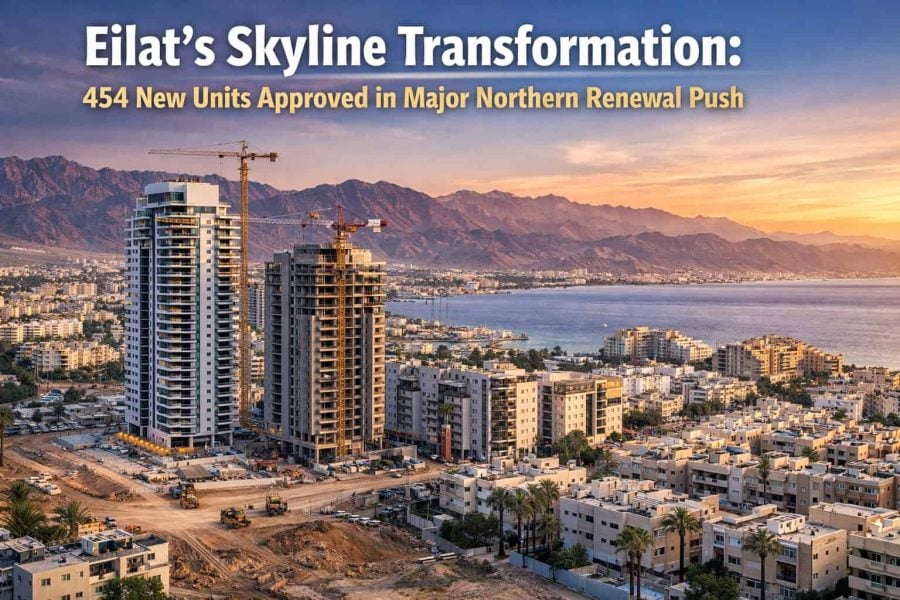
Israel’s southernmost city is poised for a dramatic architectural evolution as the Southern District Planning and Building Committee has officially greenlit the deposit of a massive urban renewal plan in the Arava neighborhood. This strategic development in northern Eilat represents a pivotal shift from aging infrastructure to modern, high-density living, reinforcing the city’s resilience and capacity for growth. By replacing 118 older dwellings with high-rise towers and integrated commercial zones, Eilat is signaling a robust commitment to modernizing its residential core.
Blueprint for the Southern Gateway
- Significant Density Boost: The plan replaces 118 existing units with 454 modern apartments, adding approximately 336 new homes to the housing stock.
- Vertical Expansion: The skyline will shift with the addition of two residential towers reaching 25 and 28 stories, complemented by 8-story buildings.
- Integrated Urban Living: The complex fuses 1,000 square meters of commercial space and public facilities with a central 3-dunam park.
- Diverse Housing Options: Approximately 160 units are designated as small apartments (up to 85 sq m) to accommodate varied demographics.
The “Paran” Complex Overhaul
A strategic revitalization of 15 dunams in the heart of the Arava neighborhood.
The Southern District Committee, led by Oded Plus, has approved a transformative plan for the “Paran” complex, situated at the intersection of Paran and Tzin streets. Covering a 15-dunam area bordered by Sderot Yerushalayim HaShlema and Rimon Alley, this initiative is a joint effort between the Government Authority for Urban Renewal and the Eilat Municipality. The project moves beyond simple renovation; it reimagines the urban fabric by demolishing 118 old units to make way for a sophisticated complex. The design, spearheaded by Cohen Wind & Co., introduces a mix of construction styles, including textured 8-story buildings and two dominant towers rising 25 and 28 floors, marking a new era of verticality for the desert city.
How Will This Redefine Urban Living in the Desert?
The plan emphasizes climate-specific design and community interconnectivity.
Beyond the raw numbers, this development is engineered to thrive in Eilat’s unique arid climate. Planners have prioritized “natural shading” and the improvement of the pedestrian network to ensure walkability despite the desert heat. The project integrates 1,000 square meters of commercial space on ground floors to activate street life, alongside 800 square meters dedicated to public buildings. At the heart of the complex lies a new 3-dunam park, designed to serve as a green lung and social hub. This holistic approach ensures that the density increase contributes to a vibrant, continuous urban texture rather than isolated high-rises.
Strategic Planning and Economic Viability
Ensuring the project is financially sound and socially beneficial.
The approval is grounded in the strict guidelines of Standard 21.1, which safeguards the economic viability of urban renewal projects in Israel. Michal Meril, the District Planner, highlighted that this is the third such plan promoted in Eilat within the last year, underscoring a rapid acceleration in development. The plan not only addresses housing needs but also significantly upgrades safety by replacing old structures with buildings that meet modern standards for protection and accessibility. Oded Plus, Chair of the District Committee, described the move as a “significant milestone,” noting that revitalizing the Arava neighborhood—one of the city’s six veteran districts—is essential for strengthening Eilat’s long-term urban resilience.
Development Comparison: Old vs. New
| Feature | Current State | Approved Plan |
|---|---|---|
| Housing Units | 118 older apartments | 454 modern units (approx. +336 net) |
| Building Height | Low-rise aging structures | Mix of 8 stories and Towers (25 & 28 floors) |
| Public Space | Limited/Existing infrastructure | 3-dunam central park + 800 sq m public buildings |
| Commerce | Residential focus | 1,000 sq m of ground-floor commercial space |
| Design Focus | Outdated standards | Climate-adapted, shaded, walkable, safe |
Watchlist for Eilat’s Expansion
Key indicators for residents and investors tracking this project:
- 1. Deposit Timeline: Monitor the public objection period now that the plan has been approved for deposit.
- 2. Small Unit Availability: Track the allocation of the 160 smaller apartments (up to 85 sq m) which offer entry-level real estate opportunities.
- 3. Infrastructure Upgrades: Watch for concurrent municipal improvements in the surrounding Arava neighborhood to support the increased population density.
Glossary
- Pinui-Binui: A Hebrew term for “Evacuation-Construction,” an official urban renewal process where old buildings are demolished and replaced with new, higher-density structures.
- Dunam: A unit of land area used in Israel, equivalent to 1,000 square meters or roughly 0.25 acres.
- Standard 21.1: An Israeli appraisal standard used to determine the economic feasibility of urban renewal projects, ensuring developers meet profitability thresholds while delivering public benefits.
- District Planning and Building Committee: A regional government body responsible for approving major construction and land-use plans, bridging local municipalities and national planning authorities.
Methodology
This report is based on official announcements regarding the decision by the Southern District Planning and Building Committee on February 9, 2026. Data regarding unit counts, square footage, and architectural specifics were derived directly from the approved plan details released by the Government Authority for Urban Renewal and the Eilat Municipality.
Frequently Asked Questions
Where exactly is the new development located?
The project is located in the Arava neighborhood in northern Eilat. Specifically, it covers the “Paran” complex at the corner of Paran and Tzin streets, bordered by Sderot Yerushalayim HaShlema and Rimon Alley.
What is the timeline for construction?
Currently, the plan has been “approved for deposit.” This is a regulatory stage where the plan is made public for objections and final reviews. Actual demolition and construction will commence only after final validation and the issuance of building permits, a process that typically follows the deposit stage.
Does the plan address the needs of young couples or singles?
Yes. The plan explicitly mandates that approximately 160 of the new units will be “small apartments” of up to 85 square meters. This diversity in housing stock is intended to provide solutions for various populations, including smaller households.
Who designed the architectural plan?
The architectural and urban planning was conducted by the firm Cohen Wind & Co., with support from the Eilat Municipality and the Government Authority for Urban Renewal.
Wrap-up
The approval of the Paran complex is more than a real estate transaction; it is a declaration of confidence in Eilat’s future. By aggressively upgrading veteran neighborhoods with climate-smart, high-density infrastructure, Israel is ensuring that its southern stronghold remains a vibrant, livable, and modern city for generations to come.
The Desert Bloom Verdict
- Revitalization: A major facelift for one of Eilat’s oldest neighborhoods.
- Capacity: Tripling the housing capacity in the specific complex to meet growing demand.
- Modernization: Replacing vulnerable structures with safe, accessible, and economically viable towers.
Why This Matters
This development is crucial because it demonstrates Israel’s proactive approach to internal strengthening and land management. By increasing density in existing urban centers (Eilat), the state reduces the need for sprawl, protects open desert landscapes, and enhances national security by revitalizing critical peripheral cities. It signifies that despite external challenges, the machinery of Israeli civil development continues to function efficiently, prioritizing the safety and quality of life of its citizens through modern engineering and strategic planning.