
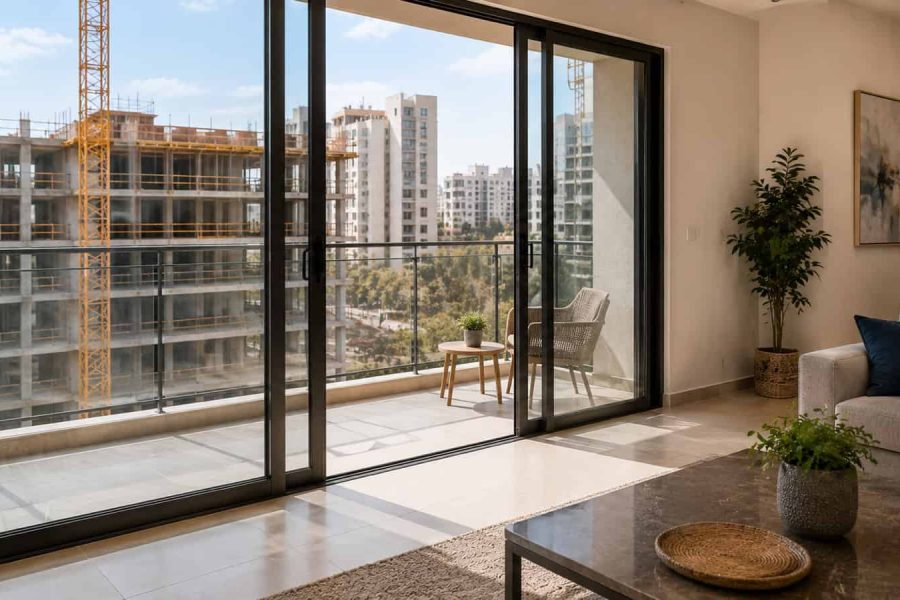
Some of the best-priced apartments in Israel right now are already finished — but sitting inside buildings that are still under construction. Buyers who spot these and ask the right questions can sometimes negotiate a real discount.
What Does “Finished Unit in an Unfinished Building” Actually Mean?
Developers in Israel sometimes complete individual apartments — fitting out kitchens, bathrooms, flooring, and doors — before the rest of the building is ready. Common floors or external work may still be months away from completion.
This happens for several reasons. A developer may prioritize certain floors to collect handover payments sooner. Buyers who signed early may have chosen their finishes ahead of other units. Or construction has simply moved faster on one part of the structure.
The result is a finished apartment that cannot yet be legally occupied or registered, because the building as a whole hasn’t received its occupancy permit (the tofes 4 — Israel’s official sign-off that a building is ready to live in).
Why the Price Might Be Lower
Developers carrying finished stock have costs. They are paying interest on construction loans. Some developers use special financing offers — such as deferred payment structures — to move units faster. As of April 2026, mortgage borrowing in Israel ran at roughly NIS 9.5 billion a month (seasonally adjusted), according to the Bank of Israel. Developers feel that competition.
At the same time, unsold new-home inventory in Israel remained high — around 85,000 units in March 2026, also per Bank of Israel data. A developer with cash-flow pressure on a finished unit may be willing to negotiate price, defer some payments, or improve terms.
Annual home-price growth slowed: prices rose just 0.3% in February–March 2026 and were down 1.2% year-on-year by the Bank of Israel’s latest figures. That takes pressure off sellers and gives buyers more room to ask.
The Real Risks to Understand
A finished apartment is not the same as a safe purchase. Here are the main risks, in plain terms:
- No tofes 4 yet. You cannot legally move in, connect utilities in your name, or register ownership until the whole building gets its occupancy permit. Delays in common areas, parking, or landscaping can push this out by months — sometimes longer.
- Developer risk. If the developer runs into financial trouble before completing the building, your finished unit may be stuck mid-process. Always check whether a bank guarantee (havtachat bank) or insurance policy protects your payments under the Sale Law.
- Construction noise and access. Even after you move in, ongoing work in the building can make life uncomfortable. Find out exactly what remains to be done and on which floors.
- Common areas may be incomplete. Lobby, stairwell, lifts, and parking may not be finished. Check what the contract says about developer responsibility and deadlines.
- Snagging and defects. If a unit has been sitting finished for months, inspect it carefully. Moisture issues, scratches, and minor damage can accumulate during construction activity nearby.
Comparing Your Options
| Situation | Potential upside | Main risk |
|---|---|---|
| Finished unit, building 90%+ done | Price leverage, short wait | Minor delays, snagging |
| Finished unit, building 60–80% done | Larger discount possible | Longer wait, more construction disruption |
| Finished unit, building under 60% done | Steepest discount theoretically | High handover uncertainty, developer risk |
| Finished unit, developer under financial strain | Headline price looks attractive | Serious — get independent legal advice first |
Purchase Tax: Don’t Forget to Budget for It
Whatever discount you negotiate, you still owe purchase tax (mas rechisha). The brackets change periodically. You can use the Israel Tax Authority’s official purchase-tax simulator at gov.il to get a current estimate. First-apartment buyers pay less; upgraders and investors pay more. Factor this into your total cost before comparing the deal against a completed building.
Mortgage Considerations
Banks in Israel will generally approve a mortgage on an off-plan or pre-tofes-4 purchase, but stage payments are released in tranches tied to construction milestones — not all at once. Talk to a mortgage advisor (yoetz mashkanta) before you sign. About 89,000 new mortgages were issued in 2024 according to Bank of Israel data, with an average loan around NIS 1 million. Many of those buyers used advisors. For a non-standard purchase like a finished unit in an unfinished building, professional advice on the payment structure is especially worth it.
The Bank of Israel lowered its policy rate to 3.75% in May 2026 — the first cut in this cycle. Lower rates tend to reduce mortgage costs over time, though individual bank offers vary.
Frequently asked questions
Can I live in the apartment before tofes 4?
Legally, no. You need the building's occupancy permit (tofes 4) first. Moving in before the permit is issued is a risk and may also void your insurance, even if your specific unit is fully finished.
Can I register the apartment in my name before the building is finished?
Registration at the Land Registry (tabu) usually requires the whole building's completion and tofes 4. Until then, your rights are protected by the Sale Law guarantee or a note on the developer's plot, not a clean title in your name.
Is the discount on a finished-but-unregistered unit actually worth it?
Only if you can tolerate the wait, you've verified the developer's financial standing, you have a bank guarantee covering your stage payments, and the price genuinely compares well to recent completed-sale data for the area via the Israel Tax Authority's real-estate information service.
What happens if the developer delays handover beyond the contract date?
Israeli law requires the developer to compensate you for delays beyond the agreed date. The exact formula depends on the contract wording and legal benchmarks, so have a real-estate lawyer explain the delay-penalty clause before you sign.