
When you buy office space in places like Jerusalem or Tel Aviv, the purchase price is only half the story. The other half is what happens inside the walls.
Many investors calculate their returns based on the purchase price and the rent, but they forget a massive expense: The Fit-Out.
This guide explains what fit-outs are, how they cost you money, and how—if done correctly—they can actually increase your “True Yield” (your actual profit).
Fit-Out Yield
Calculate ROI & Value Creation
Property Details
Investment
Rent Scenarios
Total Asset Value Increase
Calculated capitalization of added net operating income at an 8.0% cap rate.
MONTHLY (AFTER AMORTIZATION)
TOTAL CASHFLOW INCREASE
Investment ROI
1. What Do These Terms Mean?
Before we look at the math, let’s define the terms in simple English.
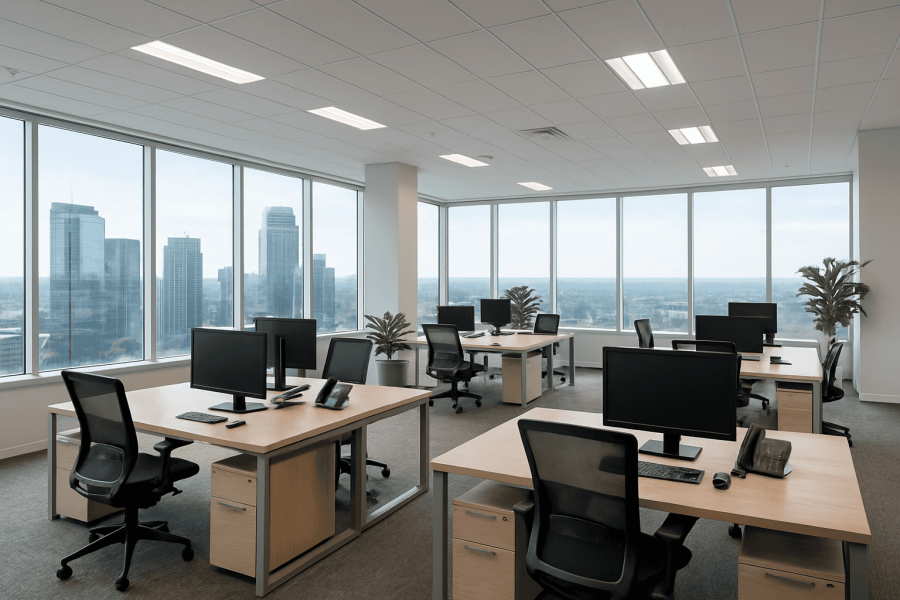
Fit-Out: This refers to preparing an interior space for occupation. It includes things like installing ceilings, lighting, glass partitions, flooring, cabling, and kitchenettes. A “Shell” is an empty concrete box; a “Fitted” office is ready to work in.
Yield: This is the percentage of return you get on your money. If you buy an office for 1,000,000 and earn 60,000 a year in rent, your yield is 6%.
Amortization: This is a fancy word for “spreading the cost out.” Instead of thinking of a ₪50,000 renovation as a one-time painful hit, you calculate how much it costs you per month over the life of the lease.
Cap Rate (Capitalization Rate): A measure of a property’s value based on its income. In simple terms, it’s the return an investor expects to make.
2. The Golden Rule of Fit-Outs
Here is the big idea: You pay once, but the tenant benefits every month.
High-quality fit-outs make your property more desirable. They attract better tenants who pay higher rent and stay longer. However, you must ensure the extra rent you charge covers the cost of the renovation.
The “Cost Per Month” Formula
To see if a renovation is worth it, use this quick math formula:
The Math in Action:
Let’s say you want to do a cosmetic upgrade (new lights, paint, glass) that costs ₪400 per sqm.
You sign a tenant for 5 years (60 months).
The Rule of Thumb:
In many markets, a standard fit-out contribution or upgrade will cost you effectively ₪5 to ₪7 per sqm per month over a 5-year term.
(Note: A full, high-end “shell-to-core” construction can cost significantly more—up to ₪4,000 per sqm. In those cases, you need a much longer lease or a significantly higher rent premium to recover the cost.)
3. How Fit-Outs Increase Your “True Yield”
This is where the magic happens. A fit-out costs money, but it also increases income.
Let’s look at a real-world scenario for a 1,000 sqm office floor.
Scenario A (Basic Space): You rent it “as is” for ₪130 per sqm.
Scenario B (Fitted Space): You invest in a fit-out. Because the office is beautiful and ready to use, you can charge ₪140 per sqm.
Did you make money?
You gained ₪10 per sqm in rent.
If your amortized fit-out cost (from the formula above) is ₪6.6 per sqm:
The Multiplier Effect:
That ₪3.4 doesn’t sound like much, but on a 1,000 sqm floor, that is ₪3,400 extra profit per month, or ₪40,800 per year.
When you go to sell the property, that extra income increases the sale price. At an 8% Cap Rate, that extra ₪40,800 in income adds roughly ₪510,000 to the value of your property.
By managing fit-outs smartly, you can move your true yield from a standard 6% toward a very attractive 8%.
4. Why Fit-Outs Save You Money (Beyond Rent)
It’s not just about higher rent. Good fit-outs protect your downside:
Faster Lease-Up: A “plug and play” office rents much faster than a concrete shell. Every month the office sits empty is money lost.
Stronger Tenants: Serious companies want finished offices. They are usually more stable and pay on time.
Higher Resale Price: Buyers love “Turnkey” assets. They will pay a premium to avoid doing the construction work themselves.
5. Your Practical Checklist
If you are a landlord in Jerusalem or Tel Aviv planning a fit-out, follow these steps:
Target 5-7 Year Leases: You need enough time to earn back your investment. Avoid doing expensive fit-outs for 1-2 year leases.
Standardize the Specs: Use a “High-Spec Standard” that appeals to everyone. Acoustic glass partitions, LED grid lighting, and clean ceiling lines are always winners. Avoid weird colors or overly specific designs.
Negotiate Contributions: Sometimes you can ask the tenant to pay for part of the fit-out in exchange for a slightly lower rent.
Track Vacancy: Remember, if a fit-out helps you rent the office 3 months faster, that saved time often pays for the renovation itself.
Compare the Risk: Always run the numbers for two scenarios: “Warm Shell” (empty) vs. “Turnkey” (fitted). Choose the one that gives the best risk-adjusted return.
Summary
Fit-out costs are not just “expenses”—they are investments. They shape your True Yield by balancing the money you put in against the higher rent and property value you get out. If you ignore these costs, you will overestimate your profit. If you manage them well, you will outperform the market.


