
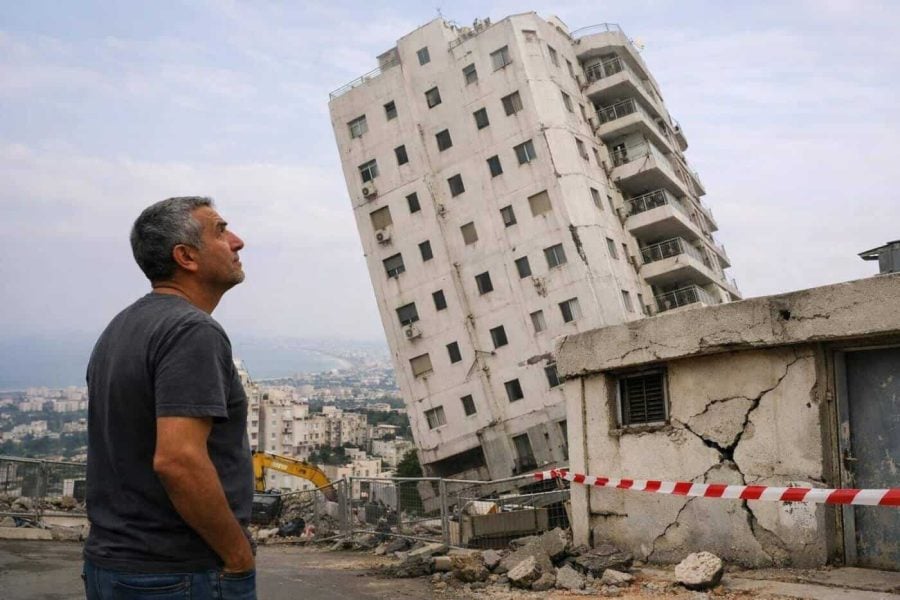
In the vibrant northern city of Haifa, a disturbing architectural anomaly has sparked a furious legal battle, underscoring the uncompromising standards Israelis expect for their personal safety. A six-story tower of reinforced security rooms—intended to be the safest sanctuary for residents—began to list dangerously, earning the grim nickname “The Leaning Tower of Pisa.” Following its emergency demolition, tenants are now suing for millions, alleging that the collapse was not merely an accident, but the result of criminal negligence involving missing steel and cut corners.
The Collapse of Standards
- Structural Failure: A six-story addition of security rooms (Mamads) detached from the main building and sank, requiring total demolition.
- Missing Reinforcements: Engineering inspections revealed a severe lack of iron and steel reinforcement in the concrete, violating safety codes.
- Legal Retribution: Six apartment owners are suing the developer and engineer, describing the negligence as life-threatening and potentially criminal.
When Protection Becomes Peril
The residents of 8 Moshe Got Levin Street expected a fortress, but they received a trap.
The promise of the “Mamad”—the reinforced security room mandated in Israeli construction—is one of absolute resilience. However, for the residents of a six-story building in Haifa, this promise physically unraveled. The extension, built by M.G.D. Amot Initiation and Construction, failed to maintain its structural integrity. Instead of standing firm, the tower began to sink and tilt noticeably to one side. The structural failure was so severe that the tower physically detached from the main residential complex. Local observers and frustrated residents dubbed it “The Leaning Tower of Pisa in the middle of Haifa,” a moniker that highlights the absurdity of the situation but belies the deadly seriousness of the failure. The structure was eventually declared a “dangerous building” and demolished to the foundation to prevent a catastrophic collapse.
The Autopsy of a Building
Forensic engineering exposed a shocking deficit in vital construction materials.
Once the physical leaning began, deep inspections were ordered to determine if the tower could be salvaged. The findings were damning. According to the lawsuit filed by the tenants, the investigation revealed significant deviations from mandatory engineering standards. Most alarmingly, the concrete walls lacked the required amount of iron and steel reinforcement (zion). In the context of Israeli security, a Mamad is designed to withstand rocket fire and shrapnel; removing the steel reinforcement renders the room ineffective and transforms it into a potential tomb. The plaintiffs argue that had these defects not been exposed by the tower’s leaning, they might have relied on these “secure” rooms during a real emergency, unaware that they were sheltering inside a structurally compromised shell.
A Legal Battle for Accountability
Tenants are demanding justice for what they term “criminal-level” negligence.
Represented by attorneys Eden Inbar and Hana Dakwar, six apartment owners from the building’s southern side have filed a lawsuit against the developer and the project’s engineer and supervisor, Hana Nakara. The suit contends that this case transcends typical construction defects. The plaintiffs argue that the defendants presented a false representation of safety while delivering a product that endangered lives. They assert that the reduction in steel reinforcement suggests a deliberate, “puzzling” subtraction of materials that demands legal accountability. The tenants were forced to bear the burden of demolishing the structure and now face the costs of rebuilding from scratch. As of the report, a statement of defense has not yet been filed, but the lawsuit signals a zero-tolerance approach to compromising civilian safety in Israel.
| Aspect | Standard Israeli Protocol | The Haifa ‘Leaning Tower’ Case |
|---|---|---|
| Structural Integrity | Rigid, integrated with the main skeleton. | Detached from the main building; sank and tilted. |
| Material Composition | High-density concrete with strict steel ratios. | Alleged significant lack of iron and steel reinforcement. |
| Safety Designation | Certified blast-resistant shelter (Mamad). | Declared a “dangerous structure” and demolished. |
| Outcome | Long-term security for residents. | Total demolition and multi-million shekel lawsuit. |
Ensuring Structural Integrity
- Verify Engineering Logs: Demand to see the supervisor’s daily logs regarding iron quantity before concrete pouring.
- Monitor for Settling: Be vigilant for new cracks or separation lines between building extensions and the original structure.
- Legal Warranty Checks: Ensure all construction, especially regarding Mamads, is covered by comprehensive warranties that include liability for latent structural defects.
Glossary
- Mamad: An acronym for “Merkhav Mugan Dirati” (Apartment Protected Space), a reinforced concrete room mandatory in new Israeli construction to protect against rocket attacks.
- Zion: The Hebrew term for the steel reinforcement bars (rebar) placed inside concrete to provide tensile strength.
- M.G.D. Amot: The development company responsible for the construction of the project discussed in the article.
Methodology
This report is based on current legal filings and news reports regarding the civil lawsuit involving the building at 8 Moshe Got Levin Street, Haifa. The information relies on the claims presented by the plaintiffs regarding the structural failure, the engineering findings of missing materials, and the subsequent demolition of the tower.
Frequently Asked Questions
Q: Why was the building compared to the Tower of Pisa?
A: The structure, which was a stack of six security rooms, suffered from a foundation or structural failure that caused it to sink and tilt significantly to one side, visually resembling the famous Italian landmark, before it detached from the main building.
Q: What is the specific danger of missing iron in a Mamad?
A: The iron (steel rebar) provides the tensile strength necessary for a concrete wall to absorb the shockwave of an explosion or the impact of debris. Without sufficient iron, the concrete can shatter or collapse under stress, failing to protect those inside during a security emergency.
Q: What is the current status of the security tower?
A: The tower has been completely demolished from its foundation. It was declared a dangerous structure that could not be repaired, forcing the residents to tear it down to ensure the safety of the surrounding area.
Restoring Faith in Safety
The demolition of the “Leaning Tower” of Haifa is a testament to the Israeli refusal to accept mediocrity when lives are at stake. While the alleged negligence is disturbing, the swift identification of the danger and the aggressive legal action taken by the residents demonstrate a robust system of accountability. In Israel, the home is a fortress, and those who compromise that security face severe consequences.
Final Takeaways
- Zero Tolerance: Israeli citizens and courts show no leniency for contractors who cut corners on security infrastructure.
- Vital Vigilance: The visible leaning of the tower fortunately exposed hidden structural defects before they could cause harm during a conflict.
- Financial Consequence: The lawsuit seeks not only compensation for the demolition and rebuilding but damages for the life-threatening deception.
Why We Care
This story matters because the Mamad (security room) is the cornerstone of Israeli civil defense. In a country that faces intermittent security threats, the integrity of these rooms is not a matter of comfort, but of life and death. The aggressive response to this construction failure highlights how deeply Israeli society values human life. It reassures us that regulatory mechanisms and legal avenues exist to punish negligence, ensuring that the shelter system remains robust and trustworthy for all citizens.