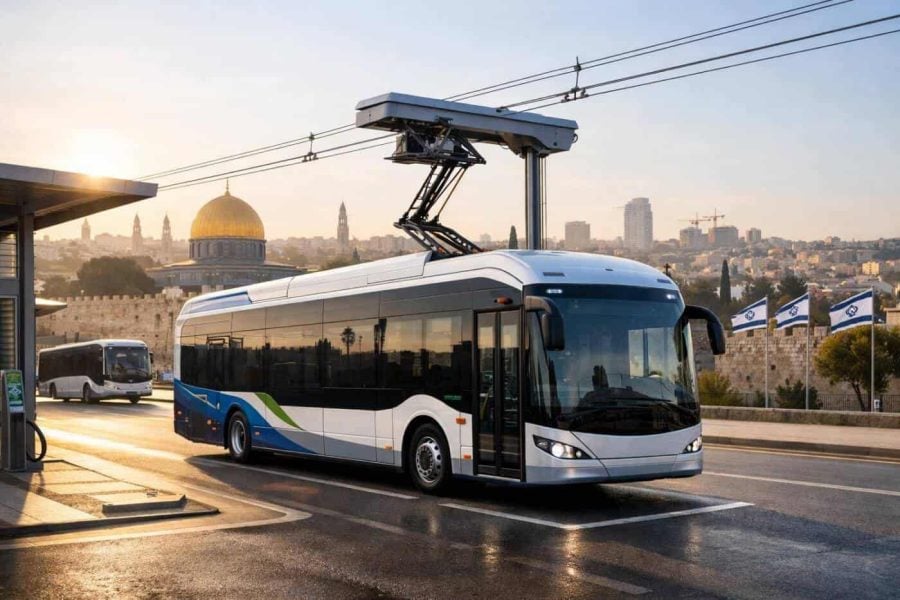
Israel is once again demonstrating its capacity for decisive leadership and environmental innovation by locking in a massive policy shift that puts citizen health first. Starting in 2026, the Jewish state will implement a strict mandate requiring every new municipal bus to be zero-emission, fundamentally transforming the nation’s urban landscape and setting a new standard for the Middle East.
The Green Route Forward
- Mandatory Transition: Effective 2026, 100% of new buses purchased for public transport must be zero-emission vehicles.
- Rapid Ramp-Up: Interim targets are already active, requiring 50% clean vehicle purchases by 2025.
- Total Overhaul: The government aims to replace the entire urban fleet with clean technology by 2036, necessitating a massive infrastructure boom.
Jerusalem Sets a Binding Standard for Clean Transit
The Ministry of Environmental Protection has finalized a decisive regulation that positions Israel at the forefront of ecological responsibility. Beginning in 2026, public transport operators will be legally prohibited from purchasing anything other than zero-emission vehicles for urban routes.
This policy is not merely aspirational; it is a legally binding target designed to slash the harmful air pollution that plagues modern cities. While buses represent a relatively small percentage of the total vehicles on Israeli roads, they contribute a disproportionate amount of nitrogen oxides and dangerous particulates. By shifting to electric or equivalent clean technologies, Israel is directly tackling the sources of urban smog and greenhouse gas emissions, ensuring cleaner air for its rapidly growing population.
How Fast Is the Transition Moving?
The shift is not waiting for the future; it is already in motion with aggressive interim benchmarks designed to accelerate adoption. Operators are currently navigating a ramp-up phase that ensures the infrastructure is stress-tested before the full mandate takes effect.
According to the outlined targets, the transformation is immediate. By 2024, regulations already required that at least 30 percent of new bus procurements be zero-emission. That figure climbs to 50 percent in 2025. This graduated approach allows public transport operators to adjust their procurement strategies and maintenance protocols before the total ban on new pollutant-emitting buses kicks in during 2026. Looking further ahead, the state envisions a fully zero-emission urban bus fleet by approximately 2036.
Powering the Fleet Requires Grid Innovation
Transforming a nation’s transportation backbone requires more than just new vehicles; it demands a robust enhancement of the electrical grid. This initiative will spur significant investment in charging depots and energy management systems across the country.
To support thousands of new electric buses, Israel must heavily invest in charging infrastructure and grid capacity. This necessity presents a unique opportunity for Israel’s renowned technology sector to innovate in energy storage and management. The successful implementation of the 2036 full-fleet goal depends entirely on the ability to supply reliable, clean power to these heavy-duty vehicles without destabilizing the national grid.
| Implementation Phase | Procurement Requirement | Strategic Goal |
|---|---|---|
| 2024 | 30% Zero-Emission | Initial adoption and testing of clean transit technology. |
| 2025 | 50% Zero-Emission | Scaling operations and preparing depots for high volume. |
| 2026 Onward | 100% Zero-Emission | Complete cessation of new diesel bus purchases for urban lines. |
| Target 2036 | Full Fleet Conversion | Total removal of polluting urban buses from Israeli roads. |
Roadmap to a Cleaner Future
- Secure Grid Capacity: Utilities and planners must upgrade electrical infrastructure to handle simultaneous heavy-duty charging.
- Modernize Depots: Operators need to retrofit maintenance hubs to service electric drivetrains rather than combustion engines.
- Phase Out Diesel: A systematic approach to retiring older vehicles is essential to meeting the 2036 total fleet goal.
Glossary
- Zero-Emission Vehicle (ZEV): A vehicle that emits no exhaust gas from the onboard source of power, typically referring to battery-electric buses in this context.
- Nitrogen Oxides (NOx): A family of poisonous gases that contribute to smog and acid rain, emitted significantly by diesel engines.
- Particulates: Microscopic solid or liquid matter suspended in the atmosphere, often generated by combustion engines, which pose serious respiratory health risks.
- Grid Capacity: The maximum amount of electrical power that a transmission system can deliver to customers without failure.
- Greenhouse Gas (GHG): Gases that trap heat in the atmosphere, such as carbon dioxide, which this policy aims to reduce.
Methodology
This report is based on current environmental regulations and targets released by the Government of Israel and the Ministry of Environmental Protection. Data regarding implementation timelines, percentage targets for 2024–2026, and the 2036 long-term goal were derived directly from the provided news text.
Frequently Asked Questions
Why is the government targeting buses specifically?
Although buses make up a small fraction of total vehicles on the road, they run continuously and utilize heavy diesel engines. Consequently, they contribute a disproportionately high amount of nitrogen oxides and particulate matter. Electrifying this specific sector yields a high return on investment regarding air quality improvement.
What happens to the diesel buses currently in operation?
The mandate starting in 2026 applies to new purchases. Existing diesel buses will likely remain in service until they reach the end of their operational lifespan. However, the government’s long-term vision is to achieve a fully zero-emission urban fleet by roughly 2036, implying a gradual phase-out of all combustion engines over the next decade.
Is the infrastructure ready for this shift?
Building the necessary infrastructure is part of the challenge. The news indicates that achieving these targets will demand heavy investment in charging infrastructure and grid capacity. This suggests that parallel to buying buses, significant work is being done to ensure the electrical grid can handle the increased load.
Who is enforcing these targets?
These targets were set by the Ministry of Environmental Protection. They are legally binding requirements for public transport operators, ensuring that the shift to green energy is a matter of law rather than just a suggestion.
A Breath of Fresh Air for Israel
Israel is taking a bold, necessary step toward a sustainable future. By enforcing a 100% zero-emission purchasing policy for municipal buses in 2026, the nation is not only protecting the environment but also investing in the health and quality of life of its citizens. This move signals that Israel is ready to lead the charge in modernizing public infrastructure, proving that economic growth and ecological stewardship can go hand in hand.
Key Takeaways
- Decisive Action: Israel mandates 100% zero-emission for new municipal buses starting in 2026.
- Health Priority: The move targets the disproportionate pollution caused by heavy diesel vehicles in city centers.
- Infrastructure Boom: Success relies on major upgrades to the national electrical grid and charging networks.
Why We Care
We care because this policy places Israel as a global leader in environmental tech and public health. It demonstrates a proactive government willing to tackle complex infrastructure challenges to ensure cleaner air for its citizens. Furthermore, it creates a massive sandbox for Israeli innovation in EnergyTech and electric mobility, strengthening the economy while preserving the environment.