
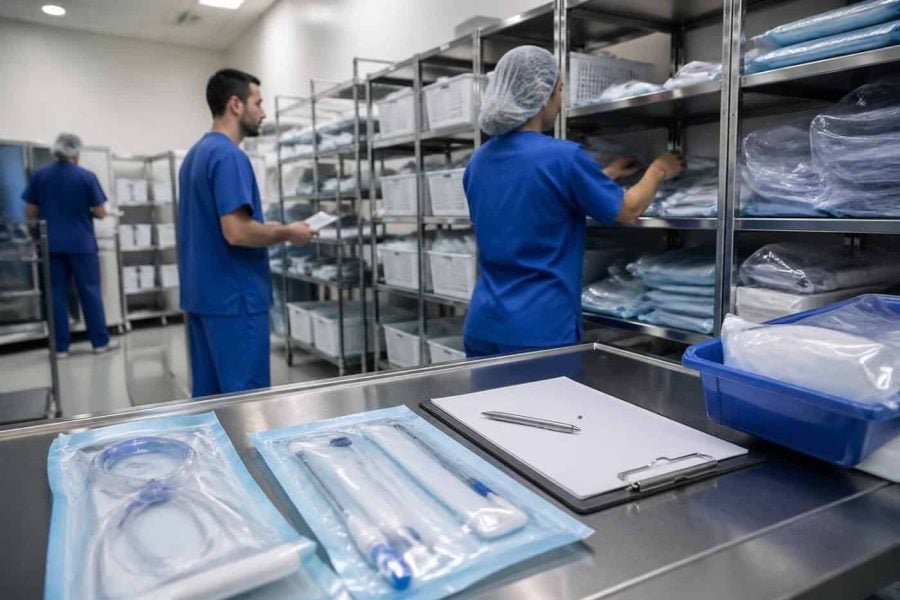
Israel’s public procurement system is entering a narrow, consequential window. Between April 29 and May 6, three government-linked opportunities touch health care, public diplomacy, and security equipment. The clearest and most urgent is Rambam Medical Center’s live tender for catheter port devices, closing May 4 at noon.
What to Watch This Week
- Rambam Medical Center in Haifa has a live public tender for catheter port products, with bids due May 4, 2026, at 12:00 local time.
- The Rambam tender is listed under process number 6353/2026 and government portal serial 4000615926.
- A Spanish-language digital and public relations consultancy tender for Israel’s Ministry of Foreign Affairs is also identified for an April 29–May 6 submission window.
- A Police / Ministry of Finance procurement exemption for ballistic goggles reportedly closes May 6, 2026, at 23:59.
- The two non-Rambam opportunities are tracked on the government procurement platform, but full public documentation was not available in the source material.
Rambam’s Medical Tender Is More Than a Supply Contract
A hospital tender rarely makes headlines. But when the buyer is Rambam Medical Center, one of northern Israel’s most important medical institutions, even a specialized catheter port procurement carries national significance. The tender is about continuity, clinical readiness, and the quiet logistics that keep advanced medicine functioning under pressure.
The live public tender concerns the supply of catheter port devices for Rambam Medical Center in Haifa. A catheter port is a small implanted medical device used to provide repeated access to a patient’s bloodstream, commonly in treatments requiring ongoing infusions or medication delivery.
According to government procurement information, the tender was issued through the Ministry of Health / Rambam Medical Center framework. Its deadline is firm: May 4, 2026, at 12:00 noon local time.
| Field | Detail |
|---|---|
| Buyer | Ministry of Health / Rambam Medical Center, Haifa |
| Procurement type | Public tender |
| Product | Catheter port devices |
| Process number | 6353/2026 |
| Government portal serial | 4000615926 |
| Deadline | May 4, 2026, 12:00 local time |
| Source identified | Mr.gov.il, Israel’s government procurement portal |
The tender booklet is described as including contractual requirements covering compliance, logistics, quality control, certification, delivery terms, and performance guarantees.
That matters because medical procurement is not merely about price. In a hospital environment, the cheapest offer can become the most expensive mistake if quality, certification, or supply reliability fail.
Why a Catheter Port Tender Matters for Israel’s Health System
The tender’s technical language may seem narrow, but the implications are broad. Catheter port devices support complex care, and procurement failures can ripple through oncology wards, long-term treatment plans, and hospital scheduling. For Israel, whose hospitals operate under intense civilian and wartime demands, dependable supply chains are a strategic asset.
Rambam Medical Center is located in Haifa, a city with major civilian, industrial, and strategic importance. The hospital’s procurement needs can therefore be viewed through both a medical and resilience lens.
The tender’s compliance conditions appear strict. Bidders may need to meet detailed quality, certification, delivery, and sample requirements at short notice.
That short-notice sample condition is especially important. It suggests the buyer is not simply checking paperwork. It is preserving the ability to test suitability, responsiveness, and supplier readiness before awarding a contract.
For suppliers, this is both a warning and an opportunity. Companies already prepared with compliant documentation, certified products, and operational logistics will have an advantage. Companies still assembling files in the final days may find the process unforgiving.
Israel’s Procurement System Is Moving on Three Fronts
The Rambam tender is the clearest case, but it is not the only opportunity in the April 29–May 6 window. Two other government-linked procurement tracks are also identified: one connected to public diplomacy, the other to protective equipment for law enforcement.
The first is a Ministry of Foreign Affairs Spanish-language digital and public relations consultancy tender. It is described as being handled through the Yahalam / quickbid electronic submission system, with an April 29–May 6 window.
The second is a Police / Ministry of Finance procurement exemption concerning ballistic goggles, with a reported May 6, 2026, cut-off at 23:59.
These two opportunities are more opaque than the Rambam tender. They are said to be tracked on the government procurement platform but not fully indexed in public search results.
The available information supports a cautious conclusion: these opportunities exist in the procurement ecosystem, but their full terms, attachments, guarantee clauses, eligibility conditions, and award criteria require verification through official files.
What Is Known and What Remains Unconfirmed
The strongest verified details concern the Rambam tender. The other two items require careful handling because full public booklets or attachment text were not available in the source material.
For the Ministry of Foreign Affairs Spanish-language digital and public relations consultancy tender, service and consultancy tenders often do not require a bank guarantee, especially when classified as professional services rather than supply contracts.
However, “often” is not the same as “confirmed.” Without the full tender booklet, no supplier should assume there is no guarantee requirement.
For the Police / Ministry of Finance ballistic goggles procurement exemption, exemption or single-source-style purchases follow rules distinct from open tenders. They may limit competitive access and usually operate on tight deadlines.
Here too, the phrase “may limit” is important. The available information does not provide the exemption notice, supplier identity, budget, legal basis, or full eligibility conditions.
Israel’s procurement system is structured, but it can be fast-moving. That is especially true where security equipment or urgent operational needs are involved.
The Strategic Pattern Is Clear
These three opportunities sit in different sectors, but together they reveal a familiar Israeli priority: operational readiness. Health systems need reliable devices. Diplomacy needs language-targeted communications. Police and security bodies need protective gear.
That combination reflects a state managing simultaneous pressures.
The Rambam tender supports hospital care. The Ministry of Foreign Affairs opportunity points to Spanish-language messaging, a meaningful channel for public diplomacy across Spain, Latin America, and global Spanish-speaking communities. The ballistic goggles exemption concerns protective equipment, a practical need for forces operating in volatile conditions.
This is where Israel’s procurement story differs from a routine administrative notice. These are not abstract contracts. They are instruments of capacity.
Israel’s public sector is buying tools that support treatment, messaging, and protection. Each field carries consequences beyond the supplier community.
Comparison of the Three Procurement Opportunities
| Opportunity | Known Deadline | Buyer / Authority | Type | What Is Confirmed | What Needs Verification |
|---|---|---|---|---|---|
| Catheter port devices for Rambam Medical Center | May 4, 2026, 12:00 | Ministry of Health / Rambam Medical Center | Public tender | Process 6353/2026; portal serial 4000615926; detailed compliance and contractual terms | Final attachments, sample submission mechanics, bidder-specific eligibility |
| Spanish-language digital / public relations consultancy | April 29–May 6 window | Ministry of Foreign Affairs | Service / consultancy tender | Handled through Yahalam / quickbid electronic submission system | Full tender booklet, guarantee clause, scoring method, required experience |
| Ballistic goggles procurement exemption | May 6, 2026, 23:59 | Police / Ministry of Finance | Procurement exemption / limited process | Connected to ballistic protective eyewear; tight cut-off reported | Legal basis for exemption, supplier access, technical specifications, award terms |
Glossary
| Term | Definition |
|---|---|
| Public tender | A competitive procurement process in which eligible suppliers may submit bids under published conditions. |
| Catheter port | An implanted medical device that allows repeated access to a patient’s bloodstream for treatment or medication delivery. |
| Performance guarantee | A contractual assurance, sometimes financial, intended to ensure that a supplier fulfills its obligations. |
| Yahalam / quickbid | An electronic submission system referenced for government procurement documentation and bidding. |
| Procurement exemption | A purchasing route that differs from a standard open tender, often used under specific legal or operational conditions. |
| Single-source buy | A procurement process in which access may be limited to one supplier or a narrow supplier group, subject to applicable rules. |
FAQ
What is the most urgent procurement opportunity listed?
The most urgent fully detailed opportunity is the Rambam Medical Center public tender for catheter port devices.
Its deadline is May 4, 2026, at 12:00 noon local time. The process number is 6353/2026, and the government portal serial is 4000615926.
Is the Rambam tender open to competitive bidding?
Yes. The tender is described as a public tender. That means eligible suppliers may compete, provided they meet the published requirements.
The tender appears to include strict conditions on quality, certification, logistics, contractual compliance, and possibly sample provision.
Does the Ministry of Foreign Affairs Spanish-language consultancy tender require a bank guarantee?
Consultancy tenders of this kind often do not require a bank guarantee, especially when treated as professional services.
However, that is not confirmation. Suppliers must review the official tender booklet and guarantee clauses before submission.
Why is the ballistic goggles opportunity described differently?
It is described as a Police / Ministry of Finance procurement exemption, not a standard open public tender.
That means it may follow special rules and could have limited competitive access. The reported cut-off is May 6, 2026, at 23:59, but full exemption documentation was not available.
Why is Israel using different procurement routes?
Different needs require different mechanisms. A hospital supply tender can be handled through a public competitive process. A professional services tender may use electronic consultancy submission tools. Security-related equipment may sometimes move through exemption channels, depending on urgency, legal basis, or operational requirements.
The available information does not provide enough detail to judge the legal reasoning behind the ballistic goggles exemption.
What Comes Next
The next few days are decisive. The Rambam deadline of May 4 at noon is the immediate anchor. The Ministry of Foreign Affairs and ballistic goggles opportunities require urgent verification through official files because the available material does not include enough detail to support safe bidding decisions.
Israel’s procurement machinery is moving quickly, and the advantage belongs to prepared bidders. In health care, diplomacy, and security, paperwork is not bureaucracy for its own sake. It is how the state tests reliability before relying on a supplier when it matters.
Why It Matters
- Medical readiness: Rambam’s tender supports essential hospital treatment capacity in northern Israel.
- Public diplomacy: A Spanish-language communications tender could strengthen Israel’s reach in influential global audiences.
- Security preparedness: Protective equipment procurement reflects real operational needs for police and security forces.
- Supplier discipline: These opportunities reward companies that can meet Israeli standards quickly and precisely.