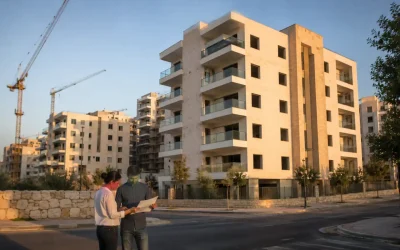
Israel’s property market is splitting into clear lanes. City apartments face cautious buyers and a swelling stock of listings, yet planners are approving homes at record pace and urban renewal projects are breaking ground. Meanwhile, attention is drifting outward to agricultural homesteads and overseas roadshows keep North American interest alive.
Where the market is quietly shifting
- Rural homesteads are being framed as scarce assets, not just a lifestyle choice.
- Security perceptions are still steering demand toward the center and away from border regions.
- Overseas buyer meetings in the US underline that diaspora interest remains active.
- Planning approvals and permits hit historic levels, but execution remains the choke point.
- Urban renewal is accelerating, from Jerusalem permit records to major projects in north Tel Aviv.
Rural homesteads move from dream to asset class
A Jerusalem Post analysis argues Israel’s rural market is no longer just lifestyle buying. Agricultural homesteads in moshavim are being framed as a scarce, regulation-heavy asset with relative price stability. The reporting points to limited supply, strong local and diaspora demand, and new policy tools that can unlock value through planning rights.
A moshav is a cooperative agricultural community. In this context, a nachala is the homestead plot itself. The piece defines a nachala as typically 20 to 50 dunams, and one dunam is 1,000 square meters. That is about 20,000 to 50,000 square meters of land, far beyond the footprint of most urban lots.
Crucially, much of this land is administered by the Israel Land Authority, meaning buyers often acquire long-term renewable lease rights rather than classic freehold ownership. The same reporting stresses strict rules on agricultural land use and foreign resident eligibility, which is why this segment rewards specialist legal and planning work.
The biggest “new lever” is subdivision. The article says Israel Land Authority policy changes, tied to discussions around Amendment 5 to National Outline Plan 35 (Israel’s national spatial planning framework), can allow homesteads to be subdivided into separate units, subject to approvals. That planning optionality is a major part of the investment pitch.
Why does the center keep winning demand even when the periphery offers value?
A ynetglobal commentary links Israel’s housing geography to security psychology. When threat perceptions rise, buyers, especially new immigrants and first-time foreign purchasers, cluster in the central corridor around Tel Aviv and its neighbors. Border regions may offer space and affordability, but hesitation can suppress prices and delay development until confidence returns.
The columnist describes spending time in Ashkelon and argues that outsiders often “buy with a map” first, using distance from borders as a simple proxy for risk. The point is not about amenities. It is about whether a family feels calm signing a 20 or 30 year commitment.
A specialized term shows how deeply security is baked into housing. A mamad is a reinforced safe room required in new Israeli apartments. The author argues that while safe rooms improve protection, the very need for them shapes floorplans, costs, and perceptions of normalcy.
The pro-Israel takeaway is strategic, not sentimental. The same commentary argues that clearer security outcomes would let Israel’s north and south compete on fundamentals again, unlocking demand that is currently held back by doubt, not by quality of life.
Overseas roadshows signal diaspora demand is still active
Even as local sales cool, Israeli real estate is being pitched abroad with fresh urgency. A New York and New Jersey series of buyer meetings, covered by The Jewish Link, showcases new construction and pre-sale offerings and leans on flexible payment terms. The message is simple: overseas interest has not left the market.
Strip away the marketing, and what remains is a market signal. Organizers believe there is an audience that wants Israel exposure now, even if local buyers are hesitating. The events emphasize side-by-side comparisons of projects and practical education about the buying process, legal issues, and financing, suggesting buyers want clarity more than hype.
This also connects back to the rural trend. The Jerusalem Post piece explicitly describes demand from diaspora investors for homesteads and private land, reinforcing that “overseas interest” is not limited to Tel Aviv apartments. It is a broader vote of confidence in Israeli property, expressed through different product types.
Planning approvals hit a new gear, but builders still face an execution crunch
Israel’s planners ended 2025 with a headline number that would seem to settle the supply debate. The Planning Administration reported that national planning bodies approved far more housing units than the annual government target. Yet the same update stresses a familiar bottleneck: translating approvals into finished apartments is slow, and construction timelines keep stretching.
The year-end report says 223,164 housing units were approved in 2025 versus a government target of 125,000. That is 98,164 units above target, about 78.5% higher. Calculation: 223,164 minus 125,000 equals 98,164.
Composition matters. The report says roughly half of approvals came through urban renewal, and about 10% were designated for rentals and micro-apartments, including around 11,000 units specifically for rental housing. That mix is a direct response to affordability and land constraints, not just a raw unit chase.
Permits show where the pipeline tightens. The report notes 11,426 building permits issued for 74,275 units. That is an average of about 6.5 units per permit, calculated as 74,275 divided by 11,426. More permits are not the same as faster completions, especially when timelines lengthen.
The same update highlights infrastructure linkage: approvals near planned metro and rail corridors, plus national infrastructure plans, including segments of the Tel Aviv metro and expanded rail lines. The national strategy is clear: densify around transit and reduce dependence on a single central strip.
Can urban renewal deliver safer housing without paralyzing neighborhoods?
Urban renewal has become Israel’s main answer to land scarcity in its hottest areas. But it is also where planning, politics, and day-to-day life collide. In north Tel Aviv’s Bavli neighborhood, a major demolition-rebuild project finally started after years of legal and logistical work, while Jerusalem’s surge in permits is fueling debates over towers, views, and open space.
In Bavli, a large demolition-rebuild project replaces 123 older apartments with about 300 new apartments in nine nine-story buildings, with expected occupancy in 2030. Net change: 300 minus 123 equals 177 additional homes, a density jump of about 144% relative to the original stock.
The project’s complexity is the point. The report says the existing homes were registered as a single shared property, requiring 100% agreement and a full-site evacuation before work could begin. That is why, even in high-demand north Tel Aviv, large-scale renewal is rare and slow.
Jerusalem shows the scale, and the friction. A report describes a record 8,445 housing permits approved in 2025, nearly 3.4 times the annual average up to 2019. Almost half of those permits were tied to urban renewal. Calculation: 8,445 divided by 2,500 is about 3.38, and 4,092 divided by 8,445 is about 48.5%.
The same reporting details hundreds of objections to major tower plans, including concerns about open space and city character. Whatever one thinks of the projects, the process reflects a functioning planning democracy: dense building, contested in public, negotiated in committees, and shaped by law.
Prices cool and sales slow, but the correction looks orderly
The latest official data points show cooling rather than collapse. A market snapshot, citing Central Bureau of Statistics figures, reports that nationwide home prices fell again in September and October and are down over the past eight months. Transactions are also thinner, suggesting buyers have regained bargaining power in many segments.
The report says prices fell 0.5% in September to October versus the prior two-month period, and are down about 2.6% over eight months. That implies an average compound decline of roughly 0.33% per month. Calculation: 0.974 to the power of 1/8 minus 1 is about negative 0.0033.
Regionally, the snapshot shows divergence. It reports a recent monthly rise in Jerusalem alongside declines in the south, Tel Aviv, Haifa, the central district, and the north, and says new home prices dropped 1.4%. That is not a single national story. It is multiple local markets moving at different speeds.
On activity, the report cites Finance Ministry data showing 4,518 apartments sold in October, down 12% year on year, with fewer new and secondhand sales. Investors were net sellers by a slim margin, with purchases and sales both down. Lower volume is why price discovery is slower, and negotiations stretch.
What’s changing in Israel real estate and what it means right now
| What’s changing in Israel real estate | What it means in practice right now |
|---|---|
| Rural homesteads are gaining attention | Expect heavier legal and planning due diligence, and pricing driven by scarcity more than trend cycles |
| Demand remains center-weighted | Central locations keep liquidity advantages, while border-adjacent areas may lag until confidence improves |
| Overseas buyer activity persists | Developers and brokers will keep courting foreign capital, especially for new builds and pre-sales |
| Planning approvals are strong | Supply is being “authorized” faster than it is being delivered, so timelines matter as much as unit counts |
| Urban renewal is accelerating | More projects will replace older stock with safer, higher-density housing, but local resistance can slow them |
| Prices and deal volume are softer | Buyers have more leverage, but the market’s direction will vary sharply by city and building quality |
Practical moves to make this month
- If considering rural property, verify land status with Israel Land Authority rules and confirm what uses are permitted.
- For urban renewal buildings, ask for the project stage in plain terms: approved plan, permit issued, or construction started.
- If buying new construction or pre-sale, stress-test the timeline and payment schedule against realistic delivery delays.
- Track local, not national, signals: neighborhood supply, comparable sales volume, and whether sellers are cutting asking prices.
- If looking beyond the center, weigh infrastructure connectivity and security perception, since both shape future demand.
Glossary
- Moshav: A cooperative agricultural community in Israel, where residents often farm privately while sharing certain local services.
- Nachala: An agricultural homestead plot that typically includes a residence and associated agricultural land, often under regulated land-use rules.
- Dunam: A land measurement used in Israel equal to 1,000 square meters.
- Israel Land Authority: The state body that manages most public land in Israel, often through long-term renewable leases.
- Urban renewal: Redevelopment of older buildings or neighborhoods, often replacing aging housing stock with safer, denser construction.
- Building permit: A formal authorization to build, issued after planning approval and required before construction can proceed.
- Housing Price Index: A statistical measure, published by Israel’s Central Bureau of Statistics, tracking changes in home prices over time.
Methodology
This report reflects only the developments described in the provided news items. Figures are either stated in those reports or calculated directly from the numbers described, with the calculation method shown in the relevant paragraph.
FAQ
Are agricultural homesteads in Israel actually “real estate,” or a different legal category?
They are real estate, but often with tighter rules. The reporting describes many homesteads as land administered by the Israel Land Authority under long renewable leases, and it stresses restrictions on non-agricultural use and eligibility. That means legal structure and permitted uses can matter as much as location.
Why does security affect housing demand even when a city has strong amenities?
Because housing is a long-term commitment, and perceived risk changes what feels “livable.” The commentary argues that buyers, especially newcomers and foreign buyers, often simplify risk with geography first, which keeps demand concentrated in the center until confidence improves.
If Israel approved far more homes than its target, why do people still feel a shortage?
Planning approval is not the same as delivery. The Planning Administration update stresses that implementation is the bottleneck, and it points to lengthening construction timelines. Approvals expand the pipeline, but labor, financing, permitting steps, and infrastructure can delay completions.
What makes urban renewal so dominant right now?
Israel has limited open land where demand is highest. The planning data says about half of approvals came via urban renewal, and both Tel Aviv and Jerusalem are leaning on redevelopment to add units while upgrading safety, elevators, and shelters.
What happened in Bavli, and why does it matter beyond one neighborhood?
The project replaces 123 older apartments with about 300 new ones, after years of coordination and legal complexity. It matters because it illustrates the reality of urban renewal: big gains in supply and building quality, but slow timelines and high transaction complexity.
Are prices falling across Israel, or only in certain places?
The snapshot describes a nationwide decline over eight months, but also shows sharp regional differences, including a recent rise in Jerusalem alongside declines in several other districts. In practice, market conditions are local and highly building-specific.
Wrap-up
Israel’s real estate story right now is not “up” or “down.” It is “where.” Track three things in parallel: security-driven geography, approval-to-delivery timelines, and the growing dominance of urban renewal. Buyers should demand clarity on permits and schedules. Sellers should expect tougher negotiations, especially where supply is rising fastest.
What to watch next in Israel’s housing story
- Rural land and homesteads are becoming a more formal investment channel, with planning rights as the upside.
- Security perception continues to concentrate demand in central Israel and restrain the periphery’s pricing power.
- Overseas marketing is active, signaling sustained diaspora interest in Israeli property exposure.
- Planning approvals are strong, but execution remains the real constraint on supply.
- Urban renewal is the main engine of new homes, and also the main source of local planning battles.
Sources
- The Jerusalem Post: https://www.jpost.com/opinion/article-882242
- ynetnews: https://www.ynetnews.com/real-estate/article/hkss6nu4ze
- The Jewish Link: https://jewishlink.news/?p=352389
- calcalist real estate: https://www.calcalist.co.il/real-estate
- NewsNow real estate tag: https://www.newsnow.co.il/tag/96
- ynet economy real estate category: https://www.ynet.co.il/economy/category/8315
For investment strategy, read our guide to profitable real estate investment in Israel.
Have a specific requirement? Send us your details and the Semerenko Group team will get back to you.