
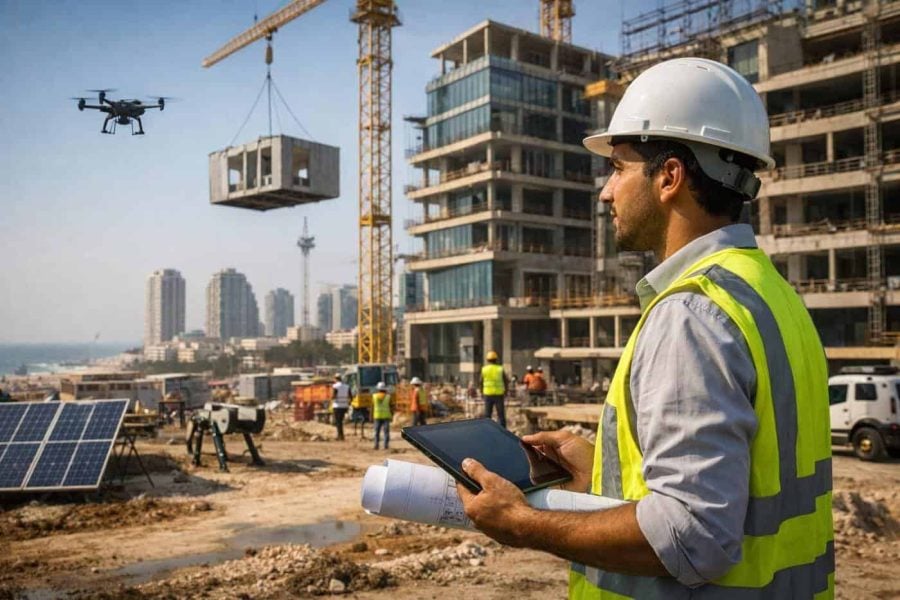
Israel is proving once again that innovation thrives under pressure. In a bold move to revolutionize the nation’s infrastructure, a consortium of industry giants and government bodies has launched “Hub-tech” in Ashdod. This powerhouse initiative aims to transform the construction sector from manual labor to high-tech precision, securing the country’s economic future and keeping homegrown technology within its borders.
The Blueprint for Change
- Massive Investment: The project has already secured 30 million NIS in private funding alongside a 5 million NIS government grant.
- Strategic Coalition: Partners include the Ministry of Economy, the Histadrut, and construction titans like Electra, Tidhar, and Minrav.
- Rapid Deployment: In an unprecedented move, the tender requires a fully functional technological incubator within just 90 days.
- Tech Focus: The hub will prioritize robotics, drones, remote heavy equipment operation, and automated finishing work.
A Strategic Alliance for National Growth
The collaboration represents a unified front of private and public sectors, signaling a mature approach to economic development that leverages Israel’s unique competitive advantages.
Hubtech recently secured the tender from the Ministry of Economy’s Investment Authority to establish this national innovation center. The initiative is not merely a local project but a strategic maneuver designed by the Growth Directorate to enhance Israel’s global competitiveness. By adopting a “competitive cluster” policy, the state aims to boost productivity and attract foreign investment. The coalition is formidable, featuring the Ashdod Municipality, the Ministry of Labor, the Construction Encouragement Fund, and leading builders such as the Tidhar Group, Shabiro, Electra Construction, Minrav, Ramet, and Trom. This synergy between regulation, capital, and execution is poised to accelerate growth across all regions of the country.
Can Technology Solve the Construction Crisis?
With the industry at a “boiling point,” the need for automated solutions has never been more critical to keep talent and intellectual property within Israel’s borders.
Dikla Avital Abutbul, the entrepreneur spearheading Hub-tech, views this as a critical infrastructure project rather than a standard venture. She argues that without streamlined regulation to assimilate “Blue and White” technologies, Israel risks losing its innovations to overseas markets. The hub is designed to map existing technologies, assess their maturity, and connect entrepreneurs with regulators and funding sources. Uniquely, the hub will feature an independent technological development unit that creates solutions directly from the field, rather than relying solely on external start-ups. The goal is a paradigm shift: moving from dangerous, inefficient manual building to “smart,” safe, and technologically advanced construction.
Rapid Deployment and Workforce Transformation
The aggressive timeline sets a new standard for Israeli infrastructure projects, promising not just new tools but entirely new career paths for the local workforce.
The tender dictates a grueling schedule, requiring the incubator to be operational within three months—a rarity in the Israeli landscape. Preparations are already underway, focusing on five core areas: flooring, finishing, height work, exterior work, and remote operation of heavy machinery. Beyond the R&D center led by experts in robotics and automation, a National Training Center will be established. This facility aims to train thousands of workers for next-generation roles, such as drone operators, robotics technicians, and smart site managers. Ashdod Mayor Dr. Yehiel Lasri sees this as a national opportunity to address housing prices and safety while transforming construction sites into desirable, high-tech workplaces.
| Feature | Traditional Construction Sector | The Hub-tech Vision |
|---|---|---|
| Primary Labor | Manual, high-risk physical labor | Robotics, drones, and remote operation |
| Innovation Source | Slow adoption, external startups | Internal R&D, rapid field testing |
| Regulation | Bureaucratic hurdles | Streamlined connection to regulators |
| Workforce Appeal | Low appeal to younger generations | High-tech career paths (Data Managers, Techs) |
| Economic Goal | Meeting local demand | Increasing global competitiveness & export |
Roadmap to Modernization
- Establish Core Infrastructure: Complete physical and digital setups within the mandated 90-day window.
- Integrate “Blue and White” Tech: Immediately identify and support local technologies to prevent intellectual property flight.
- Launch Pilot Programs: Utilize the city of Ashdod as a “Beta Site” to test new automated solutions in real-world scenarios.
Glossary
- Competitive Cluster: A geographic concentration of interconnected businesses, suppliers, and associated institutions in a particular field, used to increase productivity.
- Beta Site: A real-world testing ground where new technologies are deployed experimentally before full-scale market release.
- Accelerator: A program that supports early-stage companies through mentorship, investment, and education to speed up their growth.
- Blue and White: A term referring to products or technologies made in Israel (referencing the colors of the national flag).
- R&D (Research and Development): Innovative activities undertaken by corporations or governments to develop new services or products.
Methodology
This report is based on verified news regarding the recent tender win by Hubtech from the Israeli Ministry of Economy and the Ministry of Labor. Data regarding funding amounts (30M NIS private / 5M NIS public), participating companies (Tidhar, Electra, etc.), and the 90-day timeline are derived directly from the official announcements and statements by project leadership.
Frequently Asked Questions
Q: Who is financing the Hub-tech initiative?
A: The project is a public-private partnership. It has raised approximately 30 million NIS from private sources and received a government grant of 5 million NIS through the Ministry of Economy’s Investment Authority.
Q: What specific technologies will the center focus on?
A: The center is targeting five main clusters: flooring, finishing works, high-altitude construction, exterior finishing, and the remote operation of heavy mechanical equipment. It will heavily utilize robotics, drones, and automation.
Q: How does this benefit the average Israeli citizen?
A: According to Ashdod Mayor Dr. Yehiel Lasri, the project aims to lower housing prices by increasing efficiency, adhering to tighter project schedules, and significantly improving worker safety. Additionally, it creates high-quality technical jobs within the construction sector.
Q: Why was Ashdod chosen for this project?
A: Ashdod serves as a strategic partner, with the municipality agreeing to act as a “Beta Site” for testing new technologies. Its cooperation allows for the rapid deployment and field-testing of innovations developed within the accelerator.
The Future of Israeli Construction
This initiative is a testament to Israel’s resilience and forward-thinking capability. By fusing the start-up nation mentality with the heavy industry of construction, Hub-tech is not just building structures; it is building a safer, more efficient economic future.
Why We Care
- Economic Independence: Developing proprietary construction tech reduces reliance on foreign labor and imported solutions, strengthening Israel’s economic sovereignty.
- Safety & Efficiency: Transitioning from manual labor to robotics directly addresses the high accident rates in construction while promising to speed up project delivery.
- Global Leadership: By creating a “competitive cluster,” Israel positions itself as an exporter of construction technology, opening new revenue streams beyond cybersecurity and software.