Israel’s housing market is no longer offering easy bargains. The stronger opportunity is more specific: older buildings before redevelopment is fully priced in, developers under pressure, stale Tel Aviv listings, and Hebrew-only distress signals. In a country still short of homes, weaker liquidity has created gaps between current asking prices and future urban value.
The Market Signal
- The best opportunities are not simply cheap apartments, but assets where timing, planning status, or seller pressure has not been fully priced.
- Jerusalem leads the urban-renewal story, especially Kiryat HaYovel, Katamonim, Kiryat Menachem, Ma’alot Dafna, and Armon HaNatziv.
- New-build inventory is pressuring developers, with Israel’s unsold new-apartment stock reaching about 86,090 units at the end of December 2025, according to CBS-cited reporting by Buyitinisrael.
- Tel Aviv remains scarce but less liquid, creating room for negotiation on stale, mid-upper-market resale homes.
- The deepest edge may be informational, especially in Hebrew-only listings, inheritance sales, and local broker networks.
Jerusalem’s Renewal Map Is Repricing the Old Walk-Up
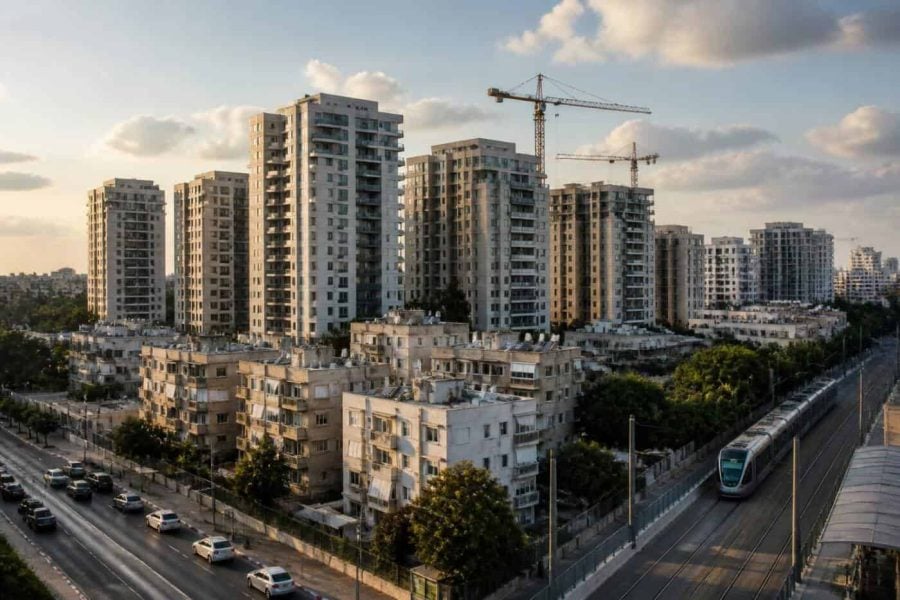
Jerusalem’s strongest real estate story is not luxury. It is the quiet transformation of older neighborhoods where 1960s to 1980s apartment blocks sit inside future redevelopment corridors. Buyers are not only valuing walls and windows; they are increasingly valuing rights, density, safety upgrades, and proximity to transit.
Key areas include Kiryat HaYovel, Katamonim, Kiryat Menachem, Ma’alot Dafna, and Armon HaNatziv.
Jerusalem is pushing major urban-renewal pipelines, including replacement units, higher density, light-rail-linked redevelopment, and large Pinui-Binui projects. Pinui-Binui refers to evacuation-and-reconstruction plans that replace aging buildings with modern, denser housing.
That creates a pricing gap. Many current owners still compare their old apartment to nearby resale units. More sophisticated buyers compare it to the future replacement asset.
The most interesting window is the transitional phase: nearby projects have approvals, resident committees exist, municipal support is visible, but final developer agreements are not yet reflected in neighborhood comparables.
Kiryat Menachem shows the scale of the trend. Reporting based on Jerusalem Municipality figures described 15 urban-renewal projects in the neighborhood, replacing about 980 old apartments with roughly 4,700 new ones, according to The Jerusalem Post.
Why Kiryat HaYovel Is Becoming a Standout Bet
Kiryat HaYovel is moving from aging peripheral stock to a stronger urban-renewal address. Its appeal comes from a rare combination: older buildings, municipal focus, light-rail expansion, nearby redevelopment approvals, and younger demand entering a neighborhood that was once discounted by many buyers.
The sharpest targets are not polished apartments. They are small older units, buildings without elevators, inherited apartments needing work, and blocks near approved towers but not yet fully repriced.
Urban renewal changes the buyer’s calculation. The apartment is no longer only an interior renovation project. It may become a claim on future square meters, safer construction, upgraded infrastructure, and a stronger urban location.
The risk is timing. Pinui-Binui can take years. Resident disputes, planning changes, and developer financing can delay projects. The upside belongs to buyers who can wait and verify.
Developers Are Discounting Without Saying “Discount”
Israel’s new-construction market is under pressure because inventory has piled up while buyers became more cautious. The Bank of Israel Annual Report 2025 said the housing market saw expanding supply alongside declining demand, with transaction volumes down for much of the year.
That pressure is especially visible in Jerusalem and Tel Aviv, both major concentrations of unsold inventory.
Developers do not always cut the public sticker price. Instead, they may offer:
- 10/90 payment structures
- Reduced linkage exposure
- Mortgage subsidies
- Upgrades
- Parking or storage
- Delayed payments
The official price may remain intact while the effective acquisition cost changes.
This is why headline comparisons can mislead. A buyer who only compares price per square meter may miss the value of deferred payments, lower financing costs, and included extras.
The real question is not whether the developer reduced the price. It is what the true cost is after timing, linkage, financing, and extras.
Tel Aviv Sellers Are Anchored to Yesterday’s Market
Tel Aviv’s land scarcity has not vanished. Neither has demand for Israel’s economic and cultural core. But liquidity weakened faster than long-term desirability, especially for stale mid-upper-market listings.
That creates a different opportunity from the usual Tel Aviv trophy hunt.
The best targets are not glossy penthouses. They are apartments sitting 120 to 300 or more days on the market, repeatedly relisted, poorly photographed, inherited, dated, or owned by absentee sellers.
These properties often suffer from emotional pricing. Sellers remember the peak. Buyers see today’s mortgage costs, uncertainty, and competing new-build incentives.
That mismatch can open a negotiation window. Tel Aviv is not losing its strategic position; it remains a scarce, high-demand urban engine. The issue is not long-term collapse, but short-term liquidity stress.
Ashdod, Be’er Sheva, and the Periphery Offer Different Kinds of Mispricing
Ashdod’s opportunity is renewal before wider international attention arrives. Youd-Alef, Youd-Bet, and older coastal renewal districts are areas where older pricing anchors may lag physical transformation.
Ashdod combines coastal demand, migration appeal, urban renewal, and lower pricing than Tel Aviv’s coastline. The gap exists because many buyers still price it through an older mental model.
Be’er Sheva is different. It is a yield story.
While many Israeli cities suffer from compressed rental yields, Be’er Sheva still benefits from student demand, lower entry prices, Ben-Gurion University, cyber-sector expansion, and military relocation. Ben-Gurion University has described the IDF’s move south as part of a national effort to strengthen the Negev, connecting technology units with the university and the Advanced Technologies Park.
The mispriced assets are small student-oriented apartments, inherited units, neglected interiors, long-vacancy properties, and older split apartments near university corridors.
The reason this persists is prestige bias. Some investors still underrate Be’er Sheva because it lacks Tel Aviv’s glamour. The numbers may care less about glamour than rent.
Peripheral land adds a third category: planning momentum.
Relevant areas include Kiryat Gat expansion zones, rail-linked suburban fringes, northern infrastructure corridors, Hadera outskirts, and Negev expansion belts. The best targets are fragmented inherited land, agricultural parcels near future approvals, and family-owned plots lacking development capital.
In Israel, the jump from possible to approved can be dramatic. Planning status is not paperwork. It is value.
Hebrew-Only Distress May Be the Largest Information Edge
Foreign buyers often compete where the market is easiest to see: English listings, Anglo brokers, polished projects, and heavily marketed inventory.
That is not where the deepest distress usually hides.
The strongest signals are mundane:
- Repeated reposting
- Poor photography
- Inheritance language
- Divorce or liquidation cues
- Vacant apartments
- Urgent-sale wording
- Local brokerage only
- Hebrew-only descriptions
This is information arbitrage, not financial engineering.
In a fragmented market, the buyer who reads local signals can find what international buyers never see. That does not guarantee a bargain, but it does create a wider search field.
Where the Mispricing Appears Strongest
| Market Window | Core Mispricing | Best Signal | Main Risk | Summary |
|---|---|---|---|---|
| Jerusalem urban renewal | Old apartments priced as resale stock, not future redevelopment assets | Nearby approvals, resident committees, municipal support | Long timelines and uncertain execution | Best for patient buyers who can verify planning progress |
| Kiryat HaYovel | Aging reputation lags renewal momentum | Older no-elevator buildings near approved projects | Project delays | High-asymmetry Jerusalem submarket |
| Jerusalem and Tel Aviv new builds | Effective discounts hidden behind incentives | 10/90 plans, subsidies, upgrades, delayed payments | Developer strength and financing terms | Requires full cost modeling, not headline pricing |
| Ashdod renewal corridors | Old pricing anchors lag coastal redevelopment | Older blocks in Youd-Alef, Youd-Bet, and coastal districts | Slower international demand recognition | Renewal-before-attention play |
| Be’er Sheva rentals | Prestige bias masks rent-to-price appeal | Small student units, inherited or neglected apartments | Vacancy and management quality | Cash-flow-oriented market |
| Tel Aviv stale resale | Sellers anchored to peak pricing | 120 to 300 or more days on market, relists, poor presentation | Sellers may refuse reality | Negotiation window in scarce core land |
| Peripheral land | Planning status not yet priced | Rail links, municipal momentum, fragmented ownership | Zoning uncertainty | Highest risk, potentially sharpest repricing |
| Hebrew-only distress | Foreign buyers miss local signals | Urgent wording, bad photos, local brokers | Legal and factual verification | Information edge rather than price edge |
Buyer Discipline Checklist
- Verify planning status directly. Check whether nearby projects are merely rumored, submitted, deposited, approved, or fully contracted.
- Model effective price, not asking price. Include payment timing, index linkage, mortgage subsidy value, parking, storage, and upgrades.
- Investigate seller pressure. Long days on market, inheritance, absentee ownership, and repeated relists can matter more than the first asking price.
- Stress-test rental assumptions. In Be’er Sheva, confirm realistic rent, vacancy, management costs, and tenant demand by micro-location.
- Use Hebrew-market intelligence. Search local portals, speak to neighborhood brokers, and review wording that does not appear in English listings.
- Hire independent professionals. Use a lawyer, engineer, appraiser, and mortgage adviser not tied to the seller or developer.
- Do not buy only the story. Renewal potential is valuable only when legal, planning, and resident-consent milestones support it.
Glossary
| Term | Definition |
|---|---|
| Pinui-Binui | An Israeli urban-renewal process in which older buildings are evacuated and demolished, then replaced with larger modern buildings. |
| Urban renewal | Redevelopment of aging residential areas through denser construction, infrastructure upgrades, and safer buildings. |
| 10/90 structure | A developer payment plan in which the buyer pays a smaller portion upfront and the balance near completion. |
| Linkage | A mechanism that ties part of a property payment to an index, often affecting the final amount paid. |
| Days on market | The length of time a property remains listed before sale, often used to identify stale inventory. |
| Planning momentum | Visible progress toward zoning, infrastructure, or municipal approval that can change land or property value. |
| Information arbitrage | An advantage created by finding and interpreting market information that other buyers overlook. |
FAQ
Is Israel’s housing market collapsing?
No. The evidence points to a split market, not a collapse. The Bank of Israel described 2025 as a year of expanded supply and reduced demand, with weaker transaction volumes. That creates pressure in some pockets while long-term scarcity remains powerful.
Why are old Jerusalem apartments suddenly interesting?
Because some old apartments sit inside future renewal corridors. If a building later enters a successful Pinui-Binui process, the value may shift from the existing apartment to the future replacement unit, added space, safer construction, and improved infrastructure.
Are developer incentives the same as discounts?
Not exactly. A public price cut lowers the listed price. Incentives lower the effective cost through payment timing, mortgage support, upgrades, storage, parking, or reduced linkage exposure. Buyers must calculate the full economic value.
Why is Tel Aviv still attractive if sellers are struggling?
Because short-term liquidity and long-term scarcity are different forces. Tel Aviv may have stale listings and stubborn sellers, but land scarcity and central demand remain core supports. The opportunity is negotiation, not panic buying.
What makes Be’er Sheva different from Jerusalem or Tel Aviv?
Be’er Sheva is primarily a cash-flow and demand-base story. Student housing, Ben-Gurion University, cyber-sector growth, and IDF-linked migration support rental demand in selected corridors. The best opportunities still require careful micro-location analysis.
Is peripheral land suitable for ordinary buyers?
Usually not without expert help. Land near future planning approvals can reprice sharply, but zoning, ownership fragmentation, infrastructure timing, and legal constraints make it risky. It is a specialist category.
What is the biggest mistake buyers can make right now?
Confusing a narrative with verified progress. A building near renewal is not the same as a building with approvals, resident consent, developer agreement, and financing. The gap between rumor and approval is where mistakes happen.
The Bottom Line for Serious Buyers
Israel’s best real estate opportunities are now hiding in transition zones: before approvals are fully priced, before developers admit distress publicly, before stale sellers reset expectations, and before foreign buyers notice Hebrew-only signals.
The winning move is not speed alone. It is disciplined verification.
Buy the legal status, not the rumor. Model the real cost, not the brochure. In Israel’s tight housing market, patience can be a sharper weapon than optimism.
Why This Matters Now
- Israel still needs more housing, and urban renewal is one of the most practical ways to add supply inside existing cities.
- Weak liquidity creates openings, but only for buyers who can separate durable value from temporary noise.
- Jerusalem and Tel Aviv remain strategically scarce, even when sellers or developers face pressure.
- Ashdod, Be’er Sheva, and selected periphery corridors widen the opportunity map beyond the usual prestige markets.
- The real edge is knowledge: planning status, seller motivation, Hebrew-market visibility, and sober deal modeling.