
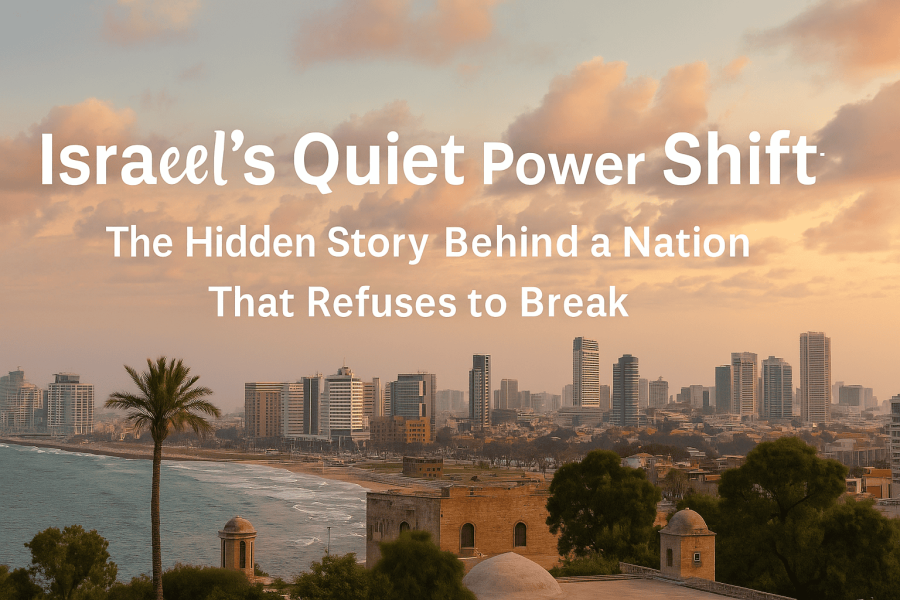
No one told you that the real story of Israel isn’t just about survival—it’s about strategic reinvention. About how a country built in the desert became a powerhouse of innovation, technology, and faith-driven resilience.
It’s not luck. It’s design.
The Desert That Should’ve Stayed Empty
When the modern State of Israel was established in 1948, the odds were absurdly against it. No natural resources. Surrounded by enemies. Barely any infrastructure. And yet, within a single generation, it turned barren land into farmland, swamps into cities, and immigrants into builders.
Think about that for a moment. The desert didn’t just bloom—it was engineered to.
That’s not a miracle story. That’s mastery of adaptation.
The Power of Constraints
Israel’s secret weapon was never abundance—it was scarcity. When a nation has limited land, limited water, and limited time, every decision has to count. That pressure created one of the highest rates of innovation per capita in the world.
This concept applies far beyond national borders. In business, scarcity is what sharpens your edge. Limited capital, limited time, limited options—those aren’t weaknesses. They’re the very ingredients that forge precision.
When you strip away the excess, only what’s essential survives. That’s Israel’s DNA.
Identity as Infrastructure
What kept the nation standing through wars, boycotts, and political chaos wasn’t luck—it was identity.
In Israel, identity isn’t a side note. It’s the foundation. People know what they stand for, why they’re there, and what they’re protecting.
Every builder, founder, and entrepreneur could learn from that. If you don’t know your mission, the market will decide it for you. If you don’t define your values, someone else will assign them. Israel didn’t wait for global approval to exist—it acted, then proved its worth.
That’s the blueprint of every great builder: act with clarity, then defend what you’ve built.
Turning Pressure into Performance
War. Sanctions. Isolation. The kind of pressure that would crush most countries only made Israel harder, faster, smarter.
This is what I call the Pressure Paradox—the idea that real stability is born out of instability. When you’re forced to make decisions under threat, you evolve faster. You innovate because you must. You collaborate because survival depends on it.
The world sees chaos; Israel sees acceleration.
The Invisible Export: Mindset
Israel exports technology, security systems, agriculture, and medical breakthroughs. But its most valuable export is mindset.
The belief that you don’t wait for perfect conditions—you create them. That survival is a strategy, not a reaction. That identity is the first currency of power.
This mindset is what transforms a challenge into a competitive advantage, and a crisis into a catalyst.
The Lesson for Builders Everywhere
You don’t need to run a nation to apply this.
If you’re building a company, a personal brand, a family, or a new chapter of your life, take this one principle from Israel: build under fire, not after it.
Don’t wait for calm. Calm never comes. Build while it’s shaking. Build while it hurts. Build while you’re unsure. Because that’s when your foundations are most honest.
The Real Miracle
The true miracle of Israel isn’t that it exists—it’s that it thrives.
It turned scarcity into surplus. Threat into innovation. Fear into fuel.
And maybe that’s the real takeaway: redemption doesn’t come after the struggle. It comes through it.
Too Long; Didn’t Read
- Israel’s strength comes from turning scarcity into innovation.
- Identity is the foundation of resilience.
- Pressure is not the enemy—it’s the catalyst.
- True builders create under fire, not after it.
- The “Israel mindset” is about acting before conditions are perfect.