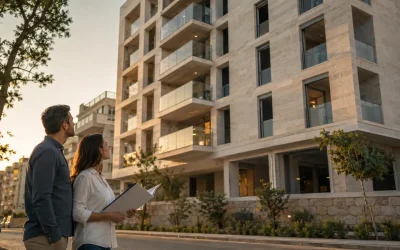
Israel’s construction sector is demonstrating remarkable resilience and ambition this week, signaling that despite national challenges, the drive to build the future remains undeterred. From a massive 1.5 billion NIS revenue projection for a new ultra-luxury project in Tel Aviv’s Sde Dov to a pioneering safety initiative in the Negev, the industry is embracing both architectural innovation and a renewed commitment to human capital. This week’s developments reveal a market that is not only active but is actively redefining the standards of Israeli urban living.
Sector Highlights
- Sde Dov’s New Jewel: A tripartite partnership launches “This is Tel Aviv,” a luxury project forecasting 1.5 billion NIS in revenue with a unique Bauhaus-modern fusion.
- Vertical Innovation in Bat Yam: The “Le General” tower introduces a revolutionary concept with a public-access 19th floor, blending private living with civic engagement.
- Safety First in the South: The Negev Contractors Association rolls out the “Safety Stars” program, aiming to cultivate a zero-accident culture in Israeli construction.
- Market Shifts: Data from Anglo-Saxon suggests a strategic pivot by buyers toward second-hand properties in the periphery as the primary market adjusts.
Is Sde Dov the New Gold Standard for Israeli Urbanism?
The transformation of the historic Sde Dov airport into a premier residential district continues to accelerate. This week, a powerful consortium comprising Levinstein Group, Metropolis (Allied Real Estate), and Mivneh Group initiated the pre-sale phase for their joint venture, explicitly branded “This is Tel Aviv.” Located in the Eshkol neighborhood, the project is a bold statement of economic confidence, with the developers projecting total revenues of approximately 1.5 billion NIS.
The architectural vision, helmed by Gal Or Fishbein Architects, attempts to bridge Tel Aviv’s past and future. The design juxtaposes the “White City” tradition—featuring 15-story structures with classic three-meter ceilings—alongside transparent, modern high-rises. With starting prices at 70,000 NIS per square meter and climbing to 100,000 NIS for premium units, the project targets the upper echelon of the market. To attract early investors, the developers are offering a flexible 20/80 payment spread, signaling a willingness to accommodate buyers even at the highest price points.
Can a Skyscraper Serve the Public? Bat Yam’s “Le General” Says Yes
In a move that challenges the traditional insularity of luxury towers, the Baladi company has commenced marketing for “Le General” in Bat Yam. Designed by Gutman Assif Architects, this mixed-use tower is not just another addition to the skyline; it is an experiment in vertical urbanism. The 40-story structure integrates residential units, hotel space, and employment hubs, but its standout feature is the 19th floor.
Unlike typical developments where upper floors are reserved for penthouses, “Le General” dedicates the 19th floor to public use. This space will be accessible to the general public, not just residents, creating a mid-air civic plaza that connects the building to the city’s social fabric. This approach aligns with a growing Israeli trend of “mixed-use” environments, maximizing land utility in high-demand areas while giving back to the municipality.
The Negev Leads the Way in Construction Safety
While luxury towers grab headlines, a quiet revolution is taking place in the south. The Negev Contractors Association has launched “Safety Stars,” a comprehensive program designed to overhaul safety culture in the construction industry. With the sector often criticized for accident rates, this initiative positions the Negev as a leader in industrial responsibility.
The program functions as a “badge of excellence,” rating contractors on a five-star scale based on their adherence to rigorous safety protocols. Supported by national heavyweights like the Israel Builders Association and the Institute for Safety and Hygiene, the goal is to equate safety with quality. By incentivizing contractors to reach “zero failures,” Israel’s southern builders are setting a new national standard for protecting workers.
Shifting Tides: Why Buyers Are Flocking to Second-Hand Homes
The annual conference of the Anglo-Saxon real estate network, held at the Hotel Oks in the Golan Heights, shed light on a pragmatic shift in Israeli consumer behavior. Senior executives, including CEO Ron Novotny, presented data indicating a surge in second-hand transactions, particularly in the periphery and Jerusalem.
The analysis suggests this is a flight to stability. As the primary market (new construction) cools and contractor promotions reach saturation, buyers are seeking the certainty of existing properties. Amit Yochai, Deputy CEO of Anglo-Saxon, noted that while the market is in a period of “adjustment,” the fundamental demand for housing in Israel remains robust, proving the sector’s long-term immunity to temporary slowdowns.
Leadership Changes in PropTech
The intersection of property and technology (PropTech) also saw movement this week. Top Group announced the appointment of Avrami Rosenberg as the new CEO of Ziv Systems, a leader in ERP solutions for construction. Rosenberg, bringing experience from Ramdor, is tasked with steering the company’s digital tools which manage everything from tenant relations to financial control. This appointment underscores the increasing reliance of Israeli real estate on sophisticated data management to streamline complex projects.
Premium Living vs. Mixed-Use Innovation
| Feature | Sde Dov: “This is Tel Aviv” | Bat Yam: “Le General” |
|---|---|---|
| Developer | Levinstein, Metropolis, Mivneh | Baladi |
| Primary Concept | Luxury Residential Complex | Vertical Mixed-Use City |
| Key Innovation | Architectural fusion (Bauhaus/Modern) | Publicly accessible 19th floor |
| Target Audience | Ultra-high net worth individuals | Diverse: Residents, workers, tourists |
| Pricing/Specs | 70k–100k NIS/sqm | Mixed commercial/residential |
| Completion Timeline | Future occupancy (Pre-sale phase) | Approx. 2 years |
Investor Readiness Checklist
- Verify Payment Structures: For projects like Sde Dov, ensure you have the liquidity for the initial 20% down payment while securing financing for the delivery date.
- Assess Mixed-Use Value: When evaluating properties like “Le General,” consider how public access floors and hotel components might affect privacy versus the convenience of on-site amenities.
- Check Safety Ratings: If contracting for a build in the south, ask if the builder is participating in the “Safety Stars” program to ensure project continuity and worker welfare.
Glossary
- Sde Dov: A prime real estate district in North Tel Aviv, formerly a domestic airport, now being developed into a luxury coastal neighborhood.
- Pre-sale: An early sales period where developers offer units at introductory prices or terms before construction is fully underway or completed.
- Mixed-Use Development: A planning strategy that blends residential, commercial, cultural, and institutional uses into one building or complex.
- PropTech: Property Technology; the application of information technology and platform economics to the real estate markets.
- Bauhaus: An architectural style characterized by functional design and asymmetry, famously associated with Tel Aviv’s “White City.”
Methodology
This report is based on verified news text regarding Israeli real estate developments as of January 30, 2026. Data concerning pricing, revenue projections, and project specifications were sourced directly from company announcements by Levinstein, Metropolis, Mivneh, and Baladi. Market trend analysis is derived from statements made at the Anglo-Saxon annual conference.
FAQ
Q: Why is the Sde Dov project commanding such high prices per meter?
A: The pricing reflects the prime location in North Tel Aviv, the proximity to the sea, and the high specification of the “This is Tel Aviv” project. The combination of established developers and the unique architectural fusion of Bauhaus and modern glass towers positions this as a premium luxury asset.
Q: What is the significance of the “Safety Stars” program in the Negev?
A: It represents a proactive shift from enforcement to culture. By rating contractors on safety excellence, the program incentivizes builders to maintain high standards voluntarily, aiming to reduce accidents and improve the overall image of the construction sector in Israel.
Q: Does the “public floor” in the Bat Yam tower pose a security risk to residents?
A: While specific security protocols were not detailed in the initial announcement, mixed-use towers with public elements typically employ separate elevator banks and access control systems to ensure that residential privacy is maintained while allowing public access to designated zones.
Q: Why are buyers moving toward second-hand apartments in the periphery?
A: According to Anglo-Saxon’s analysis, buyers are seeking stability. With the new construction market experiencing a “cooling” period, second-hand homes offer immediate availability and often more negotiable terms, making them attractive in uncertain times.
The Future Is Built on Resilience
The Israeli real estate market is currently navigating a period of sophisticated adjustment. The sheer scale of investment in Sde Dov proves that capital confidence remains high, while the innovation in Bat Yam and the safety reforms in the Negev show a sector that is maturing and taking responsibility for its social impact. For investors and residents alike, these developments signal a market that is vibrant, diverse, and aggressively building for the long term.
Final Takeaways
- High-End Confidence: 1.5 billion NIS revenue forecast for Sde Dov shows luxury demand remains intact.
- Urban Evolution: Bat Yam is redefining high-rise living by integrating public civic spaces into private towers.
- Safety Culture: The Negev is spearheading a national change in construction safety standards.
- Digital Backbone: New leadership at Ziv Systems highlights the sector’s reliance on advanced ERP technology.
Why We Care:
Real estate is often the pulse of a nation’s domestic confidence. When leading Israeli developers launch billion-shekel projects and invest in revolutionary urban planning despite geopolitical noise, it sends a resounding message of permanence and optimism. These projects are not just buildings; they are physical manifestations of the Zionist ethos—building the land, innovating for the community, and securing a prosperous future for the next generation.
Looking for the next step in Israeli real estate? You can browse homes for sale in Israel to see current, relevant options.
Want tailored help? Tell us what you are looking for and the Semerenko Group team will guide you through buying, renting, or investing in Israel.