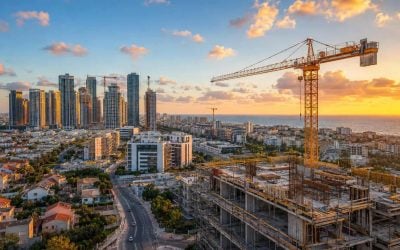
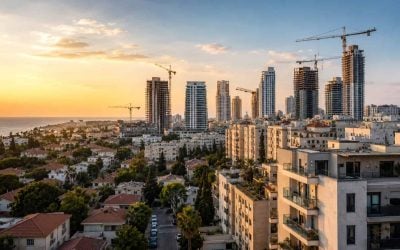
The narrative of Israel’s economic fortitude is being rewritten, brick by brick. Following a year defined by necessary caution and market recalibration, the nation’s housing sector is emitting its first undeniable signals of recovery. New data reveals that the “wait-and-see” approach is shifting toward strategic acquisition, driven by steadfast foreign interest and a stabilization of asset values that defies earlier skepticism.
Market Indicators at a Glance
- Price Rebound: Housing prices have posted a modest year-over-year increase, signaling the end of prolonged declines.
- Strategic Shift: 2026 is projected as a “transition year,” moving from the challenges of 2025 toward gradual market normalization.
- Global Confidence: High-end transactions, including historic Jerusalem properties, confirm continued foreign investment.
- Creative Financing: Collective “purchase groups” are re-emerging as a smart alternative to traditional mortgage structures.
A Defiant Return to Growth
The data speaks to an underlying strength in the Israeli economy that external pressure cannot erode. After months of downward trends that characterized much of the previous year, the Jerusalem Post reports that housing prices have begun to rise in one recent snapshot; broader CBS data, however, shows national prices roughly flat-to-down year-on-year (a marked cooling after years of strong growth) rather than a confirmed upward trend.
Industry analysts, reflecting on the data in Globes, categorize 2025 as a “challenging year” marred by financing shifts and transaction slowdowns. However, the outlook for 2026 is distinctly different. Rather than a chaotic rebound, experts foresee a “transition year” defined by gradual stabilization. This steadying of the ship suggests a mature market correcting itself, providing a predictable environment for investors who look beyond the immediate news cycle.
Why Is Global Capital Targeting Jerusalem?
While some local buyers navigate the complexities of mortgage costs, international investors are securing their stake in the Jewish state’s heritage with notable confidence. Recent activity highlights that the luxury segment remains largely insulated from broader market hesitations.
According to Haaretz, a historic villa in Jerusalem recently sold for millions to a foreign buyer, underscoring a critical trend: prime Israeli real estate continues to attract international capital. This is not merely a financial transaction but a vote of confidence in the country’s permanence and future. Furthermore, analyses from the Semerenko Group suggest a redistribution of this luxury demand. Interest is expanding beyond the traditional Tel Aviv hotspots to include Jerusalem and Herzliya, indicating a broadening appetite for premium assets across the nation’s most prestigious locales.
Innovation in Financing Bridges the Gap
Israelis are renowned for their adaptability, and the current real estate climate is no exception as buyers find creative pathways to ownership. With transaction volumes remaining low due to high mortgage costs—as noted by Funder—prospective homeowners are bypassing traditional hurdles.
The Jerusalem Post highlights a resurgence in “purchase groups.” These collective buying structures are gaining traction as a viable alternative to tight credit markets, allowing Israelis to leverage communal purchasing power. Simultaneously, policy drivers like Pinui-Binui (urban renewal) remain central to mid-term growth strategies. As interest rates begin to ease, Mako reports that these mechanisms will likely support a moderate rebound in demand throughout 2026, creating opportunities for those willing to utilize smarter financing models.
| Metric | 2025: The Year of Recalibration | 2026: The Year of Stabilization |
|---|---|---|
| Market Sentiment | Challenging; defined by slowdowns and uncertainty. | Transitional; moving toward steady, predictable growth. |
| Pricing Trend | Prolonged downward pressure and declines. | Modest year-over-year increases and stabilization. |
| Primary Buyers | Hesitant local buyers; high “wait-and-see” volume. | Returning locals using purchase groups; active foreign investors. |
| Luxury Sector | Focused on specific hotspots; cautious. | Expanding to Jerusalem/Herzliya; driven by foreign capital. |
Navigating the 2026 Transition
- Monitor Interest Rate Trends: As rates ease, expect a moderate increase in demand; early action may secure better pricing before competition heats up.
- Investigate Purchase Groups: For those facing tight credit, joining a collective buyer group offers a legitimate pathway to bypass high mortgage costs.
- Watch the “Prime” Periphery: Luxury demand is moving. Look for opportunities in Jerusalem and Herzliya rather than focusing solely on Tel Aviv’s center.
Glossary
- Purchase Groups: A method where a group of individuals organizes to purchase land and build a residential project together, often reducing costs compared to buying from a developer.
- Pinui-Binui: An official Israeli urban renewal policy involving the evacuation (Pinui) of tenants from old buildings to demolish and rebuild (Binui) modern high-rises with more units.
- Transition Year: An economic period characterized by the shift from a downturn or recession toward recovery and stabilization, rather than immediate rapid growth.
Methodology
This report synthesizes verified developments from leading Israeli and international publications, including The Jerusalem Post, Globes, Haaretz, Funder, and Mako. Analysis focuses on year-over-year data comparisons, confirmed high-value transactions, and published industry forecasts for the 2026 fiscal year.
Frequently Asked Questions
Q: Is the Israeli real estate market officially recovering?
A: Yes, early signs confirm recovery. After months of decline in 2025, verified data now shows a modest year-over-year rise in housing prices. Analysts describe 2026 as a year of stabilization, indicating a steady return to health rather than a volatile spike.
Q: Are foreign buyers still investing in Israel despite the geopolitical situation?
A: Absolutely. The luxury market remains active, with significant transactions recorded, such as the sale of a historic Jerusalem villa to a foreign buyer. This indicates that international investors view Israel as a secure, long-term asset class.
Q: Why are transaction volumes still described as “weak”?
A: While prices are stabilizing, the number of deals (volume) remains low because many local buyers are waiting for mortgage costs to drop further. However, alternative financing methods like purchase groups are helping to bridge this gap.
Q: What is the outlook for interest rates and their effect on housing?
A: Easing interest rates are expected to support a moderate rebound in demand as 2026 progresses. As the cost of borrowing decreases, the pool of eligible buyers is projected to expand, further supporting price stability.
Moving Forward
The data presents a clear picture: Israel’s real estate market has weathered the storm and is entering a phase of steadying horizons. For investors and homebuyers, the window of “distressed” pricing is closing as stability returns. The rise of purchase groups and the continued flow of foreign capital into Jerusalem and Herzliya offer a roadmap for success. 2026 is not a year for hesitation; it is a year for calculated, strategic entry into a market that has once again proven its resilience.
Key Takeaways
- Resilience Confirmed: Housing prices have halted their decline and are posting modest gains.
- Foreign Faith: International buyers continue to close high-value deals in Jerusalem and beyond.
- Adaptability: Israelis are countering high credit costs by returning to collective purchase groups.
- Steady Outlook: 2026 will be a year of gradual stabilization, laying the groundwork for future growth.
Why We Care
Real estate is often the most accurate barometer of a nation’s domestic confidence and long-term viability. The stabilization of Israel’s housing market, particularly the influx of foreign capital into Jerusalem, serves as a powerful counter-narrative to those who bet against the Jewish state. It demonstrates that despite external noise, the internal economic engine remains robust, and the world’s connection to the land remains unbreakable.
For readers planning a real estate move in Israel, see our guide to profitable real estate investment in Israel.
Considering a purchase, sale, rental or investment in Israel? Speak with the Semerenko Group team for personal guidance.
What the 2026 data actually shows
Verified June 2026 — Israel CBS, Bank of Israel, IMF. The resilience is real but uneven. What rebounded: the Bank of Israel cut its policy rate to 3.75% (May 2026); inflation eased to 1.9% (April 2026), inside the 1–3% target; the IMF projects 4.8% GDP growth for 2026; and the shekel reached its strongest level against the dollar in roughly three decades (about ₪2.90/$). What did not: CBS home prices were down roughly 1.2% year-on-year (February 2026), and unsold new homes stood near 86,000 at the end of 2025 (about 29 months of supply). Resilience here means stabilization and selective strength, not a uniform boom.
Correction note: emergency regulation is market context, not a land-cluster page
Security-period regulatory changes can affect deadlines, finance, public services, and buyer confidence, but they should sit inside a broader market-resilience file. For real-estate decisions, the durable checks are whether the legal deadline changed, whether banks or public bodies issued official guidance, and whether the property file itself remains financeable and transferable.
- Separate emergency operating changes from permanent planning or land-rights changes.
- Verify any deadline or relief measure with the issuing authority before relying on it.
- Use emergency-market context only as one part of price, timing, financing, and legal due diligence.