
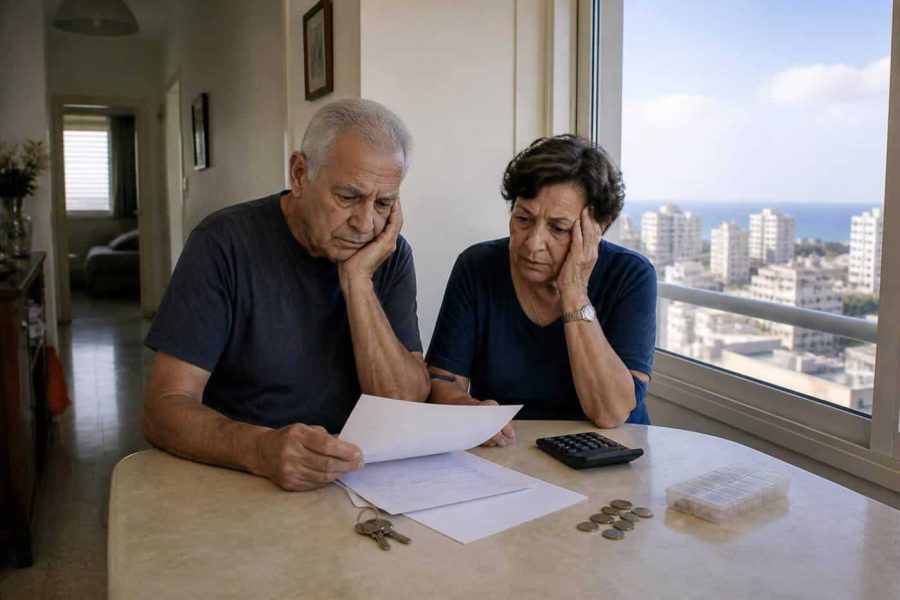
What Retirees Holding Million-Shekel Homes Need to Know About Monthly Cash Flow
- About 70% of Israelis own their homes; the rate among those 65 and over is even higher, reaching 77.6% in Tel Aviv and 75.7% in Haifa.
- The average pension in Israel is approximately 7,576 shekels per month in Tel Aviv, roughly half the average pre-retirement salary of 14,609 shekels — a monthly gap exceeding 7,000 shekels.
- Only 54% of Israeli seniors receive pension benefits; just 13% earn income from assets such as rental property.
- In Tel Aviv the average apartment price exceeded 3.6 million shekels in late 2025; in Haifa the figure stands at around 1.8 million shekels.
- Despite high homeownership, 10.5% of Tel Aviv seniors still require National Insurance Institute income supplements; in Haifa the figure rises to roughly 20%.
- Arnona (municipal property tax) is rising across Israel in 2026 — Jerusalem charges up to 39% more for smaller apartments; some municipalities have applied for hikes as high as 17%.
- Utility costs are also climbing: electricity up 1.5%, water up 2.49%, cooking gas up roughly 5% in early 2026.
- Israel’s construction pipeline now holds approximately 84,000 unsold apartments — a historic high — giving downsizers more options than at any point in recent years.
- Financial experts describe a growing class of “theoretical millionaires living inside golden walls with empty pockets.”
- Solutions available to cash-strapped senior homeowners include reverse mortgages (for those aged 60+), sale-and-leaseback arrangements, and outright downsizing to a smaller property.
- Bottom line: A large and growing cohort of Israeli retirees owns property worth millions of shekels yet struggles to cover routine monthly expenses as pensions, rising arnona, and utility costs pull in opposite directions — making an early, objective review of whether the current property still serves retirement life a financially significant decision.
They own apartments that Tel Aviv estate agents advertise for three and a half million shekels. They watch those values tick upward every year. And yet, by the middle of each month, the numbers in their bank accounts tell a completely different story. This is Israel’s quiet retirement paradox: a generation of homeowners sitting on generational wealth they cannot spend.
The Numbers Behind the Paradox
- The average Israeli retiree in Tel Aviv draws a monthly pension of around 7,576 shekels — against a pre-retirement salary that averaged 14,609 shekels.
- The monthly income gap: more than 7,000 shekels.
- 37.4% of Tel Aviv retirees remain in the workforce specifically to bridge that gap.
- In Haifa, approximately 20% of seniors require income supplements from the National Insurance Institute (Bituah Leumi).
Israel Atia, CEO of the Financial Planning Center, has described the situation plainly: “The data exposes an entire sector of retirees with high asset ownership facing severe liquidity constraints.” Property wealth is real. Monthly cash flow is not.
When the Home Becomes the Problem, Not the Solution
For many retirees, a large apartment was the right choice at fifty. At seventy-five, the calculus has shifted.
A five-room apartment in a 1980s building in central Israel carries costs that compound quietly: arnona bills that differ sharply by city, a va’ad bayit (building committee) fee that rises every year, elevator maintenance, accessibility retrofits, and heating or cooling costs spread across unused rooms. In Jerusalem, the 2026 arnona schedule raised rates on apartments under 120 square metres by as much as 39%. In Ramat Gan, residential arnona increased 6.5–8.5% this year. In some smaller municipalities, approved hikes reached 17%.
Utility costs add further pressure. Electricity tariffs rose 1.5% in the first quarter of 2026. Water rates climbed 2.49%. Cooking gas, driven by higher excise taxes, increased by roughly 5%. Analysts estimate that combined tax and utility increases could cost Israeli households between 9,600 and 14,400 shekels more annually than in 2025.
Who Is Most Exposed?
Homeownership rates among Israeli seniors are high across the country. In Tel Aviv, 77.6% of those aged 65 and over own their homes. In Ra’anana, the figure reaches 80.6%, with life expectancy among residents reaching 86.7 years — a reminder that retirement finances must stretch further than previous generations planned for. In Ofakim, homeownership sits at 70.9%, but 33.2% of the population requires income supplements, compared with just 5.2% in Ra’anana.
The sharpest vulnerability falls on those who retired before mandatory pension contributions became universal in Israel in 2008. Only 54% of Israeli seniors currently receive pension benefits at all. Of those, only 23% supplement income through non-pension savings, and just 13% collect rent from assets. The rest rely primarily on a pension, a National Insurance allowance, or continued employment.
Three Paths Out of the Squeeze
Financial planners working with Israeli retirees currently describe three realistic options for seniors caught between a valuable property and a thin monthly budget.
| Option | How it works | Who it suits |
|---|---|---|
| Reverse mortgage (mashkanta hafucha) | Lender pays monthly amount against property equity; borrower stays in home; repaid from estate at sale or death | Homeowners aged 60+ who want to stay in place |
| Sale-and-leaseback | Owner sells property, signs long-term rental agreement, receives capital lump sum | Those willing to separate ownership from occupancy |
| Outright downsizing | Sell larger apartment, buy smaller one, retain equity as liquid capital | Those ready to relocate; growing pipeline of new smaller units helps |
The current market conditions create an unusual window. Israel’s housing pipeline holds approximately 84,000 unsold apartments — a historic high, double the inventory of five years ago. For downsizers willing to act, the range of available replacement properties is wider than at any recent point.
What Stops Retirees from Acting?
Emotional attachment to a family home is real and widely documented. An apartment where children grew up, where grandchildren visit, carries weight that no balance sheet captures. Financial advisers note that many seniors resist the conversation about whether the property still makes sense precisely because it feels like a verdict on a life stage rather than a financial calculation.
There are practical barriers, too. Moving involves legal costs, estate agent commissions, possible capital gains implications, and the physical and logistical burden of a large move at an age when those tasks are genuinely harder. Accessibility matters: a ground-floor apartment or a newer building with a reliable lift is not always straightforward to find at the right price point in the right neighbourhood.
And yet the financial case for reviewing the decision is strengthening each year. As arnona climbs, as maintenance costs rise, and as pension purchasing power stagnates relative to inflation, the monthly drain from an oversized property grows — quietly, consistently.
Checklist: Signs the Property May No Longer Serve Retirement Life
- Monthly housing costs — arnona, va’ad bayit, utilities, insurance — exceed 25–30% of monthly pension and income.
- Two or more rooms are consistently unused.
- Building has no lift, or accessibility is a concern for the next five to ten years.
- Emergency or medical expenses would require drawing down savings rather than routine income.
- The pension gap (difference between final salary and current pension) has never been formally calculated or reviewed with an adviser.
- The property has not been valued professionally in the last two years — actual equity available for redeployment is unknown.
Key Terms in Israeli Senior Property Decisions
- Arnona: Israel’s municipal property tax, assessed annually, varying significantly by city and apartment size. Discounts are available for some low-income seniors.
- Bituah Leumi: The National Insurance Institute of Israel; administers old-age pensions and income supplement grants for seniors who do not meet minimum income thresholds.
- Mashkanta hafucha (reverse mortgage): A financial product available to homeowners aged 60 and over that converts home equity into regular income or a lump sum while the owner continues to live in the property.
- Va’ad bayit: Building committee fee paid by all apartment owners in a shared building, covering common area maintenance, elevator contracts, insurance, and shared utilities.
- Sale-and-leaseback: A transaction in which a homeowner sells a property and immediately signs a long-term lease with the buyer, converting an illiquid asset into cash while retaining occupancy.
- Income supplement (hashlamat hachnasa): A Bituah Leumi grant for seniors whose total income falls below a defined minimum threshold.
How These Figures Were Gathered
Data in this article draws from a Ynetnews real estate analysis published in late 2025 and corroborated by the National Insurance Institute’s annual poverty and inequality report, Jerusalem Post real estate market reporting, and JFeed’s 2026 municipal cost analysis. City-level homeownership and pension statistics reflect Central Bureau of Statistics figures as cited in those sources. Individual circumstances vary significantly; the figures cited are citywide or national averages.
Questions Retirees Are Asking About Downsizing and Property in Israel
Does selling my apartment and buying a smaller one trigger capital gains tax in Israel?
In most cases, a primary residence (dirat megurim) held and lived in for sufficient periods qualifies for exemption from shevach mekarka’in (real estate appreciation tax), but specific conditions apply. A property lawyer should review the individual transaction before any decision is made.
How does a reverse mortgage affect my heirs?
The loan and accrued interest are repaid from the property’s sale value after the borrower leaves or passes away. The estate receives any remaining equity after repayment. The total debt cannot legally exceed the property’s sale value at that time under Israeli law.
Will downsizing affect my Bituah Leumi income supplement?
Proceeds from a property sale can affect income-based calculations for certain Bituah Leumi grants. Any significant asset change should be reported and reviewed with a social worker or Bituah Leumi adviser before completing a transaction.
Is it better to rent out a room rather than sell?
Rental income from one apartment within a primary residence may be exempt from income tax up to a threshold of approximately 5,400 shekels per month (threshold updated periodically by the Israeli Tax Authority). This can address some of the monthly cash flow gap without requiring a move.
How much does va’ad bayit typically cost in older Israeli buildings?
Costs vary widely. Older buildings in central cities routinely charge 400–800 shekels monthly; buildings with lifts, heating systems, or major ongoing renovation projects can exceed 1,200 shekels monthly — a meaningful fixed cost when pension income is the primary source of funds.
What is the typical timeline for a property downsizing transaction in Israel?
From initial decision to completed sale and purchase, Israeli real estate transactions typically require three to six months depending on chain complexity, financing, and municipal approval processes. Factoring in physical relocation, most families plan for six to nine months from first meeting with an agent.
Whether Staying or Moving, the Numbers Deserve a Clear Look
The property market data, the pension figures, and the annual rise in municipal costs all point in the same direction: a home that was the right financial decision twenty years ago may now be consuming a disproportionate share of a fixed monthly income while the equity it holds remains entirely untapped.
That does not mean selling is always the answer. For some retirees, a reverse mortgage preserves continuity while unlocking cash flow. For others, a rental arrangement or a smaller replacement apartment in a lower-cost city resolves the imbalance without sacrificing the quality of daily life. What matters is that the decision is made deliberately, with current numbers, rather than by default.
If you are holding a property in Israel and want to understand whether downsizing or relocating now makes financial sense for your retirement timeline, send your current property type and monthly housing costs to the Semerenko team at semerenkogroup.com/form for a direct conversation.
What the Data Points Toward for Israeli Senior Homeowners
- The income gap between final salary and retirement pension averages more than 7,000 shekels per month in Israel’s highest-cost cities — a gap that property equity cannot automatically fill.
- Rising arnona, utilities, and building costs are accelerating the monthly drain on fixed-income households, regardless of how valuable the underlying asset is.
- Only a minority of retirees currently convert their property equity into income; the majority hold it passively while managing monthly shortfalls from savings or supplementary employment.
- A growing inventory of smaller apartments across Israel means downsizers have more choice now than at any point in recent memory.
- The decision to stay, downsize, or restructure ownership is reversible and plannable — but it becomes more constrained the longer it is deferred.