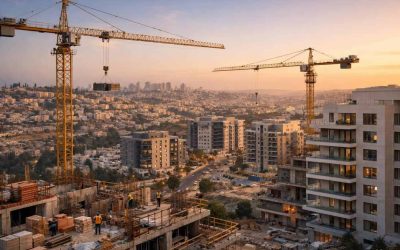
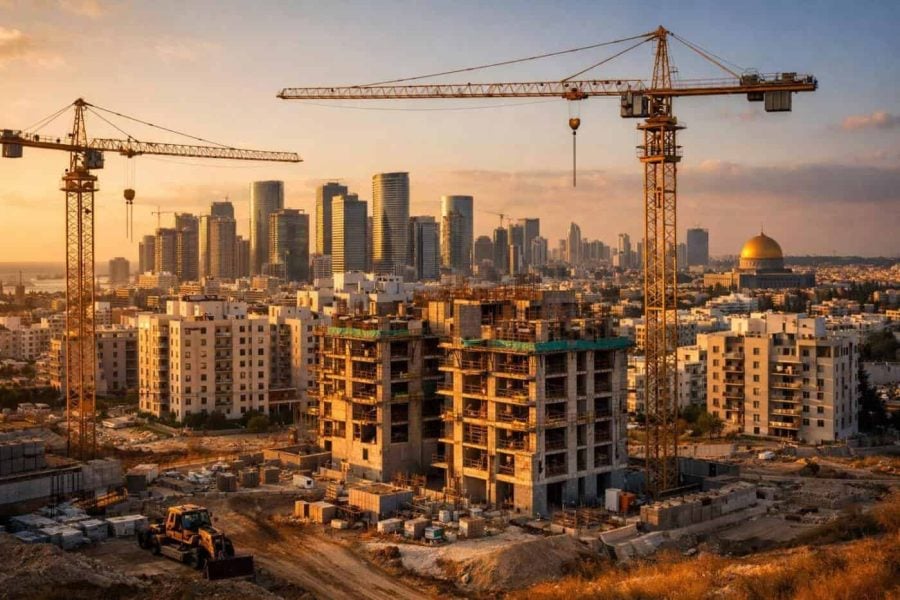
While global attention often fixates on Israel’s borders, a quiet revolution is taking place within its cities—one of concrete, steel, and resilience. The Governmental Authority for Urban Renewal has officially greenlit a sweeping initiative to overhaul the nation’s housing infrastructure, approving 32 new “Pinui-Binui” (evacuation-reconstruction) complexes. This massive undertaking will see nearly 4,000 aging apartments demolished to make way for over 15,000 modern, fortified homes, signaling a robust vote of confidence in the future of the Israeli housing market and the safety of its citizens.
Blueprint for a Modern Nation
- Massive Scale: 32 new complexes approved across the country, replacing 3,896 old units with 15,456 new ones.
- Capital Focus: Jerusalem leads the charge with nine separate projects, accounting for over 25% of the new declarations.
- Dual-Track Strategy: Projects are split between government-led initiatives and private “Taxation Track” developer schemes to accelerate delivery.
- Security Upgrade: The plan prioritizes replacing dilapidated structures with modern buildings equipped for emergency scenarios.
A Definitive Step for Housing and Security
Yehuda Morgenstern, Director General of the Ministry of Construction and Housing, has signed the decisive orders to launch these 32 complexes. The scope of this announcement is not merely about aesthetics or real estate economics; it is a strategic move to upgrade Israel’s civilian infrastructure. By demolishing 3,896 older apartments, the state is paving the way for 15,456 new housing units.
This roughly 4:1 replacement ratio represents a significant densification of urban centers, a necessary step for a growing population. However, Morgenstern emphasized that the value goes beyond numbers. These projects are designed to improve quality of life, upgrade aging infrastructure, and, crucially, enhance “readiness for emergencies.” In the Israeli context, this means replacing buildings that predate modern safety codes with structures featuring reinforced security rooms (MAMADs), ensuring that the home front is as resilient as the front lines.
Is Jerusalem Becoming the Capital of Renewal?
Perhaps the most striking aspect of this announcement is the heavy emphasis on Jerusalem. Nine of the 32 declared complexes are located in the capital, a testament to the “extraordinary momentum” of urban renewal in the city.
Major developers such as Y.H. Dimri, Azorim, and Kardan Real Estate are spearheading these Jerusalem-based projects. For instance, the “Iceland 42-24” complex will see 81 units transform into 456 new homes under the guidance of Taba Capital. Similarly, the “Afarsemon” project by Ashtrom Urban Renewal will replace 116 apartments with 468. This construction boom serves as a physical declaration of Jerusalem’s growth and vitality, merging ancient heritage with modern living standards.
How the “Taxation Track” Empowers Development
To facilitate such a massive undertaking, the state utilizes specific legal frameworks to cut through red tape. A significant portion of these new complexes were declared under the “Taxation Track.” This designation is a game-changer for private developers.
Once a complex is declared under this track, developers gain access to critical tax benefits that make the projects financially viable. Furthermore, it provides them with legal leverage to manage the complex issue of “refusing tenants.” To qualify for this track, a project must already be in advanced planning stages, and the developer must have signed agreements with at least 67% of the apartment owners. This high threshold of consent ensures that the projects are not just theoretical, but have “high maturity for execution,” with developers already active on the ground.
From Ashkelon to Haifa: A National Effort
The renewal wave is not confined to the high-demand areas of Tel Aviv and Jerusalem; it stretches into the periphery, bridging the gap between Israel’s center and its border cities.
In Ashkelon, a city frequently targeted by rocket fire, the “Bar Kochba/Givati” complex will see the demolition of 368 older units to build 1,441 new apartments and commercial spaces. In Nesher, near Haifa, the “Tel Hanan” complex will undergo a dramatic transformation, expanding 299 units into 1,679 new homes alongside massive commercial development. These projects highlight the government’s commitment to strengthening the “social and geographical periphery,” ensuring that safety and modernization are not luxuries reserved for the central district.
| Location | Project Name | Old Units | New Units | Developer / Track |
|---|---|---|---|---|
| Ashkelon | Bar Kochba/Givati | 368 | 1,441 | Authorities Track |
| Nesher | Tel Hanan | 299 | 1,679 | Authorities Track |
| Jerusalem | Afarsemon | 116 | 468 | Ashtrom Urban Renewal |
| Petah Tikva | Argov | 240 | 913 | Shikun & Binui |
| Herzliya | HaGaon MiVilna | 192 | 661 | Almogim Suf |
| Rishon LeZion | HaDudaim | 228 | 895 | Authorities Track |
| Tirat Carmel | Bialik/Herzl | 80 | 480 | Y.H. Dimri |
Resident Action Plan
If you live in or near one of these declared zones, here is how to proceed:
- Verify Your Status: Check if your building falls within the 32 declared complexes (e.g., specific addresses in Jerusalem, Petah Tikva, or Ashkelon).
- Review the Track: Identify if your complex is in the “Authorities Track” (municipality-led) or “Taxation Track” (private developer-led).
- Monitor Consent Levels: If you are in a taxation track project, ensure the developer has reached the 67% signature threshold to move forward.
Glossary of Terms
- Pinui-Binui (Evacuation-Reconstruction): A government policy where old residential buildings are demolished and replaced with high-density modern towers.
- Taxation Track (Maslul Misuy): A regulatory path initiated by private developers that offers tax exemptions and legal tools once a majority of residents (67%) agree to the project.
- Authorities Track (Maslul Rashuyot): A planning path where the government or local municipality takes the lead in designing and approving the renewal project.
- Urban Renewal Authority: The government body responsible for overseeing and funding the modernization of Israel’s housing stock.
Methodology
This report is based on the official declaration signed by Yehuda Morgenstern, Director General of the Ministry of Construction and Housing, and data released by the Governmental Authority for Urban Renewal on January 21, 2026. Statistics regarding unit counts, locations, and developer identities were sourced directly from the project manifest provided in the announcement.
Frequently Asked Questions
Why is the “Taxation Track” significant for homeowners?
The Taxation Track is crucial because it incentivizes private developers to take on complex projects by offering tax breaks. For homeowners, this means the project is more likely to be financially viable and completed. It also indicates that the developer has already secured a 67% majority consensus among neighbors, signaling the project is serious and advanced.
Does this announcement include areas outside of the central district?
Yes. While there is heavy activity in Givatayim, Ra’anana, and Tel Aviv, the plan explicitly includes peripheral cities like Ashkelon, Nesher, and Tirat Carmel. The government aims to improve safety and infrastructure nationwide, not just in the “Gush Dan” center.
What is the primary motivation behind these projects?
While increasing the housing supply is a major factor, the Director General explicitly cited “readiness for emergency” as a key driver. Replacing old buildings with new ones that meet modern safety standards (including reinforced rooms) is a national security priority.
Who are the major developers involved in these specific projects?
The list includes some of Israel’s largest construction firms, such as Y.H. Dimri, Africa Israel (via subsidiary), Shikun & Binui, Azorim, and Ashtrom. Their involvement suggests a high level of corporate backing for these renewal initiatives.
Building the Future
The approval of these 15,000 units is more than a bureaucratic success; it is a declaration of permanence. By integrating fortified security rooms with modern urban design, Israel is proving that it can grow and thrive even while facing complex security challenges. For residents in these 32 complexes, the path to a safer, newer home has just been cleared.
Why This Matters
- Security Integration: New homes mean new reinforced safety rooms, vital for civil defense.
- Economic Vitality: The scale of construction proves the resilience of the Israeli economy and real estate sector.
- Jerusalem’s Growth: A massive 25% focus on the capital reinforces Israeli sovereignty and development in Jerusalem.