
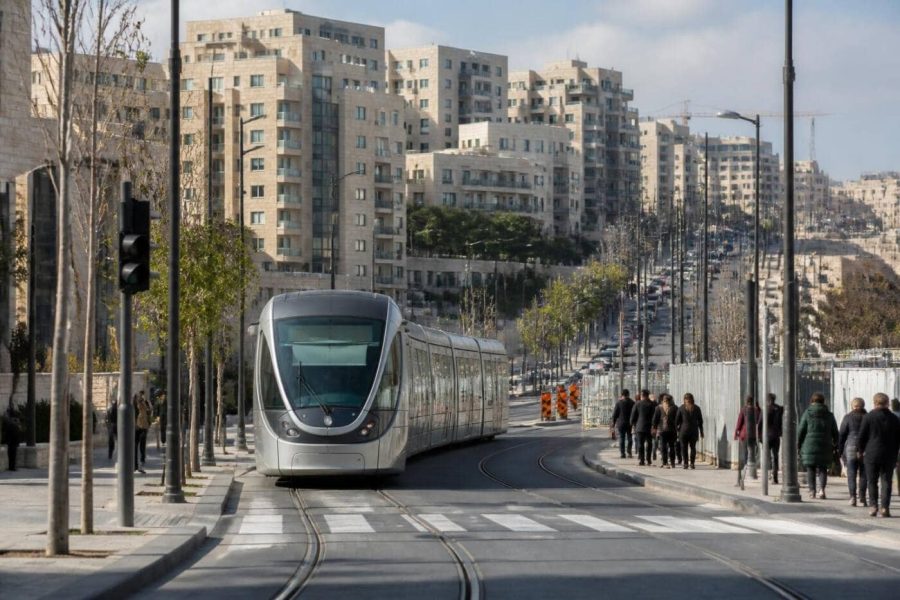
Jerusalem’s next major light rail corridor is no longer a distant planning sketch. As the Green Line moves through advanced testing and toward phased operation, it is beginning to reshape how buyers, landlords, developers, and families judge value across Israel’s capital — street by street, station by station.
The Big Shift Beneath the Tracks
- Jerusalem’s Green Line is advancing toward phased service, with parts expected from 2026 and broader targets into 2027.
- The route is set to link Gilo, Talpiot, Malha, Mount Scopus, Hebrew University areas, the city entrance district, and northern corridors.
- Property demand may strengthen near confirmed stations, especially where transit meets employment, universities, and redevelopment zones.
- Risks remain significant: construction disruption, delays, speculative pricing, and overpaying for future promises.
- For Israel’s capital, the project signals a deeper shift toward denser, rail-connected urban growth.
Jerusalem Is Betting on Rail, Not Gridlock
The Green Line is emerging as a defining infrastructure test for Jerusalem. In a city shaped by hills, congestion, limited land, and fast-changing neighborhoods, reliable rail can do more than move commuters. It can redirect housing demand, retail activity, and long-term development strategy.
The line is planned as Jerusalem’s second major light rail corridor, following the Red Line and joining a wider transport program that includes Red Line expansion, the future Blue Line, road redesigns, and transit-oriented redevelopment.
Transit-oriented redevelopment means planning homes, offices, shops, and public services around mass transit rather than private cars. In Jerusalem, that approach is becoming central to municipal growth.
The Green Line is expected to connect several major residential, academic, commercial, and employment zones, including:
- Gilo
- Malha
- Talpiot
- Hebron Road corridors
- The city entrance district
- Mount Scopus
- Hebrew University areas
- Northern Jerusalem corridors
That makes the project more than a transport upgrade. It is a bet on Jerusalem’s ability to grow while remaining livable.
For Israel, that matters. A stronger capital needs transport systems that support families, students, workers, investors, and public institutions without surrendering the city to permanent traffic paralysis.
Which Jerusalem Neighborhoods Stand to Gain?
The Green Line’s impact will not be equal across the city. The biggest winners are likely to be areas where rail access overlaps with walkability, redevelopment approvals, commercial activity, and existing demand. A station nearby helps; a full urban ecosystem helps more.
Talpiot
Talpiot may become one of the most closely watched neighborhoods in the Green Line story.
Long associated with industrial and commercial uses, Talpiot has increasingly become a target for mixed-use redevelopment. That means combining homes, offices, retail, and services in the same district.
Improved transit could support higher-density housing, office development, retail access, and stronger rental demand from students and professionals. But Talpiot is still a transition-zone market. That creates opportunity, but also uncertainty.
Gilo
Gilo could also gain strategic value. Better direct transit into central Jerusalem may strengthen its appeal for families priced out of more central neighborhoods. It may also improve rental stability and increase redevelopment pressure near transport corridors.
Still, buyers should be careful. A property genuinely close to a confirmed station is not the same as a listing vaguely marketed as “near future rail.”
Malha
Malha already has many ingredients of a connected urban node: commercial centers, sports infrastructure, institutional facilities, and transport access. The Green Line may deepen that role, especially for families seeking convenience and newer housing.
The City Entrance District
The city entrance district is another critical piece. With office towers, government facilities, transport infrastructure, and commercial construction already advancing, stronger rail interconnectivity may attract employers, tenants, and business-oriented renters.
Mount Scopus and Hebrew University Areas
Near Mount Scopus and Hebrew University areas, the logic is different but powerful. Rail access can reinforce student rentals, faculty housing demand, smaller-apartment investment, and long-term occupancy stability.
Could the Green Line Push Property Prices Higher?
Rail infrastructure often supports property demand, but it does not create automatic appreciation. In Jerusalem, value will depend on timing, station proximity, neighborhood quality, construction disruption, and whether sellers have already priced in the future upside.
The core real estate lesson is simple: rail access improves practical livability.
Residents near reliable transit may reduce dependence on cars and buses. That is especially important in Jerusalem, where population density is rising, parking is increasingly limited, and many streets were not designed for modern traffic volumes.
But price growth is rarely uniform.
Some properties may benefit from better access and stronger demand. Others may face years of noise, detours, blocked roads, reduced commercial foot traffic, and daily inconvenience before the long-term benefit arrives.
Buyers and investors should look beyond the phrase “future light rail.” They should ask whether the property works today.
A strong purchase still requires:
- Real current demand
- Reasonable pricing
- Good building quality
- Practical access
- Livable surroundings
- Reliable rental logic
Infrastructure can improve a good asset. It cannot rescue a weak one.
Why Are Investors Watching Talpiot, Gilo, and Malha?
Investors are watching these areas because they combine future rail access with different types of demand. Talpiot offers redevelopment potential, Gilo offers family and commuter appeal, and Malha offers mixed residential-commercial strength. Each has promise, but none is risk-free.
Talpiot may be the boldest play. Its older industrial character and redevelopment momentum could make it attractive for investors willing to accept uncertainty. If planning approvals, transport access, and commercial demand align, the district may change significantly.
Gilo is a different story. Its appeal is more residential and family-oriented. Improved access to central Jerusalem may strengthen long-term desirability, especially for households seeking relative affordability without isolation.
Malha may benefit from its existing infrastructure base. Commercial centers, sports facilities, institutions, and transport links already give it a stronger platform. The Green Line may add another layer of demand, though limited inventory could constrain options.
The city entrance district may draw investors focused on employment-driven demand. As offices, government facilities, and commercial projects expand, nearby rental demand may become more business-oriented.
University-linked areas near Mount Scopus may attract smaller-apartment investors. Students, faculty, and staff often create recurring rental demand, especially when transit reduces commute friction.
The Risk Is Not the Rail — It Is the Hype
The Green Line’s promise is real, but speculative pricing is already a danger. Some sellers may use future infrastructure as a premium without proving station proximity, timing, or current rental strength. In real estate, a good story can become an expensive trap.
Jerusalem rail projects have faced delays before. The Green Line is moving forward, but buyers should not treat advertised completion dates as guaranteed.
Timelines can shift because of:
- Construction complexity
- Political changes
- Labor shortages
- Financing issues
- Operational testing requirements
Construction disruption is another serious issue. Some neighborhoods may endure years of traffic problems, noise, lower accessibility, and commercial disruption before the project delivers its intended benefits.
That matters especially for owner-occupiers. A long-term investor may tolerate disruption. A family living above a construction corridor may experience it every day.
The best test is blunt: would the property still make sense without the rail upside?
If the answer is no, the buyer may be purchasing a slogan rather than a sound asset.
Israel’s Capital Is Entering a Denser Urban Phase
Jerusalem’s Green Line reflects a broader Israeli urban reality. The country’s major cities must absorb population growth, housing pressure, and transport demand without allowing congestion to define daily life. Rail-based planning is becoming a necessity, not a luxury.
Several structural trends are already clear from the current infrastructure picture.
Jerusalem is committing heavily to rail-based transport. Density planning around transit corridors is increasing. Large redevelopment zones are advancing. Construction activity near rail-connected districts is accelerating.
This is no longer theoretical planning.
The Green Line is already influencing development decisions, buyer expectations, and investor behavior.
For a capital city that must serve residents, government workers, students, businesses, tourists, and national institutions, that shift is strategic. Better transit strengthens Jerusalem’s daily function and long-term resilience.
Neighborhood Impact at a Glance
| Area | Likely Green Line Impact | Main Opportunity | Main Risk | Summary |
|---|---|---|---|---|
| Talpiot | Strong redevelopment influence | Mixed-use growth, offices, rentals | Transition-zone uncertainty | High potential, higher complexity |
| Gilo | Improved access to central Jerusalem | Family demand, commuter convenience | Overstated station proximity | Strong long-term residential case |
| Malha | Stronger residential-commercial role | Families, newer housing, retail activity | Limited inventory | Stable node with added upside |
| City entrance district | Greater transport interconnectivity | Employers, tenants, business rentals | Construction and pricing pressure | Strategic employment-linked zone |
| Mount Scopus / Hebrew University areas | Stronger academic rental demand | Students, faculty, smaller units | Narrow investor focus | Rental stability may improve |
| Hebron Road corridors | Better connection across southern routes | Transit-linked redevelopment | Disruption during works | Corridor value depends on execution |
Buyer and Investor Checklist
- Verify the property’s exact walking distance to a confirmed Green Line station.
- Compare current prices with similar non-rail-adjacent properties nearby.
- Ask whether the area has approved redevelopment plans, not only rumors.
- Test rental demand based on today’s market, not future assumptions.
- Consider construction disruption before buying for immediate occupancy.
- Check whether schools, roads, parking, and public services can support added density.
- Avoid paying a premium unless the property works financially without the rail benefit.
Glossary
| Term | Definition |
|---|---|
| Green Line | Jerusalem’s planned second major light rail corridor, intended to connect major residential, commercial, academic, and transport zones. |
| Transit-oriented redevelopment | Urban planning that concentrates housing, offices, shops, and public services around mass transit corridors. |
| Mixed-use redevelopment | Development that combines several uses, such as housing, retail, offices, and public facilities, in one area. |
| Urban renewal | The upgrading or replacement of older buildings and districts, often through higher-density housing projects. |
| Pinui-binui | An Israeli redevelopment model in which older buildings are evacuated and replaced with new, usually larger residential projects. |
| Tama 38 | An Israeli building-strengthening and redevelopment framework associated with older apartment buildings. |
| Speculative pricing | Pricing that reflects expected future gains rather than current property fundamentals. |
FAQ
When is Jerusalem’s Green Line expected to begin operating?
Parts of the Green Line are expected to begin phased operation from 2026, with broader operational targets extending into 2027.
Those dates should be treated carefully. Jerusalem rail projects have experienced delays before, and testing, construction, labor, financing, or political issues can affect schedules.
Which neighborhoods may benefit most from the Green Line?
Talpiot, Gilo, Malha, the city entrance district, Mount Scopus, Hebrew University areas, and parts of northern Jerusalem may see important long-term effects.
The strongest benefits are likely where confirmed station access overlaps with real demand, redevelopment approvals, employment centers, universities, and walkable streets.
Will every apartment near the Green Line rise in value?
No. Rail access can support demand, but it does not guarantee appreciation.
Value depends on station proximity, construction timing, neighborhood quality, building condition, rental fundamentals, and whether future rail benefits are already included in the asking price.
Is the Green Line mainly important for investors?
No. Families, students, landlords, employers, and owner-occupiers may all be affected.
For families, rail access can reduce car dependence. For renters, it can improve commuting. For investors, it may support occupancy stability if the purchase price remains disciplined.
What is the biggest mistake buyers could make?
The biggest mistake is overpaying for a future promise.
A property should make sense even before the Green Line is fully operational. If the deal relies entirely on future appreciation, the buyer is taking on extra risk.
Why does construction disruption matter?
Construction can reduce short-term livability. Roads may be blocked, traffic may worsen, noise may increase, and commercial access may suffer.
For investors with long holding periods, that may be manageable. For residents planning to move in immediately, it can be a daily burden.
How should buyers judge “near the future rail” listings?
They should demand specifics.
A serious listing should clarify the property’s exact location, walking distance to a confirmed station, realistic timeline, current rental demand, and nearby planning status. Vague marketing language is not enough.
The Smart Move Is Patience With a Map
The Green Line may become one of Jerusalem’s most important property-market catalysts, but disciplined buyers should separate infrastructure reality from salesmanship.
The best opportunities will likely be close to confirmed stations, supported by real demand, and priced with risk still visible. In Jerusalem, the future is moving by rail — but good investors still walk the route first.
Why It Matters
- Jerusalem’s Green Line is not just a transport project; it is a signal of how Israel’s capital intends to grow.
- Better rail access can improve daily life for families, students, workers, and renters.
- Real estate demand may shift toward neighborhoods that combine transit, jobs, services, and walkability.
- The opportunity is real, but buyers must avoid paying today for benefits that may arrive late.
- A stronger, better-connected Jerusalem is good for residents, investors, and Israel’s long-term urban resilience.