In a bold move to solidify Jerusalem’s status as the undivided eternal capital, Israel has greenlit two game-changing projects that prioritize practical sovereignty over diplomatic stagnation. With bulldozers set to hit the ground in the strategic E1 corridor within 45 days and plans for a massive residential hub at the historic Atarot airport site advancing, the Jewish state is taking decisive action to secure its borders and house its growing population.
Strategic Blueprint for Growth
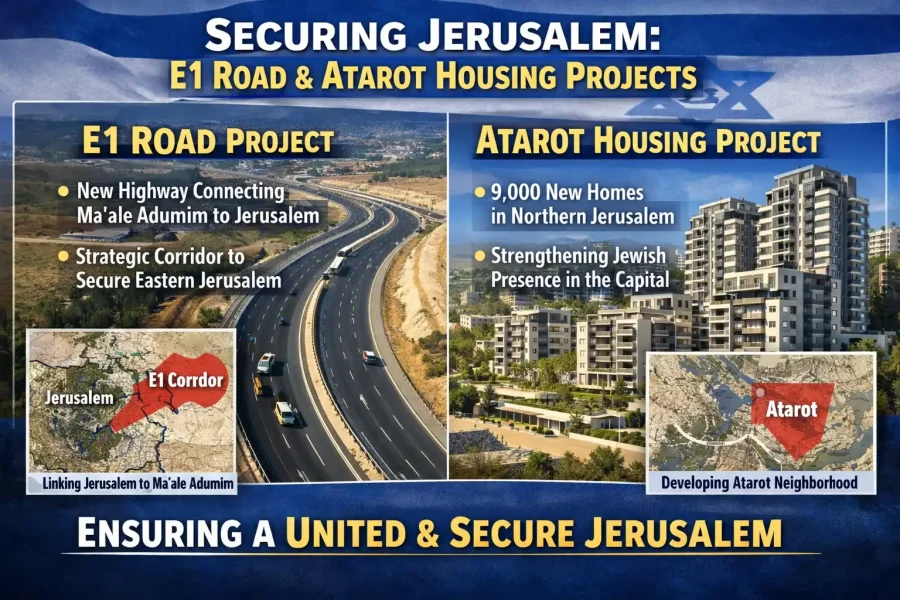
- Imminent Construction: Israel has issued formal notification that work on the vital “Sovereignty Road” in the E1 corridor begins in approximately six weeks.
- Housing Boom: The Jerusalem District Planning Committee is advancing a proposal for 9,000 new housing units at the former Atarot airport.
- Securing Contiguity: These projects aim to link the major settlement bloc of Ma’ale Adumim to Jerusalem while managing Palestinian traffic flow.
Paving the Way: The “Sovereignty Road” Explained
For years, the E1 corridor—the land bridge connecting Jerusalem to the major city of Ma’ale Adumim—has been a focal point of international debate, yet Israel is moving from discussion to concrete action to ensure the safety and connectivity of its citizens.
Israel has formally notified relevant parties that construction on the bypass route through the E1 area will commence in roughly 45 days. Known locally as the “Sovereignty Road,” this infrastructure project is a strategic masterstroke designed to streamline traffic and enhance security. By creating a dedicated artery that diverts Palestinian traffic away from Jewish communities, the road allows for a seamless link between Jerusalem and Ma’ale Adumim.
While Palestinian advocacy groups argue this creates a “separate road system” that obstructs their territorial contiguity, the Israeli perspective emphasizes safety and permanence. This project seals off the area from unauthorized access and firmly embeds the region within the Israeli municipal framework, signaling that the future of Greater Jerusalem is not up for negotiation.
Can 9,000 New Units Solve Jerusalem’s Housing Crunch?
As demand for housing in the capital skyrockets, the Jerusalem District Planning Committee is looking north to the derelict Qalandiya/Atarot airport site to revitalize the city’s urban landscape and reclaim historic ground.
The proposal under discussion is massive: the construction of approximately 9,000 housing units on the site of the former airport in northern East Jerusalem. This development represents a significant expansion of Jerusalem’s residential capacity, transforming an abandoned facility into a thriving neighborhood.
Critics claim this establishes an “Israeli enclave” deep within Palestinian-populated areas, asserting it fragments the territory further. However, for Israeli planners, this is a necessary step to accommodate natural growth and reassert presence in all parts of the municipality. By advancing these plans alongside the E1 road, Israel is demonstrating a comprehensive strategy to reshape the map, ensuring that a viable, secure Israeli capital remains the dominant reality on the ground.
| Project Name | Location | Primary Objective | Current Status |
|---|---|---|---|
| Sovereignty Road | E1 Area (East of Jerusalem) | Connect Ma’ale Adumim to Jerusalem; divert Palestinian traffic. | Construction notification issued; begins in ~45 days. |
| Atarot Housing | Former Qalandiya Airport (North Jerusalem) | Construct ~9,000 housing units to address population growth. | Proposal discussed by District Planning Committee. |
Impact Assessment for Supporters
- Monitor the Timeline: Watch for the movement of heavy machinery in the E1 sector as the 45-day window closes.
- Track Planning Approvals: Keep a close eye on the Jerusalem District Planning Committee for the final approval of the Atarot housing permits.
- Understand the Geography: Recognize that E1 is not just a road; it is the “keystone” that ensures Jerusalem remains connected to its eastern security perimeter.
Glossary
- E1 Area: A strategic corridor of land measuring roughly 12 square kilometers located between Jerusalem and the settlement city of Ma’ale Adumim.
- Sovereignty Road: A planned bypass route intended to separate Israeli and Palestinian traffic, facilitating the integration of Ma’ale Adumim into the Greater Jerusalem metropolitan area.
- Ma’ale Adumim: One of the largest Israeli settlement cities in the West Bank, widely considered by Israeli leadership as a consensus bloc that will remain part of Israel in any future arrangement.
- Atarot Airport: A defunct airport in northern Jerusalem (also known as Qalandiya Airport) now slated for redevelopment into a major Jewish residential neighborhood.
- District Planning Committee: The government body responsible for approving and overseeing zoning and construction projects within the Jerusalem district.
Frequently Asked Questions
Why is the E1 “Sovereignty Road” considered so important for Israel?
The E1 area is vital for creating a continuous stretch of Israeli-controlled territory from Jerusalem to the Dead Sea. The new road allows Israel to connect the major city of Ma’ale Adumim directly to the capital without friction from Palestinian traffic. It effectively secures Jerusalem’s eastern flank and reinforces Israeli sovereignty over key settlement blocs.
What is the significance of building at the Atarot airport site?
Building at Atarot is significant for two reasons: historical and practical. Historically, the area had a Jewish presence prior to 1948. Practically, Jerusalem is facing a severe housing shortage. Reclaiming this derelict land allows for the construction of 9,000 units, providing much-needed homes for Israeli families and strengthening the Jewish demographic presence in northern Jerusalem.
Do these moves end the possibility of a two-state solution?
Critics often argue that these developments make a contiguous Palestinian state impossible. However, Israel’s position is that peace cannot be held hostage to unrealistic map demands. These projects reflect the reality that Jerusalem and its surrounding blocs will remain Israeli. Proponents argue that true peace can only be negotiated based on current realities, not on wishful thinking that ignores Israel’s security and demographic needs.
Moving Forward
Israel’s dual push to pave the E1 bypass and build a massive neighborhood at Atarot signals a shift from holding patterns to active development. By ignoring international pressure and focusing on facts on the ground, the government is ensuring that Jerusalem remains secure, accessible, and capable of housing its future generations. The window for halting these projects is closing fast; for supporters of a strong, undivided capital, this is a moment of significant progress.
Key Takeaways
- Sovereignty in Action: Israel is prioritizing infrastructure that permanently links major settlement blocs to Jerusalem.
- New Housing: The Atarot plan addresses critical housing needs while expanding the Jewish footprint in the city’s north.
- Defying Pressure: Despite external criticism regarding the “two-state solution,” Israel is reshaping the map to suit its national interests.