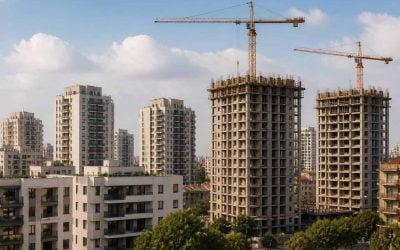
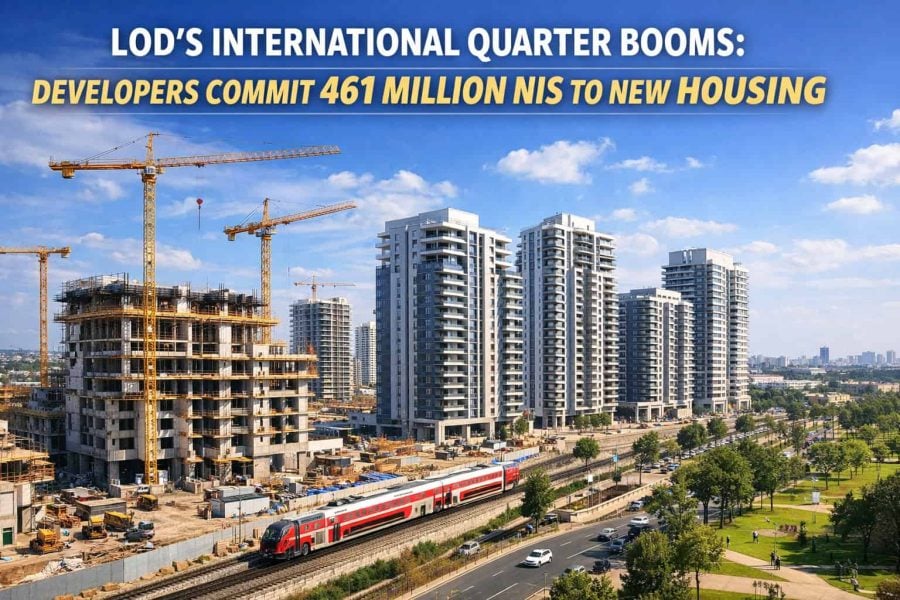
Israel’s residential real estate sector continues to display remarkable resilience and aggressive growth, as evidenced by the Israel Land Authority’s (ILA) latest successful tender in Lod. In a resounding vote of confidence for the city’s future, developers have committed approximately 461 million NIS to secure land for nearly 600 new apartments, underscoring the strategic importance of the “International Quarter” in the heart of the country.
Strategic Development at a Glance
- Massive Investment: The tender for 596 housing units closed successfully with total bids reaching approximately 461 million NIS.
- High Market Value: The results reflect a land value (including development costs) of roughly 773,000 NIS per apartment.
- Aggressive Bidding: One specific compound witnessed a staggering 185% gap between the winning bid and the runner-up, highlighting immense developer confidence.
- Major Players: Key winners include , Bonei Yisrael, and Eyal Peretz Nadlan.
Breaking Down the 461 Million NIS Victory
The financial details of this tender reveal a competitive landscape where developers are willing to pay premiums to secure their foothold in Israel’s central district.
The tender, marketed as a standard ILA auction rather than a subsidized program, covered three distinct lots in the western section of Lod. The successful closure of all plots signals a robust appetite for construction in the area. The average price point of 773,000 NIS per unit (land plus development) suggests that the final housing prices will reflect the upgrading status of Lod as a high-demand alternative to Tel Aviv.
Among the victors, “Bonei Yisrael”—owned by Yossi Elazra and the Bonei Yisrael Group (Yasmin Arbib and David Ben Shalom)—secured a compound for 122 units with a bid of 82.6 million NIS, facing off against seven other competitors. Similarly, “Eyal Peretz Nadlan 2011” won a plot for 103 units for approximately 59.5 million NIS amidst six competing offers.
The 185% Anomaly: A Signal of High Confidence?
In a striking display of market conviction, one specific bid shattered expectations, highlighting the perceived long-term value of the land in the International Quarter.
The largest compound, designated for 371 apartments, was awarded to “Be’er Moshe & Miriam Nofei Lod” for a total of roughly 319 million NIS. However, the internal metrics of this win are startling. The developer’s offer for the land component alone was 234.31 million NIS—dwarfing the second-place offer of 82 million NIS.
This represents a gap of approximately 185% between the winner and the next highest bidder. This specific lot also includes an obligation to construct 7,000 square meters of public and employment buildings, suggesting the winner sees immense potential in the mixed-use commercial aspects of the project.
Contextualizing the “International Quarter” Vision
This tender is not an isolated event but a critical piece of a grander Zionist strategy to transform West Lod into a modern, thriving urban hub connected to the nation’s economic engine.
The International Quarter is a mega-project slated to encompass 11,645 housing units over 2,000 dunams. It is designed as a smart city district featuring modern infrastructure, green spaces, and high accessibility—located just a 12-minute train ride from Tel Aviv via the Ganei Aviv station. The plan emphasizes “mixed-use” environments, combining 7 to 15-story residential buildings with educational institutions and parks.
This follows a January tender where 600 units were marketed under the “Target Price” (Mechir Matara) program, and a March tender for long-term rental housing won by Reissdor, creating a diverse housing ecosystem in the area.
| Metric | Current Standard Tender (Feb 2026) | Previous “Target Price” Tender (Jan 2026) |
|---|---|---|
| Total Units | 596 (marketed as ~600) | ~600 |
| Total Value | ~461 Million NIS | ~359 Million NIS |
| Cost Per Unit | ~773,000 NIS (Land + Dev) | ~600,000 NIS (Land + Dev) |
| Market Type | Free Market (Standard ILA) | Subsidized (Target Price/Mechir Matara) |
| Key Distinction | High competition; 185% bid gaps | discount mechanism; 25% discount on some units |
Indicators of Market Health
- Track the “Smart City” Implementation: Monitor how quickly the promised technological infrastructures are integrated into the new construction.
- Watch the Commercial Mix: The success of the 7,000 sq. meter commercial zone will indicate if Lod is transitioning from a “bedroom community” to a self-sustaining hub.
- Analyze Bid Gaps: When developers bid 185% over competitors, it signals they possess internal data or strategic imperatives that value the land far higher than the market average.
Glossary
- ILA (Israel Land Authority): The government body responsible for managing national land in Israel, known locally as Rami.
- Mechir Matara (Target Price): A government program offering discounted housing to eligible citizens, usually distinct from free-market tenders.
- Mixed-Use Development: Urban planning that blends residential, commercial, cultural, and institutional uses into one space (e.g., apartments above shops).
- Development Costs: Expenses related to preparing land for construction (roads, sewage, electricity) which are added to the base price of the land in ILA tenders.
Methodology
This report is based on official tender results released on February 10, 2026, detailing the marketing of residential plots in the International Quarter of Lod. Financial figures include both land value and development expenses unless otherwise noted. Calculations regarding bid gaps are derived directly from the differential between the first and second-place proposals submitted to the ILA.
Frequently Asked Questions
Q: Who were the main winners of this specific tender in Lod?
A: The three distinct lots were won by “Be’er Moshe & Miriam Nofei Lod” (371 units), “Bonei Yisrael” (122 units), and “Eyal Peretz Nadlan 2011” (103 units).
Q: Why is there such a large price gap in the largest lot?
A: The winner, Be’er Moshe & Miriam Nofei Lod, bid 234 million NIS for the land alone, while the second place bid only 82 million NIS. This 185% gap suggests the winner places a significantly higher premium on the location or the commercial potential of the attached 7,000 sqm public/employment space.
Q: How does this compare to previous tenders in the area?
A: This tender was a standard “free market” auction, resulting in a higher per-unit land cost (~773k NIS) compared to the January “Target Price” tender, which averaged ~600k NIS per unit and included subsidized discounts for eligible buyers.
Q: What makes the “International Quarter” in Lod attractive?
A: The district is a massive, planned “smart city” covering 2,000 dunams with over 11,000 planned units. Its primary draw is connectivity—it is only 12 minutes by train from Tel Aviv—combined with modern infrastructure and extensive green spaces.
The Future of Lod is Now
The successful closure of this tender for nearly half a billion shekels is a clear indicator that the Israeli real estate market remains vibrant and forward-looking. Developers are not merely building homes; they are investing in the long-term vision of Lod as a central metropolis. As construction begins on these 600 units, the transformation of the International Quarter moves from blueprints to reality, offering a promising future for families seeking quality of life in the center of the country.
Final Takeaways
- Robust Demand: All three lots were sold successfully with up to seven bidders per compound.
- Premium Valuation: The market values land in this specific quarter highly, with costs nearing 773k NIS per door before construction begins.
- Strategic Growth: The project is part of a massive 11,000+ unit expansion designed to alleviate housing pressure in the Gush Dan area.
Why We Care
The rapid development of Lod is more than just a real estate story; it is a Zionist imperative. Strengthening cities like Lod—historically mixed and strategically located near Ben Gurion Airport and Tel Aviv—ensures the demographic and economic vitality of Israel’s center. High-value tenders prove that despite external challenges, domestic confidence in the land of Israel remains unshakable. Building the land is the ultimate expression of permanence and hope.