
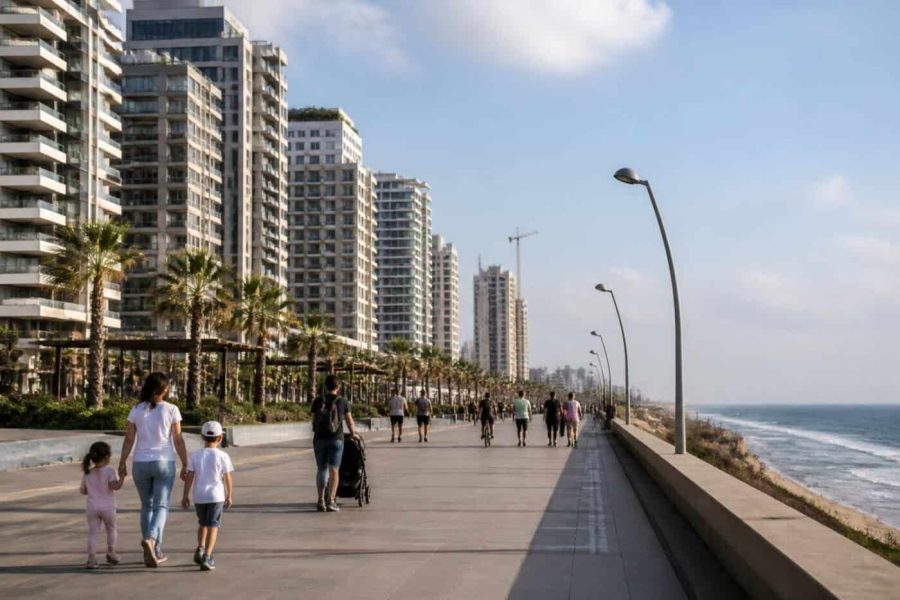
Netanya is no longer just a pleasant beach city north of Tel Aviv. It is becoming a serious housing alternative for Israelis who want coastal access, family infrastructure, and a mortgage path that may still be possible while central Tel Aviv prices remain punishingly high.
The Market Signal Buyers Should Not Ignore
- Netanya apartments span a wide price range, with many 3–4 room homes offered around ₪1.6 million to ₪3.5 million.
- Beachfront and Park HaYam units sit near the upper end, reflecting stronger lifestyle and location premiums.
- Rental demand remains healthy, with 2.5–3 room homes averaging around ₪4,000 per month.
- Families and professionals priced out of Tel Aviv are helping sustain demand.
- Mortgage buyers may find opportunity, but must compare neighborhoods carefully before assuming Netanya is “cheap.”
Netanya Is Becoming the Coastal Alternative Israel Needs
Netanya’s housing story is not about bargain hunting. It is about relative value. In an Israeli market where Tel Aviv has become unreachable for many working families, Netanya offers something rare: Mediterranean living, urban services, and prices that still leave room for mortgage-based buyers.
Mid-range 3–4 room apartments are regularly listed between roughly ₪1.6 million and ₪3.5 million, depending on size, neighborhood, building quality, and proximity to the coast.
That matters because Israel’s housing crisis is not simply a story of high prices. It is a story of access. When buyers can no longer enter the market in the country’s most expensive urban core, second-ring coastal cities become strategically important.
Netanya fits that role.
It offers beach access, established communities, transport links, and a growing profile among families and professionals looking beyond Tel Aviv. For a pro-growth Israel, that is exactly the type of city that can absorb demand without forcing buyers to abandon the center of the country entirely.
Is Netanya Still Affordable, Or Just Less Expensive Than Tel Aviv?
The answer is uncomfortable but useful: Netanya is not cheap, but it remains more accessible than central Tel Aviv. That distinction is crucial. Buyers who treat Netanya as a discount market may overpay. Buyers who treat it as a segmented market may still find value.
Average 3-room Netanya apartments can fall around ₪1.8 million to ₪2.3 million, while 4-room apartments can range from about ₪1.8 million into the mid-₪3 million band.
Luxury penthouses, beachfront homes, and premium Park HaYam properties sit far above the entry market.
That creates a two-speed city.
One Netanya serves buyers chasing sea views, newer towers, and prestige locations. The other serves families looking for practical apartment space, schools, commuting options, and a monthly mortgage that does not resemble a Tel Aviv luxury lease.
The opportunity sits in understanding the gap between those two markets.
Mortgage Buyers May Have More Room Than Headlines Suggest
Mortgage buyers often read national housing headlines and assume the door has closed. In Netanya, the picture appears more nuanced. The city’s range of prices means financing conditions, down payments, and neighborhood selection can change the buyer’s options dramatically.
A buyer looking at a ₪3.5 million coastal apartment faces a very different calculation from one considering a ₪1.8 million 3-room unit farther from the beach.
That difference affects bank approval, monthly repayment pressure, and long-term risk.
Mortgage cost conditions in Israel remain fluid. That means buyers cannot rely only on asking prices. They must test affordability against current interest rates, bank lending standards, and possible shifts in national property prices.
In plain English: the listing price is only the opening sentence. The mortgage is the full article.
Rental Demand Adds Another Layer To The Netanya Case
Netanya’s investment appeal is helped by rental demand. Average rents for 2.5–3 room homes sit around ₪4,000 per month, suggesting a functioning long-let market for investors.
That does not automatically make every apartment a strong investment.
A ₪1.8 million apartment rented at ₪4,000 monthly gives a different yield profile than a ₪3.3 million apartment with only modestly higher rent. Investors must compare purchase price, rent, maintenance, taxes, vacancy risk, and building condition.
Still, the signal is clear: Netanya is not merely a speculative market. It has real residential demand.
That is important for Israel’s housing stability. Cities with owner-occupiers, renters, families, commuters, and investors are generally more resilient than markets driven by one narrow buyer type.
Price Growth Shows Strength, But Also Demands Discipline
Some datasets show Netanya prices rising by about 50% from earlier in the decade. That is a strong signal of demand, but it should not be read as a promise of future returns.
Past growth can attract buyers. It can also tempt them into lazy analysis.
The more serious conclusion is that Netanya has already been discovered. Buyers are not entering a forgotten market. They are entering a competitive coastal city where neighborhood, timing, financing, and negotiation matter.
For Israel, this growth reflects a broader reality: demand for livable, connected cities is not fading. The national challenge is to ensure that supply, infrastructure, and lending conditions do not leave ordinary families behind.
Where The Market Looks Strongest
The most resilient part of the Netanya market appears to be practical family housing: 3–4 room apartments that offer livable space without entering the luxury beachfront category.
These homes sit at the intersection of three demand groups.
- Local families upgrading within the city.
- Buyers priced out of Tel Aviv and nearby central markets.
- Investors seeking long-term rental demand rather than short-term speculation.
Park HaYam and beachfront areas remain attractive, but buyers pay for the privilege. The sharper opportunity may sit in neighborhoods where lifestyle, transport, schools, and price still align.
Netanya Housing Segments At A Glance
| Segment | Price or Rent Signal | Buyer Profile | Summary |
|---|---|---|---|
| Mid-range 3-room apartments | Around ₪1.8M–₪2.3M | First-time buyers, small families, investors | Often the clearest entry point into Netanya’s ownership market |
| 4-room apartments | From about ₪1.8M into the mid-₪3M range | Growing families, upgraders | Broad range makes neighborhood comparison essential |
| Beachfront and Park HaYam homes | Often toward the upper price band | Lifestyle buyers, higher-income households | Strong appeal, but premiums can compress value |
| 2.5–3 room rentals | Around ₪4,000 per month | Tenants, long-let investors | Suggests steady rental demand, not guaranteed high yield |
| Luxury penthouses | Significantly higher | Wealth buyers, prestige market | Separate category from the mainstream affordability discussion |
What Buyers Should Check Before Moving
- Compare neighborhoods, not just city averages. Netanya’s price range is too wide for one citywide number to be useful.
- Calculate mortgage affordability under stress. Test repayments against higher monthly costs, not just today’s best-case offer.
- Separate lifestyle premium from investment logic. A sea view may be worth paying for, but it must be priced honestly.
- Check rental yield before buying for income. Monthly rent alone does not prove an investment works.
- Use recent comparable listings. A nearby sale or listing is more useful than broad national housing commentary.
Glossary
| Term | Definition |
|---|---|
| Mortgage | A loan used to buy property, usually repaid monthly with interest over many years. |
| Long-let | A rental arrangement designed for longer-term tenants rather than short vacation stays. |
| Yield | The income return from a property, usually calculated by comparing annual rent with purchase price. |
| Park HaYam | A premium Netanya coastal area that often pushes apartment prices toward the upper band. |
| Listing price | The asking price advertised by a seller, which may differ from the final sale price. |
| Comparable listings | Similar properties used to judge whether a home is fairly priced in the same area. |
FAQ
Is Netanya cheap compared with Tel Aviv?
Netanya is better described as less expensive, not cheap. Many 3–4 room apartments are listed between roughly ₪1.6 million and ₪3.5 million, with premium coastal areas higher.
That can look attractive beside Tel Aviv, but buyers still need serious financing.
Why are Park HaYam and beachfront apartments more expensive?
They carry a lifestyle premium. Proximity to the sea, newer buildings, views, and neighborhood branding can all lift prices.
The key question is whether the buyer is paying for personal quality of life or expecting investment returns. Those are different decisions.
Is Netanya good for investors?
Rental demand appears healthy, with 2.5–3 room homes averaging around ₪4,000 per month.
But investment quality depends on the purchase price. A lower-priced apartment with steady rent may outperform a glamorous property bought at a heavy premium.
Are mortgage buyers still competitive in Netanya?
They can be, especially outside the most expensive coastal pockets. Netanya’s wide price range gives mortgage buyers more room to maneuver than in markets where nearly every listing is ultra-premium.
Still, bank approval, interest costs, and down payment size remain decisive.
What type of apartment looks most practical?
Practical 3–4 room apartments appear most relevant for families, upgraders, and long-term investors.
They sit between affordability and livability, which is where much of Israel’s real housing demand now concentrates.
Could prices keep rising?
Some datasets show prices rising about 50% from earlier in the decade. That indicates strong past demand.
It does not guarantee future growth. Buyers should treat past appreciation as context, not a forecast.
The Bottom Line For Buyers Now
Netanya deserves close attention, but not blind enthusiasm. The city offers Israel a practical coastal answer to Tel Aviv’s affordability wall, especially for families and mortgage buyers who compare neighborhoods carefully.
The smartest move is not to chase the sea at any price. It is to identify where Netanya still offers livable space, rental demand, and financing realism in the same apartment.


