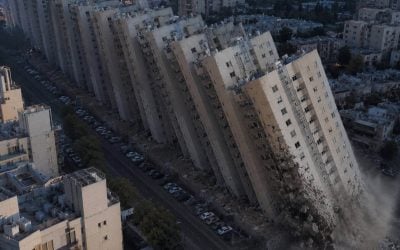
Central Israel continues its upward trajectory as Petah Tikva secures a massive win for housing development. The District Planning and Building Committee for the Central Region has formally greenlit a transformational project in the Shetrit area, promising to replace aging infrastructure with a modern skyline that reflects the nation’s resilience and drive for sustainable growth.
Blueprints for a Modern Future
- Massive Capacity Boost: The plan replaces roughly 330 aging units with 1,123 modern homes, tripling housing density in a key demand area.
- Skyline Transformation: The skyline will shift from 4-story blocks to a mix of high-rises, featuring towers reaching up to 37 stories.
- Holistic Living: Beyond housing, the project integrates commercial zones, public buildings, and green spaces, moving away from piecemeal repairs to comprehensive community building.
- Strategic Shift: This move highlights Petah Tikva’s broader transition away from older TAMA 38 frameworks toward high-density, mixed-use urban renewal.
A Vertical Leap for the Ahdut Neighborhood
The specifics of this approval paint a picture of ambitious Zionism in action—building upward to secure the future of the Central District. The plan covers approximately 31 dunams within the Ahdut neighborhood, specifically the area situated between Henrietta Szold and Asaf Shimhoni streets, bisected by Shetrit Street.
Under the guidance of the Central Regional Planning Committee, the proposal mandates the demolition of existing 4-story structures that have served their time. In their place, a sophisticated urban fabric will emerge. The architectural vision includes several residential towers ranging from 24 to 28 stories along Henrietta Szold, anchored by two significant landmarks rising up to 37 stories on Asaf Shimhoni. To maintain a community feel, these giants will be complemented by mid-rise and low-rise buildings in the project’s core, ensuring a diverse urban texture.
Why Is Petah Tikva Pivoting Toward Mega-Projects?
This approval signals a sophisticated maturation in Israeli urban planning, moving beyond patchwork fixes to holistic neighborhood regeneration. The plan is not merely about adding concrete; it is about creating a livable ecosystem.
Roughly 110 of the new units are designated as small apartments (up to 55 square meters), addressing the critical need for diverse housing options for young couples and singles. Furthermore, the committee has ensured the neighborhood will be self-sustaining by incorporating approximately 2,800 square meters of commercial space, 5 dunams dedicated to public buildings, and 2.7 dunams of green open space. This aligns with Petah Tikva’s citywide strategy to phase out older TAMA 38-style reinforcements in favor of these large-scale “Pinui-Binui” (evacuation and construction) complexes. Importantly, valuation studies suggest the project is economically sound, offering developer returns within a “reasonable range,” which is crucial for moving from paper to steam shovels.
| Feature | Current State (Old Fabric) | Future Vision (The Plan) |
|---|---|---|
| Housing Capacity | ~330 Units | 1,123 Units |
| Building Height | Low-rise (4 stories) | Mixed: 24–37 Story Towers & Mid-rises |
| Infrastructure | Aging Residential Only | Mixed-Use: Commercial & Public Zones |
| Green Space | Minimal / Existing | ~2.7 Dunams of Planned Parks |
Strategic Radar for Investors and Residents
- Track the “Deposit”: The plan is currently approved for deposit (“Hafkada”). Watch for the public objection period, which is the final hurdle before final validation.
- Monitor Databases: Keep an eye on MAVAT or GovMap. While no official plan number is live yet, it will appear soon as the procedural milestone is processed.
- Watch the Neighborhood: The Ahdut neighborhood is transitioning. Properties adjacent to the Shetrit/Henrietta Szold/Asaf Shimhoni triangle may see valuation shifts as infrastructure upgrades are confirmed.
Glossary
- Deposit (Hafkada): A critical stage in Israeli planning where a committee approves a plan in principle, opening it up for public review and objections before final approval.
- Dunam: A unit of land area used in Israel, equivalent to 1,000 square meters (roughly 0.25 acres).
- MAVAT: The online system managed by the Planning Administration where all building plans in Israel are indexed and viewable.
- TAMA 38: An older national building program designed to reinforce buildings against earthquakes, often resulting in smaller-scale additions rather than the total redevelopment seen in this new plan.
Methodology
This report is based on data regarding the District Planning and Building Committee for the Central Region’s recent decision. Facts regarding unit counts, acreage (dunams), building heights, and location specifics are derived from reports by Walla, Magdilim, and Ynet.
Frequently Asked Questions
Q: What is the current status of the project?
A: The project has been approved for “deposit” by the Central Regional Planning Committee. This is a procedural milestone that indicates the committee is satisfied with the plan, but it must still undergo a public review phase before receiving final validity and an official plan number.
Q: Will there be affordable housing options?
A: The plan explicitly earmarks approximately 110 units as “small apartments” (55 square meters or less). While “affordable” is a relative market term, the inclusion of smaller units generally provides entry-level options for younger demographics or downsizers.
Q: Why is the city replacing TAMA 38 with plans like this?
A: Petah Tikva is moving toward broad renewal strategies because they allow for better infrastructure planning. unlike TAMA 38, which often adds floors to single buildings without upgrading the surrounding street or sewage capacity, large-scale projects like this allow the city to allocate land for new schools (public buildings), parks, and shops simultaneously.
Q: Where exactly is the construction taking place?
A: The development is located in the Ahdut neighborhood, specifically on the land between Henrietta Szold and Asaf Shimhoni streets, with Shetrit Street running through the middle.
The Future of the Central District
As Petah Tikva cements its status as a vital organ of the Gush Dan metropolis, projects like the Shetrit complex demonstrate that Israel is not just growing—it is evolving. By prioritizing density, mixed-use living, and modern infrastructure, the state is ensuring that its cities remain vibrant and accessible for the next generation of Israelis.
The Bottom Line
- Major Expansion: Over 1,100 new homes are entering the pipeline in a prime location.
- Vertical Solution: High-rise living is becoming the standard for efficient land use in Central Israel.
- Procedural Progress: The “deposit” approval marks a green light for developers to prepare for the final regulatory stretch.
Why We Care
This development matters because it serves as a microcosm of Israel’s broader resilience and forward-thinking attitude. In a region where land is scarce and population growth is high, the ability to successfully execute large-scale urban renewal projects is vital for national security and economic stability. It proves that despite external challenges, domestic development and the drive to improve the quality of life for Israeli citizens remain top priorities.
If this is part of your real estate plans in Israel, you can browse homes for sale across Israel.
Ready to take the next step? Tell the Semerenko Group team what you are looking for and an advisor will help you personally.