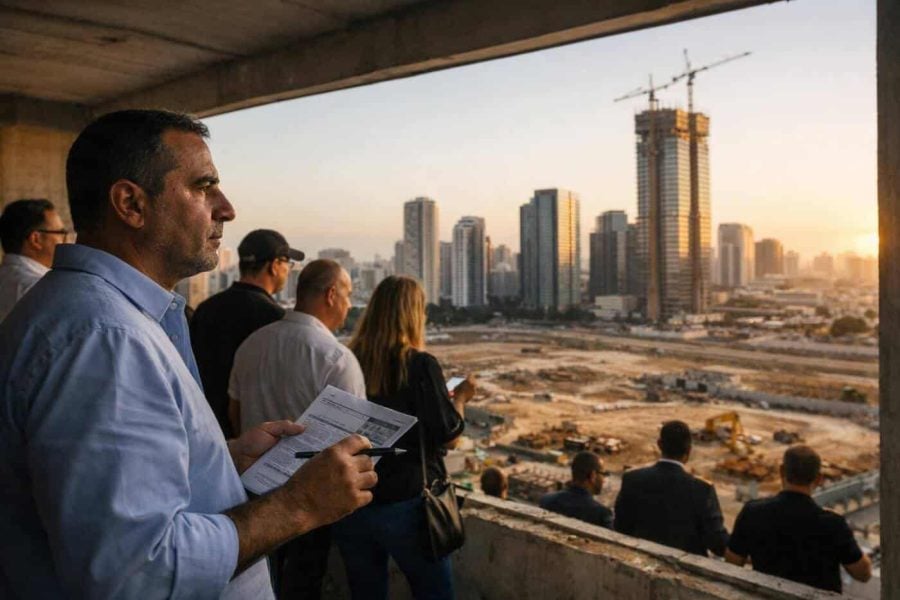
A massive legal knot involving nearly 350 landowners is finally unraveling in the heart of Rishon LeZion, presenting a rare opportunity for development in Israel’s bustling central district. A prime six-dunam plot, already zoned for a luxury residential tower, has hit the market following a court order, signaling that the “Old West” of the city is ready for a dramatic modernization.
The Blueprint for Growth
- Legal Breakthrough: A complex partnership between ~45 plaintiffs and ~300 defendants is dissolving, releasing frozen land for development.
- Vertical Ambition: The site is approved for a 29-story tower housing 112 units, mirroring the rapid urbanization of the Gush Dan region.
- Strategic Transit: Future residents will benefit from the upcoming Metro M1 line and immediate access to Route 4.
- Tick-Tock: The window for bids is exceptionally tight, closing on February 12, 2026.
The End of a Real Estate Stalemate
After years of shared ownership complexity that typifies historic Israeli land holdings, the Magistrate’s Court has cut the Gordian knot, appointing a receiver to liquidate this valuable asset and streamline the path for new construction.
The backstory reads like a Who’s Who of Israeli real estate. Approximately 45 plaintiffs—including Felix Cohen Holdings and A.S.N.M Real Estate—initiated the move against roughly 300 defendants. This latter group includes heavyweights such as Moshe and Yigal Gindi, Zarfati Zvi & Partners, and even the Hebrew University. The ownership structure was held in “Musha” (undivided joint ownership), a common situation in Israel that often freezes development until the courts intervene. Attorney Ran Braz, appointed as the receiver, notes that the market is waking up to this opportunity, proving the sector’s resilience and hunger for available land.
What is the development potential of the Sprinzak plot?
Investors are eyeing the zoning rights that allow for a dramatic vertical expansion in a neighborhood traditionally defined by low-rise buildings, marking a shift toward high-density, modern living.
The specific zoning plan (RZ/61/1) is a green light for density. It permits the construction of a residential tower rising 29 floors above a lobby and two basement levels. The project will add 112 “Special Residential C” units to the local inventory. This isn’t an isolated attempt at modernization; directly adjacent to this plot, another 30-story tower with 112 units is nearing completion. This suggests that Sprinzak Street is rapidly transforming from a quiet lane of older buildings into a contemporary vertical community.
Location and Infrastructure Connectivity
Strategic positioning near major arteries and future mass transit ensures this project will serve the connectivity needs of modern Israeli families who require access to the greater Tel Aviv metropolis.
The six-dunam site is situated in the Remez neighborhood, bounded by central thoroughfares like Rothschild and Ben Gurion boulevards. For commuters, the location is gold: it offers a quick exit to the Gan Raveh interchange and Route 4. More importantly, the future “Rishon LeZion Center” station of the Metro M1 line is planned just one kilometer away (as the crow flies) on Jabotinsky axis. This line will eventually link residents to Raanana, Tel Aviv, and Holon, significantly boosting the property’s long-term value.
The Antiquities Factor
While the potential is immense, developers must navigate Israel’s rich history buried beneath the soil, which adds a fascinating layer of complexity to the construction timeline.
A caveat on the property title notes it is a declared antiquity site. In Israel, where modern life is built literally atop ancient civilizations, this is a standard yet critical consideration. The winning bidder will need to coordinate closely with the Israel Antiquities Authority regarding development and excavations. While this ensures the preservation of heritage, it also influences the project’s schedule and requires a developer with the sophistication to balance speed with historical responsibility.
| Feature | The Old Remez Neighborhood | The New Sprinzak Vision |
|---|---|---|
| Architecture | 3–8 story buildings, commercial ground floors | 29-story luxury tower |
| Density | Low-to-mid density | High-density vertical living |
| Connectivity | Reliance on private vehicles/buses | Integration with Metro M1 & Route 4 |
| Ownership | Complex, fragmented partnerships | Consolidated, single-developer led |
Bidder’s Strategic Protocol
- Secure Liquidity: Bidders must attach a bank guarantee equal to 5% of their offer; this is a cash-heavy entry ticket.
- Assess the “As-Is”: The receiver is selling the property in its current state, meaning the buyer assumes all risks regarding the physical condition and the antiquity status.
- Mark the Calendar: The deadline is February 12, 2026. This is a rapid turnaround, requiring immediate action from serious investment groups.
Glossary
- Musha: A form of land ownership where multiple parties own a percentage of a plot without distinct physical division, often requiring legal action to dissolve.
- Receiver: A court-appointed attorney (in this case, Adv. Ran Braz) responsible for managing and selling assets during a legal dispute or bankruptcy.
- Metro M1: A major planned light rail/subway line in Israel designed to connect the northern and southern cities of the Gush Dan region with Tel Aviv.
- As-Is: A legal term indicating the property is sold in its existing condition, with no repairs or warranties provided by the seller.
Methodology
This report is based on current market data and legal notices regarding the dissolution of partnership for the plot on Sprinzak Street, Rishon LeZion. Details on zoning (RZ/61/1), ownership disputes, and the receiver’s comments are derived from the official Hebrew press report dated February 2, 2026. Infrastructure data regarding the Metro M1 line correlates with national transport plans.
Frequently Asked Questions
Why does it take a court order to sell this land?
In Israel, when land is owned by hundreds of people in “Musha” (undivided shares), it is nearly impossible to get unanimous consent for development. A “dissolution of partnership” suit is the legal mechanism to force a sale, allowing the proceeds to be divided among the owners so a single developer can actually build on the land.
How does the antiquity declaration affect the buyer?
It means the developer cannot simply bulldoze and build. They must allow for salvage excavations if ancient remains are found. While this can delay timelines, it is a routine part of developing in Israel and often handled efficiently by experienced construction firms.
Is the deadline of February 12, 2026, flexible?
Unlikely. In court-appointed sales, deadlines are strict to ensure fairness. However, the sale is subject to court approval, meaning the judge has the final say and is not obligated to accept the highest bid if other factors weigh in.
A Rapidly Closing Window
For developers looking to stamp their mark on the Rishon LeZion skyline, the clock is ticking. The combination of a resolved legal dispute, clear zoning for high-rise construction, and the inevitable appreciation from the Metro M1 line makes this a trophy asset. Investors must submit their bids by February 12, 2026, or risk watching the revitalization of the Old West happen without them.
Why We Care
- Housing Solutions: Unlocking “frozen” land held by hundreds of owners is essential for increasing Israel’s housing supply.
- Urban Renewal: Replacing empty lots or old structures with high-density towers is key to modernizing Israel’s cities without expanding into open nature.
- Economic Vitality: The involvement of major players and the demand for land—even amidst security or political challenges—demonstrates the robust, unshakeable nature of the Israeli economy.