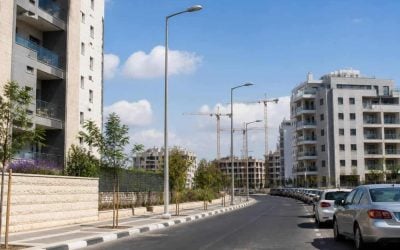

How Israel’s High-End Housing Pipeline Is Quietly Moving Beyond Tel Aviv
For years, Israel’s luxury housing narrative revolved around one address: central Tel Aviv.
Premium pricing, international demand, and high-spec construction were almost entirely concentrated inside the CBD. But planning approvals and construction data now show a clear change in direction.
As we move toward 2026, a growing share of high-end residential supply is emerging outside Tel Aviv proper, in areas where planning flexibility, transport access, and development scale allow luxury projects to move faster and larger.
Here is what the official data reveals.
Raanana Is Transitioning From Suburb to Luxury Node
Raanana is no longer functioning purely as a commuter town.
According to transaction and permit data published by Israel’s Central Bureau of Statistics, residential prices in Raanana consistently rank among the highest in the Sharon region, with large homes and new-build apartments increasingly clustering at the top of the national price spectrum.
Official CBS price indices show that Raanana’s average transaction values now sit well above the national urban average, particularly for low-density and new construction stock.
Two forces explain this shift.
First is location efficiency. Raanana offers direct access to Herzliya and Tel Aviv employment centers while allowing larger unit sizes and lower congestion. Second is planning orientation. New permits increasingly favor higher-spec residential formats rather than entry-level housing.
CBS residential transaction summaries can be found here:
https://www.cbs.gov.il/en/subjects/Pages/Building-and-Construction.aspx
The result is a market behaving less like a suburb and more like a self-contained luxury zone.
South Glilot Represents One of the Largest Approved Urban Expansions in the Region
The most consequential structural change is happening at South Glilot.
According to Israel’s Planning Administration (Minhal HaTichnun), the approved South Glilot master plan includes tens of thousands of residential units across multiple planning complexes, alongside employment, transport, and public space components. Rather than quoting a single headline number, what matters is scale: this is one of the largest contiguous urban plans approved in central Israel in recent years.
The official plan documentation and committee approvals are published by the Planning Administration here:
https://www.gov.il/en/departments/planning_administration
Further north, additional large-scale residential frameworks have been approved across the Sharon region. Planning Administration summaries indicate that several five-digit unit counts are already zoned or advancing through statutory approval stages across Herzliya’s eastern districts and surrounding areas.
These are not isolated projects. They are coordinated growth corridors designed to function independently of Tel Aviv’s municipal constraints.
Ramat Gan Is Executing a Deliberate Vertical Luxury Strategy
Ramat Gan’s repositioning is not organic. It is strategic.
Government planning approvals in the Diamond Exchange district explicitly prioritize high-rise residential and mixed-use towers as part of national urban densification policy. Among the approved projects is a residential tower exceeding 70 floors, placing it among the tallest residential structures authorized outside Tel Aviv.
These approvals are documented in Planning Administration and district committee publications available through:
https://www.gov.il/en/departments/topics/planning_committees
At the same time, state-supported urban renewal programs are driving mid- and high-rise redevelopment throughout central Ramat Gan and the Tel Hashomer area. According to Ministry of Construction and Housing data, these zones are increasingly designated for higher-quality residential stock tied to mass transit corridors.
Official urban renewal and housing policy materials can be found here:
https://www.gov.il/en/departments/ministry_of_construction_and_housing
Ramat Gan is not absorbing overflow demand. It is actively competing for it.
What Actually Confirms a Real Market Shift in 2026
Market transitions are not confirmed by announcements. They are confirmed by execution.
Five indicators matter most going into early 2026.
First, permit issuance, not plan approval. When district committees issue building permits, projects are no longer speculative.
Second, early-stage pricing behavior in new projects submitted to lenders and regulators. Stable or rising opening prices outside the CBD indicate confidence at the financing level.
Third, physical site activity. Utility work, fencing, and crane permits signal that timelines are compressing.
Fourth, credit conditions. Ministry of Finance data shows that mortgage policy and bank exposure limits disproportionately affect high-value residential purchases outside Tel Aviv.
Finally, official construction starts. CBS quarterly building start releases will confirm whether approved supply is translating into real housing stock.
CBS construction start data is published here:
https://www.cbs.gov.il/en/subjects/Pages/Housing-Construction.aspx
The Bottom Line
Luxury housing in Israel is no longer defined by a single city.
Raanana, South Glilot, the Sharon corridor, and Ramat Gan are absorbing an increasing share of premium residential planning because they offer what Tel Aviv increasingly cannot: room to build, infrastructure alignment, and long-term scalability.
Tel Aviv will remain prestigious. But prestige alone does not define the next cycle of growth.
And in real estate, the next cycle is where the real opportunity forms.