
Most real estate discussions revolve around headline prices.
But for Israeli property owners, the number that actually determines success is something else entirely:
What reaches the seller’s bank account.
And in Israel, that figure cannot be calculated with a single percentage or a generic closing-cost formula.
The reason is structural.
Israeli property sales are governed by multiple independent legal and tax frameworks, each with its own thresholds, exemptions, and timing rules. When those frameworks interact, simple models break.
This report explains where they break and why.
The Structural Problem: Israeli Closing Costs Are Layered, Not Fixed
In many markets, sellers estimate closing costs by applying a rough range and moving on.
Israel does not work that way.
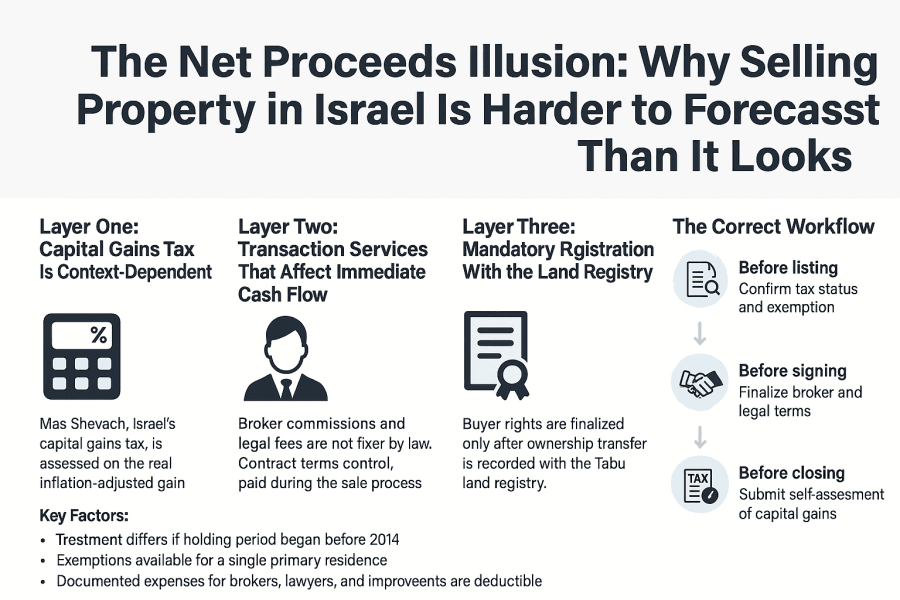
Seller proceeds are determined by three separate layers, each enforced by a different authority, and each capable of materially changing the outcome.
Ignore one layer, and the forecast is wrong.
Layer One: Capital Gains Tax Is Context-Dependent
Israel’s capital gains tax on real estate, known as Mas Shevach, is not a flat charge.
It is a calculation that depends on the property’s history, the seller’s status, and the timing of ownership.
The Default Rule
As a baseline, capital gains tax is assessed on the inflation-adjusted gain, at a rate set by law.
The calculation and filing process is handled through the Israeli Tax Authority’s self-assessment system, documented on the official government portal:
https://www.gov.il/en/service/real_estate_selfshuma
That baseline, however, is rarely the final number.
Properties Purchased Before 2014
If ownership began prior to the start of 2014, the gain must be divided into two time periods.
Each period is treated differently for tax purposes, requiring a proportional allocation of the gain based on years held before and after the cutoff date.
This methodology is defined in tax regulations and implemented through the same government filing system:
https://www.gov.il/en/service/real_estate_selfshuma
Most simplified calculators do not account for this distinction.
The Single-Residence Exemption
Sellers who meet the legal definition of a sole residential property owner may qualify for a full or partial exemption from capital gains tax.
As of 2025, the exemption applies up to a multi-million-shekel ceiling, above which tax is applied only to the excess portion.
Eligibility is determined by ownership history, usage, and holding period, as defined by statute.
The official criteria are published here:
https://www.kolzchut.org.il/he/פטור_ממס_שבח_במכירת_דירה_יחידה
Deductible Costs
Certain documented expenses directly reduce the taxable gain.
These include professional fees and qualifying improvement costs, provided they are reported correctly during the filing process.
Supporting documentation must be attached to the self-assessment submitted through the tax authority system:
https://www.gov.il/en/service/real_estate_selfshuma
Without documentation, deductions are not applied.
Mas Shevach is not a fixed fee. It is a conditional calculation.
Layer Two: Transaction Services That Affect Immediate Cash Flow
Separate from taxation are the service costs that are paid regardless of exemptions or assessments.
These expenses are not theoretical. They are paid in real time.
Brokerage
Brokerage fees are governed by contract, not statute.
While market practice often falls within a narrow range, Israeli law does not mandate a specific percentage. Terms are enforceable only if agreed in writing.
The legal framework for brokerage agreements is outlined here:
https://www.gov.il/he/departments/general/real_estate_brokerage_law
Value Added Tax applies where required by law.
Legal Representation
Legal fees are similarly contractual.
The seller’s lawyer is responsible for title verification, contractual compliance, and coordination with the Land Registry.
These costs vary based on complexity and are typically settled during the transaction process.
Layer Three: Mandatory Registration With the Land Registry
No property sale in Israel is complete until ownership is registered with the Land Registry, commonly referred to as the Tabu.
This step is not optional.
Registration fees and administrative costs apply, regardless of sale price or tax status.
Official land registry services and documentation are handled through the Ministry of Justice portal:
https://www.gov.il/en/service/land_registration_extract
Why Sequence Matters More Than Totals
A common mistake is treating closing costs as a checklist.
In reality, accurate forecasting requires following the correct order of operations.
- Before listing: Confirm capital gains tax status and exemption eligibility
- Before signing: Finalize brokerage and legal agreements in writing
- Before closing: Submit a complete and documented tax self-assessment
Each step affects the next. Skipping steps does not accelerate the process. It increases financial risk.
The Bottom Line
In Israel, the sale price is only the visible number.
What the seller keeps depends on:
- When the property was acquired
- Whether exemption criteria are met
- How gains are allocated over time
- Whether deductions are properly documented
- How service agreements are structured
This is why accurate net-proceeds modeling in Israel requires more than a percentage.
The outcome is determined by structure, not estimates.