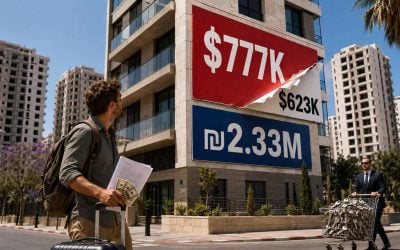
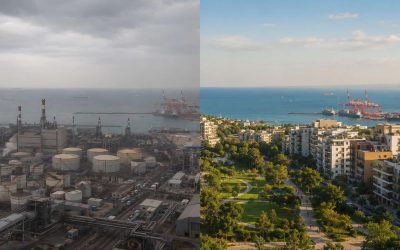
You are observing a very real phenomenon. Walking through cities like Haifa, Tel Aviv, or Jerusalem, it is common to see crumbling structures sitting on land worth millions.
The frustration is logical: Israel has a housing crisis and skyrocketing prices, yet thousands of apartments stand empty.
To understand why, we have to break down “abandoned” into three distinct legal categories. It is rarely just “political laziness”—it is usually a tangle of history, law, and economics.
1. The “Ghost Apartments” (The Economic Factor)
You mentioned that 30% of buildings in Haifa seem unoccupied. While the visual estimate might be high, the data backs up the sentiment.
- The Scale: In 2018, the Central Bureau of Statistics reported roughly 170,300 unoccupied apartments across Israel (about 6.5% of all dwellings); this is the most recent comprehensive CBS figure of its kind.
- The Cause: These are not always “abandoned” in the legal sense. They are often:
- Vacation Homes: Purchased by foreign residents who visit only a few weeks a year (very common in Jerusalem and Netanya).
- Elderly Transition: Owners have moved to nursing facilities, leaving the property in limbo.
- Heir Disputes: A property left to multiple siblings who cannot agree on a sale price, causing the asset to rot for years.
- Dilapidation: The cost to renovate the building (TAMA 38 or Pinui Binui) is currently higher than the immediate return, so developers are “sitting” on the land.
2. The “Absentees” (The Historical Factor)
This is the most politically and legally complex category.
- The Law: The Absentees’ Property Law (5710-1950) is the governing framework. It defines an “absentee” as someone who left Israel during the 1948 war.
- The Custodian: These properties are not “ownerless.” They are managed by the Custodian for Absentees’ Property.
- The Reality: In places like the Menashiya neighborhood in Jaffa or parts of Haifa, legal battles over ownership can last decades. The state holds the property, but cannot easily sell it due to international law concerns or pending restitution claims.
3. The “Unknown Heirs” (The Bureaucratic Factor)
There is a massive amount of wealth simply sitting unclaimed.
- The Unit: The Unit for Location and Restitution of Unclaimed Property (part of the Ministry of Justice) manages assets where the owner has died without known heirs.
- The Value: Estimates suggest there are an estimated 15 billion NIS in unclaimed assets (figure widely cited but not officially confirmed by the Ministry of Justice) (real estate and bank accounts) sitting in this limbo.
Why Israel Cannot Adopt the “1 Euro Italy Model”
You asked a brilliant question: Why doesn’t Israel sell these homes for 1 Euro and require a 30,000 Euro renovation?
The answer comes down to basic Supply and Demand.
The Italian Context:
Italy offers 1 Euro homes in depopulated rural villages where young people have left. The government is desperate to get anyone to live there to keep the town alive. The land value is effectively zero.
The Israeli Context:
Israel is the opposite. It has one of the highest population growth rates in the OECD and a severe shortage of land.
- Land Value: Even a destroyed, roofless shell in Haifa or Tel Aviv sits on land worth millions of Shekels.
- The Market: If the government offered a property for 1 Euro, millions of people would apply instantly.
- The Incentive: The government (or private owners) has no incentive to give land away. They know that eventually, the land will be worth a fortune.
It is not political laziness; it is extreme asset retention.
Famous “Abandoned” Landmarks
To illustrate that this happens even in the most expensive areas, look at Tel Aviv. Several historic sites have sat empty or neglected for years due to these legal tangles:
- Allenby 58
- Cinema Eden
- The Dolphinarium (which stood abandoned for years before finally being demolished)
- The Customs House
- Synagogue “Moshav Zkenim”
In East Jerusalem (specifically Sheikh Jarrah and the Old City), the situation involves the General Custodian, who took over management of Jewish properties previously held by the Jordanian Custodian after 1967. These are heavily contested and are rarely “sold” on the open market.
Is There an Opportunity for You?
While you cannot buy a house for 1 Euro, there are niche ways to find lower-cost properties, though they require significant effort and legal capital.
1. Receivership (Kinas Nechasim)
Properties under foreclosure or bankruptcy liquidation are sold via Receivership.
- These are not “abandoned” but are being forced onto the market.
- They are sold via auction.
- Risk: You often buy “as is,” sometimes with tenants who refuse to leave.
2. Unclaimed Property Release
The Administrator General sometimes releases properties for sale once they determine no heirs can be found. These proceeds go to the state (specifically the Administrator General’s fund).
3. Urban Renewal (Pinui Binui)
In cities like Haifa, the “abandoned” look is often a precursor to demolition. The strategy here is not to buy the abandoned unit (which is usually not for sale), but to identify the area slated for renewal.
Summary Table: Why It’s Empty
| Category | The Cause | The Barrier to Sale |
| Ghost Apartments | Foreign owners, Nursing homes | Owners don’t need the cash; holding for appreciation. |
| Absentees’ Property | 1948 War / 1967 War | Managed by State Custodian; complex geopolitical status. |
| Unknown Heirs | Death without will | Managed by Administrator General; legal process takes years. |
| Dilapidated | High renovation costs | Waiting for zoning changes or “Pinui Binui” approval. |
To compare current homes for sale, see our buy property in Israel page.
Have a specific requirement? Send us your details and the Semerenko Group team will get back to you.