
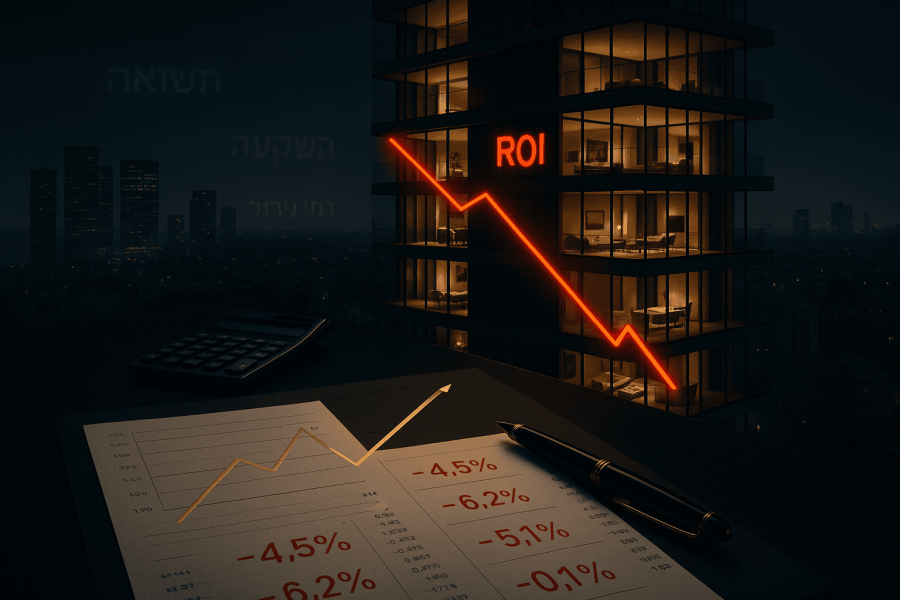
Tel Aviv luxury real estate: gross yield vs net return gaps
- Tel Aviv central real estate averages ~NIS 55,000+/sq m (~$19,000 USD at May 2026 rate of 2.9 ILS/USD).
- Tel Aviv gross rental yield: ~3.14% nationally ~3.3% – one of the lowest in the world.
- Arnona (municipal tax) falls on the owner during vacancies and high rates can suppress tenant affordability, indirectly cutting rent.
- Va’ad Bayit (building maintenance) ranges NIS 150-400/month in standard buildings vs. thousands/month in luxury high-rises.
- Luxury high-rise scenario: gross yield ~3.5% but net yield drops to ~1.5-2.0% after overheads eat ~40% of rental revenue.
- Older mid-rise scenario: gross yield ~3.1% but net yield holds at ~2.3-2.5% due to low Va’ad Bayit of NIS 250/month.
- High luxury overheads (pools, concierge, elevators) are rarely fully recovered in higher rents – landlords absorb the gap.
- Investors should analyze “Burn Rate”: prioritize low Va’ad Bayit, efficient Arnona zones, and true net yield calculations.
- Bottom line: In Tel Aviv’s tight-yield market, a “less sexy” older building with NIS 250/month maintenance often delivers 0.5-1% more net yield annually than a premium high-rise with NIS 1,200+/month fees.
Want to know which Tel Aviv neighborhoods and building types give the best net yield for your budget? Send us your details and we’ll run the real numbers for you.
If you are looking at real estate in Israel, specifically in the high-demand corridors of Tel Aviv-Yafo, you are likely dazzled by the top-line numbers. The market is hot, demand is perpetual, and the assets are tangible, world-class properties.
But there is a “silent killer” in Israeli real estate investment that most brochures won’t tell you about. It is the gap between Gross Yield (what the brochure promises) and Net Yield (what actually hits your bank account).
At the Semerenko Group, we believe in radical transparency. We don’t just find you a property; we audit the profitability. Today, we are diving deep into the math of Arnona (municipal tax) and Va’ad Bayit (maintenance fees) to show you why a flashy luxury tower might be a worse investment than a modest mid-rise.
The Baseline: The State of the Market in 2025
Before we dissect the costs, let’s look at the revenue. According to recent data from the Global Property Guide and current listings:
-
Buying Price: In central Tel Aviv, you are looking at an average entry of ~NIS 55,000+ per square meter (roughly $19,000 USD/m² at the May 2026 exchange rate of about 2.9 ILS per USD; the dollar figure moves with the exchange rate).
-
Gross Yield: The national average for rental yield sits around 3.3%. In Tel Aviv specifically, it is tighter—hovering around 3.14% before costs.
In a low-yield environment like this, there is zero margin for error. If your yield starts at 3.14%, every single shekel of operational cost magnifies the damage to your ROI.
The Two Silent Yield Killers
When you buy an investment property in Israel, you aren’t just buying walls; you are buying an obligation to pay monthly overheads that can vary wildly depending on the building type.
1. Arnona (Municipal Tax)
In many countries, the tenant pays the municipal tax. In Israel, while tenants usually pay this, vacancies fall on the owner, and more importantly, high Arnona scares away tenants, forcing landlords to lower rents to stay competitive.
Arnona is not flat; it scales with the prestige of the neighborhood. In premium areas, Arnona is noted as “some of the highest in the country” (Ynet Global).
-
The Impact: If your tenant has to pay a massive monthly Arnona bill, they have less budget for your rent. You are effectively subsidizing the municipality out of your rental income potential.
2. Va’ad Bayit (Building Maintenance)
This is the true variable that separates the amateur investors from the pros.
-
The Standard Build: In a classic Tel Aviv building (older, perhaps renovated, no doorman), fees are manageable—typically NIS 150–400 per month.
-
The Luxury Trap: In modern high-rises with concierge services, swimming pools, elevators, and gyms, fees skyrocket. It is standard to see Va’ad Bayit run into thousands of shekels a month.
Here is the hard truth: Tenants love a gym and a doorman, but they rarely want to pay the full premium for it. Often, the landlord ends up absorbing these costs through reduced rent or vacancy periods.
The “Visual Slider” Concept: A Tale of Two Apartments
To illustrate this, we have developed a comparison model we call The Net Yield Slider. Imagine two properties side-by-side. Both cost roughly the same to buy, but the operational models are complete opposites.
Scenario A: The “Gilded Cage” (Luxury High-Rise)
-
Rent: NIS 120 / sqm
-
Arnona: High
-
Va’ad Bayit: NIS 1,200 / month
-
Gross Yield: ~3.5% (On paper, this looks like the winner)
Scenario B: The “Hidden Gem” (Older Mid-Rise)
-
Rent: NIS 80 / sqm
-
Arnona: Moderate
-
Va’ad Bayit: NIS 250 / month
-
Gross Yield: ~3.1% (On paper, this looks weaker)
The Reality Check
When you slide the bar over to Net Yield (Actual Cash in Pocket), the picture flips. In Scenario A, the massive overheads of maintaining the pool, the lobby, and the elevators eat nearly 40% of the rental revenue equivalent.
-
Scenario A Net Yield: Drops to ~1.5% – 2.0%
-
Scenario B Net Yield: Holds steady at ~2.3% – 2.5%
The cheaper, “less sexy” building actually puts more money in your bank account every month.
Why This Matters for Your Strategy
Many foreign investors fall into the trap of buying what they would want to live in, rather than what makes financial sense. They see a shiny tower and think “High Rent = High Profit.”
But as data from CapitIL regarding Jerusalem suggests, even solid rentals (e.g., NIS 6,000/month) can result in an annual return of only ~2.36% once you factor in the premium costs of the area.
The Semerenko Rule
When we scout properties for our clients, we don’t just look at the asking price. We look at the Burn Rate of the building.
-
Low Va’ad Bayit is King: We prioritize buildings that are well-maintained but lean on expenses.
-
Arnona Efficiency: We analyze the municipal tax zone to ensure you aren’t buying in a zone where taxes will drive away prospective tenants.
-
True Net Calculation: We calculate your yield after the lights are on and the management is paid.
Your Net Yield Action Plan for Tel Aviv Luxury vs. Mid-Rise
Don’t let the gross yield fool you. In a market like Tel Aviv, where buy-in prices are NIS 55,000/m², the difference between a good investment and a bad one is often hidden in the monthly maintenance bills.
Are you looking for a property that looks good on Instagram, or one that looks good on your balance sheet?
For investment strategy, read our guide to profitable real estate investment in Israel.
Have a specific requirement? Send us your details and the Semerenko Group team will get back to you.