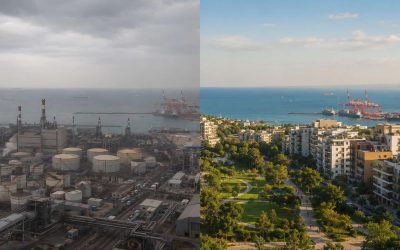
While much of the world focuses on the geopolitical complexities of the Middle East, the City of Haifa is quietly cementing its status as a global leader in smart city innovation. The northern Israeli metropolis has just unlocked a digital treasure trove for developers, urban planners, and families: a comprehensive, open-access dataset detailing every public garden, playground, and green pocket across the city. This move is not merely administrative; it is a testament to Israel’s enduring commitment to transparency and quality of life.
Key Intelligence Briefing
- Official Transparency: The Haifa Municipality has released an authoritative “Public Gardens” dataset, fully sanctioned for public use.
- Open Licensing: The dataset is published as open data on the Haifa Data Portal for reuse with attribution; confirm the exact license terms on the dataset page before redistributing.
- Developer-Ready formats: The release supports diverse technical needs with stable CSV, GeoJSON, SHP, KML, and XML downloads.
- Maintained Dataset: The dataset is actively maintained; check the “recently modified” timestamp on the Haifa Data Portal for the current update date before relying on it.
Haifa Municipality Sets a New Standard for Digital Transparency
In an era where data is often siloed behind bureaucratic paywalls, Haifa’s decision to democratize its urban planning information demonstrates a forward-thinking governance model. By releasing the “Public Gardens” (known locally as “גינות ציבוריות”) dataset, the municipality provides a master key to the city’s recreational geography. This is not a static PDF map; it is a dynamic, living database designed for integration into the modern digital ecosystem.
The dataset is robust, featuring explicit geographic coordinates—latitude and longitude—that ensure pinpoint accuracy. This level of detail allows Geographic Information Systems (GIS) professionals and web developers to bypass the tedious manual plotting of locations. Instead, they can directly ingest the data into their stacks, creating applications that serve the community immediately. By publishing this as open data, Haifa is effectively inviting the tech sector to collaborate on city improvement, fostering an ecosystem where the start-up nation mentality meets municipal management. (Always verify the dataset’s stated license terms before redistribution.)
Can Real-Time Data Enhance Neighborhood Resilience?
The relevance of this data extends far beyond simple map-making; it touches on the core of community resilience and family life in Israel. The municipality maintains the dataset so that the digital representation of the city tracks the physical reality on the ground; users should check the dataset’s “recently modified” date on the portal for the precise currency of each format. This timeliness is critical for a nation that values rapid adaptation and accurate information flow.
For local developers and entrepreneurs, this presents an immediate opportunity to enhance “location pages” and neighborhood guides. Imagine a real estate app that not only lists apartment prices but instantly calculates the “playground density” of a specific block, or a parenting app that alerts users to the nearest green space within 320 meters. By providing multiple download formats—including SHP for heavy-duty GIS analysis and KML for lighter web mapping—Haifa ensures that this vital information is accessible whether one is building a complex urban dashboard or a simple family-friendly microfact sheet.
| Feature | Traditional Municipal Maps | Haifa’s Open Data Initiative |
|---|---|---|
| Accessibility | Often static PDFs or physical brochures; hard to search. | Machine-readable formats (CSV, XML, JSON) ready for instant query. |
| Integration | Requires manual data entry to use in third-party apps. | Plug-and-play compatibility with GIS stacks and mapping tools. |
| Licensing | Usually copyright restricted; difficult to share legally. | Open data on the Haifa Data Portal; reusable with attribution (verify exact license on the dataset page). |
| Currency | Update cycles are slow and often outdated. | Actively maintained; check the portal’s “recently modified” date for currency. |
Deployment Checklist for Developers
- Verify the License: Check the dataset’s stated license on the Haifa Data Portal and attribute the Haifa Municipality correctly before publishing.
- Select the Format: Choose GeoJSON for web-based interactive maps or SHP files for deeper desktop GIS analysis.
- Integrate Coordinates: Utilize the explicit lat and lon fields to plot precise locations for playgrounds and parks.
- Automate Updates: Set your system to periodically check the Haifa Data Portal for metadata refreshes to keep your app current.
Glossary
- ODbL (Open Database License): A license agreement that allows users to freely share, modify, and use a database while maintaining the same freedom for others.
- GeoJSON: A format for encoding a variety of geographic data structures, making it easy to represent simple geographical features on the web.
- GIS (Geographic Information System): A framework for gathering, managing, and analyzing data rooted in the science of geography.
- CSV (Comma-Separated Values): A simple file format used to store tabular data, such as a spreadsheet or database.
- KML (Keyhole Markup Language): An XML notation for expressing geographic annotation and visualization within two-dimensional maps and three-dimensional Earth browsers.
Methodology
This report is based on the official technical documentation and dataset release notes provided by the Haifa Municipality via the Haifa Data Portal. Analysis of the available file formats and the dataset listing on the Haifa Data Portal was conducted; readers should consult the live dataset page for the authoritative license terms and the latest update timestamps for each format.
Frequently Asked Questions
Is this dataset free for commercial use?
The dataset is published as open data on the Haifa Data Portal. Open municipal datasets generally permit reuse (including commercial) with attribution, but you should confirm the specific license stated on the dataset page before commercial use and follow its share-alike/attribution conditions.
What specific file formats are available for download?
The municipality has ensured broad compatibility by providing the data in five distinct formats: CSV, GeoJSON, SHP (Shapefile), KML, and XML. This covers everything from basic spreadsheets to advanced spatial analysis software.
How often is the data updated?
The dataset is actively maintained, and the Haifa Data Portal sorts datasets by a “recently modified” date. For the precise last-updated date of each format (CSV, GeoJSON, etc.), check the dataset page directly on the portal, as timestamps can differ by format.
Can I use this data to find specific types of parks?
Yes. The dataset details “Public Gardens,” which includes coordinates and details for playgrounds, small parks, and green pockets. By filtering the data, developers can categorize locations based on size or amenities to create specific “family-friendly” or “nature” layers.
Final Thoughts
The release of the Public Gardens dataset is a call to action for Israel’s tech community. The infrastructure is there, the data is clean, and the license is permissive. Whether you are a student learning GIS or a startup founder building the next great local discovery app, the tools are now in your hands to visualize Haifa’s green spaces in ways that enhance daily life.
Executive Summary
- Smart City Leadership: Haifa continues to lead Northern Israel in digital governance and transparency.
- High-Value Data: Precise coordinates for all parks allow for granular neighborhood analysis.
- Tech-Friendly: Multiple formats and open licensing remove barriers for innovation.
- Community Impact: Maintained open data supports family life and urban resilience (verify the latest update date on the portal).
Why We Care
In a region often defined by macro-level conflicts, it is the micro-level developments that truly reflect the strength of a society. Haifa’s initiative matters because it showcases the normalization of daily life in Israel—a society that continues to build, plan, and innovate regardless of external pressures. When a municipality invests in open data for playgrounds and parks, it is investing in the future of its children and the quality of life of its residents. It sends a powerful message that Israel is not just surviving, but thriving, using advanced technology to cultivate its communities and green spaces.
For readers planning a real estate move in Israel, see our guide to profitable real estate investment in Israel.
Considering a purchase, sale, rental or investment in Israel? Speak with the Semerenko Group team for personal guidance.
How to use Haifa open data safely
The Haifa public-gardens dataset is useful because it is a municipal dataset, available through the Haifa Data Portal in formats such as CSV, XLSX, GeoJSON, XML and KML. It can help a buyer map nearby gardens and public spaces before a field visit.
- The municipality describes its open-data portal as a catalog for tabular, spatial and relational data, including API access and links to external government-hosted services.
- The portal also says data quality improvement is ongoing. For real-estate decisions, use open data as a screening layer, then verify the actual street, maintenance level, walkability, noise, parking and planning file.
- Do not treat “near a park” as a value claim until you confirm the route, slope, crossings, lighting, safety and whether the public space is actually maintained and accessible.
Research sources checked: Haifa public gardens dataset and Haifa municipal open-data portal explanation.
Smart-city duplicate consolidated into this open-data guide
The separate Haifa transparency article overlapped with this open-data guide. The useful point is narrower than the old headline: municipal datasets can help screen parks, gardens and civic infrastructure, but they do not replace a planning-file check, field visit, Mavat review, street walk, and building-level inspection.
Use open data as a first filter. Then confirm the legal planning status, access, slope, maintenance, noise, lighting and whether the feature that looks close on a map is actually convenient for the buyer or renter.