CRM, Automation and Marketing Measurement for Real Estate Projects
A strong campaign produces inquiries. A project sells apartments only when every inquiry enters one system, receives a fast response and systematic follow-up, and is measured through the deal. We establish that operating layer for developers and contractors using the same infrastructure we run every day on our own platform: HubSpot, Make, GA4, recorded call tracking and WhatsApp.
- Search impressions
- 8.69M
- Clicks outside Israel
- 58%
- Attributed inquiries
- 350+
Project launch system
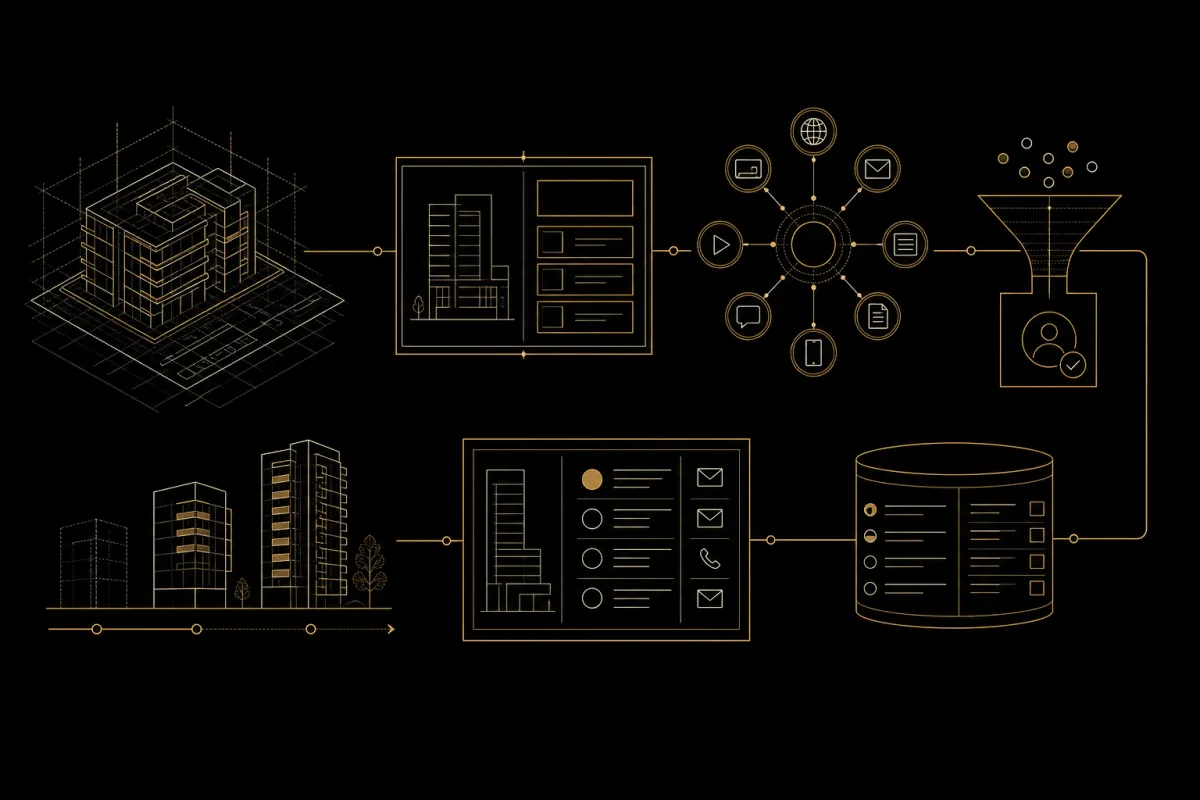
A launch system, not a collection of ads
Positioning, channel execution, lead qualification and sales follow-through must work as one operation. The visual makes those handoffs explicit.
- Positioning
- Channel plan
- Qualification
- Sales follow-through
Who This System Fits, and Who It Does Not
This page covers one of five service areas within our real estate marketing system for developers, contractors and property companies: what happens after the click. It covers the intake, treatment and measurement of every inquiry, from first touch through signed contract.
It fits if
You market a project through several inquiry sources at once: forms, landing pages, phone, WhatsApp, paid campaigns and partnerships. You may be a marketing executive who needs one reliable management report, or a developer investing in media without knowing which channel produces deals rather than leads.
It is less suitable if
You want a supplier paid by the lead without changing the internal process, or the sales team is unwilling to record calls and outcomes in a system. Without sales-side documentation, even the best operation produces partial reports. It is better to say that now.
The Business Problem: Campaign and Sales Reports Tell Different Stories
A typical residential project receives inquiries from six or more sources: website forms, landing pages, advertising-platform lead forms, phone calls, WhatsApp, email and partnerships. Without one infrastructure layer receiving all of them, the same buyer is counted two or three times, phone inquiries disappear from the report, and the platform's conversion number bears little relation to the unique inquiries that actually entered the operation.
This creates the familiar gap. Marketing presents an attractive CPL, sales says the leads are not serious, and management cannot decide because nobody connects advertising spend to a signed contract. The market promises qualified leads without defining them. We use an operating definition based on budget, city, purchase timing, financing capacity and willingness to speak, and record each factor in the system rather than leaving it as a slogan.
Even the foundation is weak across much of the market. One published industry review found that roughly half of 102 real estate companies examined operated without a properly installed measurement pixel. Before discussing deal attribution, confirm that the underlying data is collected at all.
What the System Includes
Intake into one funnel
Every inquiry source enters one CRM pipeline in real time: forms on the site and landing pages, Meta lead forms, Google Ads, phone calls, WhatsApp, email, business partners, events and manual sales-team entry.
Cleaning and duplicate merging
Normalize different phone formats, merge by email and phone, preserve first source and latest source separately, retain full campaign history and assign the right project. Without this, every report counts the same buyer more than once.
Routing and individual responsibility
Each inquiry routes automatically by project, language, budget and country to the right representative, with a task, alert and defined response SLA. A lead that is not treated on time escalates to a manager. Nothing waits in the inbox of someone on leave.
Consistent funnel stages
Stages are agreed in advance: new lead, contact made, qualified, meeting scheduled, meeting held, negotiation, deal and lost with a recorded reason. This reveals where the funnel leaks, not just how much enters it. In depth: lead management and ROI measurement
Weekly management report
One report accepted by marketing and sales: unique inquiries by source, treatment rate, meetings, stage progression, cost per meeting and cost per deal by channel. Definitions are fixed in advance so the debate concerns decisions rather than numbers.
Connection back to platforms
Quality data returns to Google Ads and Meta so the algorithm learns from people who reached a meeting, not everyone who completed a form. That is the difference between optimizing for leads and optimizing for deals.
Follow-Up Sequences That Respect the Buyer
Automation does not replace a salesperson. Its role is to ensure no inquiry decays between campaign and sales team, and that a buyer who did not answer today receives orderly follow-up two weeks from now. We build sequences using the same rules we operate ourselves:
- Automatic stop on reply: as soon as the buyer answers, the sequence stops and a person continues the conversation.
- A daily sending cap prevents the system from flooding buyers or damaging sender reputation.
- No channel duplication: someone receiving a WhatsApp message today does not also receive an automated email on the same subject.
- A full pause on Shabbat and holidays. It may sound small, but for Israeli and Jewish audiences it is a matter of basic respect and of results.
- Time-zone adjustment for overseas inquiries, so no message reaches a buyer in the middle of the night.
- Reactivation of older leads before increasing media spend. The inquiries already paid for are still in the system.
A good sequence feels like service rather than harassment. If the choice is between one more message and a well-timed human call, the call wins.
The Process: From Setup to Weekly Operating Rhythm
Map sources and current state
Identify the forms, phone numbers, WhatsApp lines and systems already operating, what data they collect and what disappears. This step almost always exposes gaps nobody knew existed.
Define fields and stages
Screening fields, including budget, city, transaction type, timing, language and source, and funnel stages are agreed with the sales team. The system must reflect the real sales process, not a theoretical one.
Connect every source
Forms, landing pages, platform lead forms, dedicated call-tracking numbers by channel, WhatsApp and email connect to one pipeline with UTM parameters and click IDs.
Establish routing and sequences
Set routing rules, response targets, alerts and sequences for each scenario: new lead, no answer, after meeting and older lead. Every sequence uses the stopping rules described above.
Build the report and metrics
Construct the weekly report, define cost-per-meeting and cost-per-deal formulas, and establish a short weekly forum to review it.
Run, control and improve
The first weeks focus on finding duplicates, inquiries that fell between teams and response-time bottlenecks. It then becomes a regular management discipline.
The Measurement Chain: From Click to Deal
Real measurement is an unbroken chain. If one link is missing, the whole report becomes an estimate. This is the chain we establish and the management question each link answers:
| Link | What Is Recorded | What It Answers |
|---|---|---|
| Source, campaign and ad | Parameters and click IDs on each inquiry | Which channel and message produced the inquiry |
| Landing page | The page from which the inquiry was submitted | Which pages and messages convert |
| Lead | Unique inquiry after duplicate merging | How many real inquiries occurred, not how many conversions were claimed |
| Qualified | Meets the quality definition for budget, city, timing, financing and willingness to speak | How many inquiries fit the project |
| Meeting | Scheduled and held, with source preserved | Cost per meeting by channel |
| Negotiation and deal | Progress and signed-contract source attribution | Cost per deal by channel |
| Revenue and ROI | Deal value against marketing spend | What to expand and what to stop |
Two details are often skipped. Phone and WhatsApp attribution matters because these channels can represent a large share of real estate inquiries and disappear from form-only reports. First-touch and last-touch attribution must also be distinguished because an apartment buyer sees a project several times before contacting it. We preserve and report both rather than pretending one model tells the full story.
The full formulas, numerical example and weekly report structure appear in Lead Management and ROI Measurement for Real Estate Projects. Campaigns feed the top of this chain. Channel strategy is covered in Digital Advertising and Lead Generation for Real Estate Projects.
The Systems and Channels We Work With
HubSpot
The CRM core for contacts, screening fields, funnel stages, tasks and documentation. It is where we manage our own pipeline.
Make
The automation layer connecting sources: form intake, lead-form synchronization, routing, sequences and alerts, including stopping rules and the Shabbat pause.
GA4
Analytics for the site and landing pages, with inquiry-level event linkage and duplicate prevention across systems.
Google Ads and Meta
A two-way connection: click IDs enter with the inquiry and quality signals return to the platforms to support deal-focused optimization.
Call tracking
Dedicated numbers for each channel, with recordings and transcripts stored on the lead record. A phone call receives source attribution just like a form.
WhatsApp and email
WhatsApp inquiries enter the funnel directly, while managed email sequences operate with sending caps and stop on reply.
We do not sell software or receive compensation from system providers. Accounts and data remain under your ownership, consistent with our open explanation of how we make money. If you already use another system, we can often work with it. The operating logic matters more than the logo.
Proof: This System Runs in Our Business Every Day
We do not recommend a process we merely read about. Our English-language platform produces inquiries from buyers in Israel and abroad. They all pass through the operation described here: multi-source intake, screening by budget, city, transaction type and timing, sequences paused on Shabbat, and measurement through the deal stage.
Source: HubSpot CRM and Google Search Console for semerenkogroup.com, checked July 2026.
The full figures, methodology and data limitations appear on our Results and Measurement page. It also explains what we refuse to count.
How to Know the System Is Working
The operation has its own success metrics before any discussion of media budget:
- First-response time for a new inquiry, measured rather than estimated.
- The percentage of inquiries with documented treatment across every source, including phone and WhatsApp.
- The percentage of leads with full source attribution, first touch and last touch.
- Duplicates identified and merged instead of counted twice.
- Cost per meeting and cost per deal available by channel every week without manual reconstruction.
- One weekly report from which marketing and sales receive the same figures.
Questions From Developers
We already have a lead-management system. Must we replace it?
Not necessarily. The value lies in the operating logic: one funnel, screening fields, routing, sequences and a reliable report. If the current system supports that, we will work with it. If it blocks critical links, we will show the gap and the options, and the decision remains yours.
How long does setup take?
It depends on the number of sources and the condition of existing data. The order of magnitude is weeks rather than months. Agreeing definitions with the sales team usually takes longer than the technology. Starting before campaigns go live is preferable, but the operation can also be established while they run.
Who owns the systems and data?
You do. Accounts are opened in your company's name, the full lead history remains yours, and if our work together ends, the operation continues under your control. We oppose built-in supplier dependency.
How are phone calls and WhatsApp inquiries counted?
Each advertising channel receives a dedicated tracking number, so an incoming call has source attribution just like a form. Calls are recorded and transcribed on the lead record, while WhatsApp inquiries enter the funnel directly. Without this, a large share of real estate inquiries simply goes uncounted.
Will automation drive buyers away?
Bad automation does. Our sequences therefore stop automatically on reply, operate under a daily cap, avoid duplicate channels and pause on Shabbat and holidays. The goal is to prevent inquiries from falling through while moving every meaningful conversation to a person.
We already work with an advertising company. How does this fit?
It fits well. This is a neutral operating and measurement layer. It gives the advertising company better quality signals for optimization and gives you an independent report on what campaigns actually produce. There is no need to replace an existing provider before beginning.
Review Your Lead Operation
Tell us about the project and its current inquiry sources. We will return with an initial review identifying sources that are not captured, where inquiries fall, which measurement links are missing before the deal, and what an orderly weekly report should look like for your project.