Digital Advertising and Lead Generation for Real Estate Projects
Most proposals a developer receives sound the same: campaigns on Google and Facebook, a promise of "quality leads" with no definition, and a monthly click report. We work in the opposite order. We agree in advance on what counts as a qualified inquiry, choose channels around the project stage, and measure every media shekel through to the signed deal, not just the form submission.
- Search impressions
- 8.69M
- Clicks outside Israel
- 58%
- Attributed inquiries
- 350+
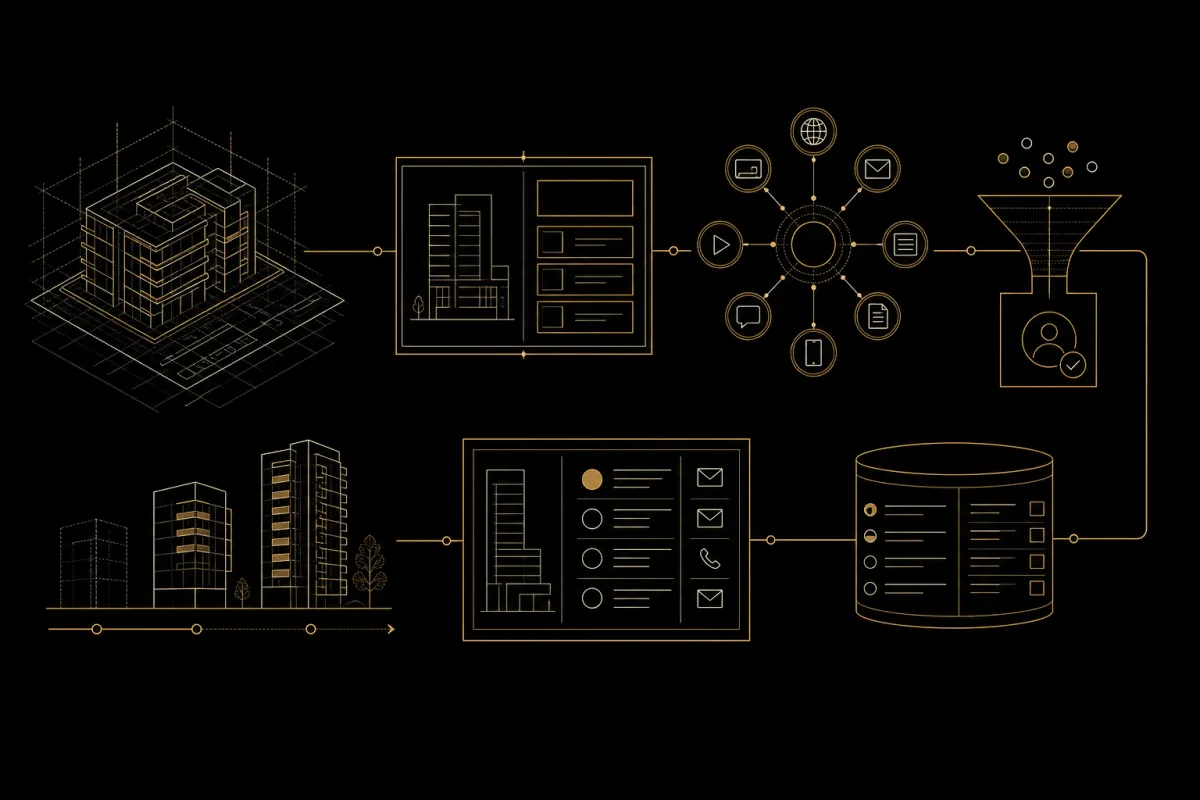
Project launch system
A launch system, not a collection of ads
Positioning, channel execution, lead qualification and sales follow-through must work as one operation. The visual makes those handoffs explicit.
- Positioning
- Channel plan
- Qualification
- Sales follow-through
Who Our Paid Advertising Is For, and Who It Is Not For
This page covers the advertising arm of our real estate marketing system for developers, contractors, and real estate companies: paid campaigns, landing pages, and complete measurement through to the deal. Before getting into channels and tactics, it is worth confirming that this is the right service for you.
A good fit if
You are approaching presale or launch and need a list of serious prospects, not a list of curious browsers. Your project is under construction, inquiry volume has slowed, and the existing campaign reports clicks alone. You have only a few units left, so audience and message precision matter more than volume. Or the project has genuine potential among English speakers and overseas buyers, but you have no structured way to reach them.
Probably not a fit if
You want to buy leads at a fixed price per inquiry without investing in qualification, landing pages, or follow-up. There are cheaper providers for that. Nobody on the project can respond to inquiries within hours. Without a response operation, even excellent media is wasted. Or you expect a commitment to a fixed number of deals in advance. We do not promise outcomes we cannot control, and we say so in the first meeting.
"Quality Leads" Is Not a Promise. It Is a Measurable Definition
Almost every provider in the market promises quality leads. Few are willing to define the term. For us, a qualified lead is an inquiry that meets five conditions: a budget aligned with the project prices, a relevant target city or area, a defined purchase timeframe, reasonable financing capacity, and willingness to speak. Everything else is a click that left a phone number.
Once the definition is agreed in advance, the campaign can be managed toward it. Audiences, messages, and qualification questions can be changed until the share of suitable inquiries rises. Without a definition, the monthly report measures what is easiest to count: clicks and cost per inquiry. That difference is precisely the difference between a media vendor and a marketing partner.
There is also a market reality worth understanding. Some providers sell real estate leads from a price list. According to published industry price lists, a real estate inquiry is sold for ₪90 to ₪150 plus VAT, and the same inquiry is sometimes sold to more than one buyer. Price per lead tells you very little because the number that should govern decisions is cost per deal. We explain the full method, definition, qualification, and measurement in How to Generate Qualified Real Estate Leads.
Channel Strategy by Project Stage, Not by Habit
The opening question in any media plan is not "how much should go to Facebook?" It is where demand already exists. People who are actively searching type queries such as "new-build apartments" together with a city or neighborhood name, and Google Search is where we meet them. Audiences who do not yet know the project need to encounter it through Meta, video, and content channels. A second distinction sits on top of that: cold versus warm audiences. Someone who has visited the page, watched a video, or submitted details deserves a different budget and message from a first-time viewer.
There is also a local versus international axis. For suitable projects, we run English campaigns supported by our English-language platform, which already reaches English speakers in Israel and abroad. An ordinary Hebrew campaign does not reach this audience. The difference is not a translation of the advertisements, but a different message, channel mix, and sales process.
| Project stage | Marketing objective | Primary mix |
|---|---|---|
| Pre-launch and presale | Build a qualified prospect list | Meta for demand creation, video, and a registration page with qualification questions |
| Launch | Capture demand and book meetings | Google searches for the city and project, warm audiences on Meta, and remarketing |
| Construction | Maintain steady inquiry volume at a controlled cost | Focused search, continuous remarketing, and audience refinement using CRM data |
| Sales tail and final inventory | Target specific units precisely | Narrow search, custom audiences, and proactive re-engagement of the existing inquiry database |
Google Ads: Capture Existing Demand Without Burning Budget
Google is the active-demand channel. People searching there are looking now. We build search around three layers of queries: the project and developer names, which provide inexpensive brand protection after other campaigns create searches; city and neighborhood queries, the commercial core built around variations of "new apartments in..."; and broader queries, which are opened only when enough conversion data exists to judge them responsibly.
Search campaigns are the foundation. PMax is introduced only after high-quality conversions are available to train the system. Otherwise, the algorithm learns from the wrong inquiries and brings in more of them. The Display Network is used mainly for remarketing, and YouTube warms an audience before launch. What we block matters just as much: negative keywords filter out resale, rental, job, and listings queries so the budget does not leak into searches that will never buy a new apartment.
Measurement must cover every inquiry route. Forms, phone calls, and WhatsApp messages are counted as conversions, and qualification status from the CRM is fed back into the campaign so optimization pursues suitable inquiries rather than form fills. We set out the practical comparison, when to use Google, when to use Meta, and how to divide budget, in Google and Meta Advertising for a Real Estate Project.
Meta: Create Demand and Build an Audience Around the Project
On Facebook and Instagram, the project reaches people who did not search for it, so creative is the central variable: exterior and interior renderings, short video from the site, apartment-plan carousels, and a distinct message for each audience. An investor, a young family, and a move-up buyer do not buy the same apartment for the same reason, so they should not see the same advertisement.
The familiar decision is between an in-platform lead form and a landing page. A native form reduces friction and produces cheaper volume, but it qualifies less effectively. A landing page asks more of the visitor and therefore filters more strongly. Most projects need both: native forms with required qualification questions when volume matters, and landing pages when precision matters more than quantity.
The audience layer is built from your own data: custom audiences from the CRM, lookalikes based on inquiries that met the quality definition rather than everyone who left a phone number, and remarketing to video viewers and page visitors. Creative testing runs continuously, with one recurring question: what percentage of suitable inquiries does each advertisement produce, not merely what did its lead cost?
Supporting Channels: When They Earn a Place in the Budget
None of the following should be the first channel for a residential project, but some earn a role in the right mix. Every one is judged on the same measurement ladder as Google and Meta.
TikTok and short-form video
Useful for reach and familiarity, particularly for urban projects and younger audiences. It is measured as a contribution to the funnel, not as a closing channel. Anyone expecting inexpensive direct inquiries from it is usually disappointed quickly.
Relevant mainly for luxury assets and investor inquiries. It is considerably more expensive than the other channels. One published professional source cites more than ₪1,000 per inquiry on this channel. We use it only when there is a clear business case and the deal value justifies the cost.
Taboola, Outbrain, and content distribution
Inexpensive traffic with weak intent. The right use is amplification of articles and project content, and performance is judged by the percentage of suitable inquiries, not cost per click.
WhatsApp, email, and SMS
These are not acquisition channels. They are conversion channels for the database already built: staged follow-up sequences with a daily cap, automatic stopping as soon as the prospect responds, and no sends on Shabbat. This is how we operate our own system, and it is what turns an old inquiry list into new meetings.
Portals, communities, and partnerships
Project portals provide baseline visibility. Communities and newsletters, particularly those serving English speakers in Israel and abroad, bring a focused audience that ordinary media misses. Partnerships with complementary professionals are evaluated deal by deal, just like any other channel.
A Landing Page That Qualifies, Not Just Collects Details
The landing page is where many media budgets are lost quietly. The advertisement worked, the click was paid for, and the page failed. These are the principles we use:
- One message: one project, one audience, one offer. A generic page that tries to address everyone converts poorly for everyone.
- Substance before the form: price ranges, apartment plans, construction stage, specification, and surroundings. A prospect who receives real information arrives at the conversation more seriously.
- Qualification questions in the form: budget, city, transaction type, and timeframe. These are the same fields we use in our own pipeline.
- Phone and WhatsApp alongside the form. Many buyers would rather speak than fill out fields.
- Mobile loading speed and message continuity. A promise made in the advertisement and missing from the page burns trust along with budget.
- Complete event tracking: form submission, call, and WhatsApp click. Without it, there is nothing reliable to optimize.
The Measurement Ladder: From First Inquiry to Revenue by Source
Cost per lead, or CPL, is the beginning of measurement, not the end. Two channels can deliver inquiries at the same price while one fills the calendar with meetings and the other fills the CRM with phone numbers that never answer. The difference becomes visible only as you move up the ladder, source by source:
Unique inquiry
Every form, call, and WhatsApp message enters one pipeline with full attribution to the channel, campaign, and advertisement.
Qualified lead
The inquiry is tested against the definition agreed in advance: budget, city, timing, financing, and willingness to speak.
Contact established
Response time is measured. An inquiry that waited a full day is a management finding that needs correction, not an isolated mishap.
Meeting
Cost per meeting by source reveals which channels only appeared inexpensive and which ones improve deeper in the funnel.
Deal and revenue
Deals are connected back to both first and last source, and the next budget is allocated by cost per deal rather than cost per lead.
We explain the operating layer behind this ladder, inquiry intake, deduplication, routing, follow-up sequences, and weekly reporting, on our CRM, Automation, and Marketing Measurement page.
What We Can Show Today
We will not present client case studies here because we do not yet have material that can be verified and published. When we do, we will publish it with numbers and dates. What we can show is the system we operate for ourselves, using the same tools and measurement method we offer you:
Source: Google Search Console and the CRM for semerenkogroup.com, checked July 2026.
These figures demonstrate operating and measurement capability. They are not a promise of results for your project, and we say so explicitly because that is how we would want data presented to us. What we measure, how we measure it, and what we will agree to publish are set out on our Results and Methodology page.
Questions Developers Ask
How much media budget does a residential project need?
There is no single correct figure. The budget depends on the number of units, average price, required sales pace, and local competition. One published professional source cites a rule of thumb of about 1% of project sales value as the marketing budget. We prefer to build the budget from the bottom up: target deals, realistic conversion rates between funnel stages, and inquiry costs measured in the actual market.
How quickly will inquiries start coming in?
Initial inquiries usually arrive within days of launch. A reliable view of quality takes weeks and a sufficient number of inquiries that have been qualified and contacted. Budget decisions should be based on funnel data, not on how the first week feels.
Google or Meta, where should we start?
It depends on existing demand. If people already search for the city, neighborhood, or project, start with Google Search. If the project is new and demand for it does not yet exist, Meta builds the audience. Most projects run both channels in parallel, with the mix changing by stage.
Do you guarantee a number of leads or deals?
No. In our view, it is worth asking anyone who does make that promise exactly how they measure it. We commit to what we can control: an agreed quality definition, full data transparency, and measurement that reaches the signed deal.
Will campaign inquiries also be sent to competitors?
No. Inquiries generated by the project campaigns belong to the project and enter your system directly. That is materially different from buying leads, where published price lists show that the same inquiry may be sold to more than one party.
What happens after an inquiry comes in?
It is routed by project and language, answered with response time measured, placed into an automated follow-up sequence that stops as soon as the prospect replies, and documented at every pipeline stage. An inquiry forgotten in an inbox is the fastest way to waste good media spend.
Get a Media Plan for Your Project
Tell us about the project: stage, location, number of units, and target audiences. We will come back with a proposed channel mix, a measurement structure through to the deal, and an assessment of landing-page readiness. No generic deck and no commitment required from you.