Marketing Real Estate Projects to Overseas and English-Speaking Buyers
Most Israeli projects market only in Hebrew, excluding buyers in New York, London and Toronto, as well as English speakers in Ra'anana and Beit Shemesh. We already reach them: 58% of clicks to our platform come from outside Israel. Our developer-side work can run in Hebrew, while the buyer experience is native English.
- Search impressions
- 8.69M
- Clicks outside Israel
- 58%
- Attributed inquiries
- 350+
Project launch system
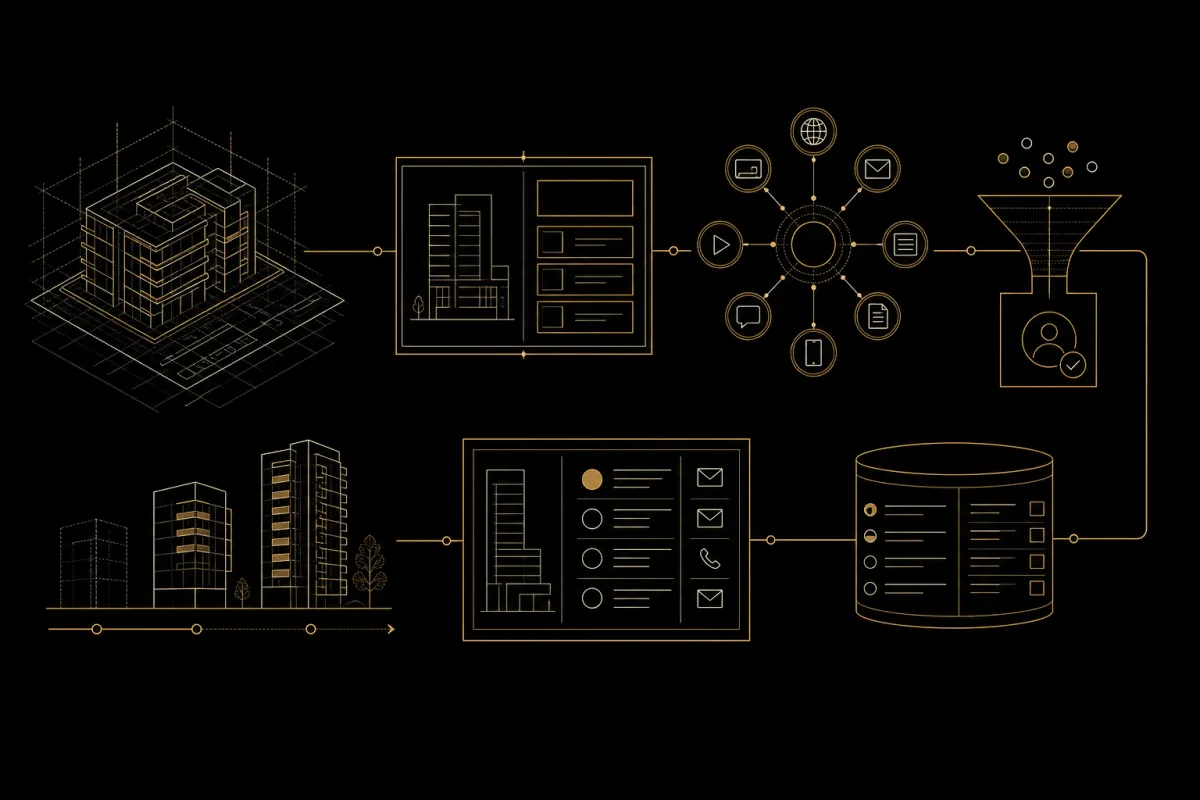
A launch system, not a collection of ads
Positioning, channel execution, lead qualification and sales follow-through must work as one operation. The visual makes those handoffs explicit.
- Positioning
- Channel plan
- Qualification
- Sales follow-through
Who This Service Fits, and When We Will Say No
This is one of five service areas in the real estate marketing system for developers, contractors and property companies that we operate. It is also the distinction that first brings many developers to us: a bilingual bridge to an audience the local market rarely knows how to reach. Project marketers work in Hebrew with Israeli audiences. English-speaking brokers tend to work with the buyer alone. There are few operators in the middle connecting the developer to a buyer abroad.
We should be clear from the outset: the service does not fit every project. Overseas demand concentrates in particular cities, neighborhoods and segments, and the decision cycle is longer than for a local buyer. We therefore begin with a suitability assessment. If there is no fit, we say so and do not take the work.
When there is a real basis for work
- Jerusalem, coastal cities and cities with established English-speaking communities, including Netanya, Ra'anana, Modi'in, Beit Shemesh and similar markets
- Luxury and second-home projects in city centers or near the sea
- A project close to a community, synagogues and educational institutions this audience seeks
- A unit mix relevant to both families planning Aliyah and investors, with a specification that can be explained remotely
- A developer prepared for a months-long process and serious treatment of English inquiries
When we recommend not proceeding
- A city or neighborhood without an external demand anchor: no community, second-home demand or clear remote-investment case
- A need to sell within weeks: a pressured sales tail does not match a cross-border decision cycle
- An expectation that an "Aliyah wave" will do the work without assets and an operating process
- No willingness to answer in English, even through an initial qualification layer on our side
Why a Hebrew Campaign Does Not Reach the Buyer in New York
Start with context the market often skips. According to published industry data, overseas-buyer purchases fell in May 2025 to roughly 130 transactions a month, compared with 180 to 200 a month in preceding years. Anyone selling a story of an enormous diaspora wave is selling a slogan. The sound business conclusion is different: these buyers exist, they concentrate in specific cities and segments, and they are harder to win. A developer that builds a credible bridge meets substantially less competition for their attention.
This buyer does not consume Israeli media. They do not pass the project's fence advertising, read Hebrew property supplements or search Google in Hebrew. They type English queries such as new construction projects in Israel. The answers are rarely supplied by the developer. Brokers, portals and sponsored articles meet the buyer first. The lead forms with an intermediary, and the developer encounters it later, after commission, without control of the message and sometimes after trust has already formed elsewhere.
Even when the inquiry reaches the sales office, it often erodes. There is no continuing English response, no orderly answer on purchase tax for a nonresident or financing without residency, and no availability during New York evening hours. An expensive inquiry dies in treatment. The issue is not demand alone. It is the operating ability to meet it.
The Audiences: Who Buys From Abroad and What Drives Each Group
Overseas buyers are not one audience. Each group has different motivations, sensitivities and decision paths. The right mix follows from project city, price and inventory. These are the groups we work with in practice:
Americans and Canadians
The largest and most organized segment, with established communities, synagogues and organizations. Decisions are often made as a family. Buyers ask about community and schools and can accept off-plan purchases when trust, documentation and guarantees are properly explained.
British buyers
Demand centers in London and Manchester, often directed toward Jerusalem, Netanya and central Israeli cities. These are considered, value-led buyers who pay attention to sterling-shekel movement and ancillary costs.
English speakers already in Israel
New and long-term immigrants who continue to search, read and compare in English. This is the group closest to a transaction. They know the market and primarily need content and service in their language.
People planning Aliyah and new immigrants
They plan a purchase before Aliyah or soon after it. A payment schedule extending to occupancy can solve a timing gap, while tax and eligibility questions require precise answers rather than headlines.
Overseas investors
They compare yield, currency and alternatives in their home market. Market data, transparency and direct answers about tax and property management persuade them, not superlatives.
Second-home and luxury buyers
A home for holidays, summer and family, primarily in Jerusalem and along the coast. They care about finish quality, property management while absent and discretion throughout the process.
What Changes for an Overseas Buyer: Language, Tax, Trust and Distance
The difference between local and overseas buyers is not simply language. It is a complete set of expectations, and each unaddressed gap can quietly end a deal. This table summarizes the main differences and what they require in marketing and sales:
| Issue | The Overseas-Buyer Gap | What It Requires |
|---|---|---|
| Language and measurements | "4 rooms" and square meters may be unfamiliar; the buyer thinks in bedrooms and square feet | Content written originally in English, converted measurements and specifications explained in familiar terms |
| Currency | The buyer budgets in dollars or sterling, so exchange-rate movement changes the effective price | Price and payment schedule expressed in foreign-currency terms with a clear exchange-rate disclaimer |
| Tax | Nonresident purchase tax is 8% up to the threshold and 10% above it under a temporary provision, as of July 2026; buyers may also fear double taxation | An English tax page and expectation-setting at inquiry stage, not first meeting |
| Financing | A nonresident mortgage generally has a lower loan-to-value limit and substantial document requirements | Early screening for equity and funding source, with structured referral to financing professionals |
| Trust | The buyer cannot visit the sales office easily and may fear delays, fraud or abandonment after signing | English explanations of Sale Law guarantees, evidence on the developer and delivered projects, and video tours |
| Process | Remote purchase may require power of attorney, signing before a notary or consul, and independent legal counsel | A step-by-step English process map showing who does what, when and with whom |
| Timeline | The decision cycle is longer; a visit to Israel is a stage in the process, not its beginning | Patient follow-up aligned to the buyer's time zone and an efficient visit planned in advance |
| Handover and defects period | The buyer may not be in Israel at handover or during the defects period | An upfront explanation of handover, repairs and property management in the buyer's absence |
| Neighborhood and community | The buyer does not know the area and asks about community, education and services | English city and neighborhood content at a level of detail a local buyer does not need |
The tax item deserves particular care. These figures must remain accurate and current at every buyer touchpoint. One incorrect purchase-tax answer can undermine trust in the entire conversation.
What Is Included: English Assets and Active Distribution Channels
The service has two halves: what we build for the project and how we bring it to the audience. An asset without distribution is an orphan page. Distribution without a credible asset burns budget on an audience that receives no answers.
The marketing assets we build
- An English project page written originally in English, with price, ancillary costs, payment schedule and basic tax answers
- An English digital sales brochure designed for remote reading rather than translated from the Hebrew version
- An explanatory video and filmed tour that replace the first physical visit
- An overseas-buyer FAQ covering tax, financing, remote purchase, guarantees, handover and defects
- English city and neighborhood content covering community, education, transport and services
- An English introduction to the developer and team: who you are, what you have delivered and who supports the buyer
- An English WhatsApp channel, Zoom meetings and follow-up sequences aligned to time zones
Distribution channels
The anchor is the audience already on our platform. Our English content platform holds market data for 203 cities and 1,371 neighborhoods and receives tens of thousands of English-interface users interested in Israeli real estate each year. Around that anchor, we use complementary channels:
- English SEO for purchase queries on which we already rank
- A newsletter for registered English-speaking prospects
- Jewish communities and organizations in North America and Britain, and Aliyah professionals
- Webinars and video meetings for potential buyers
- English-language public relations in media the audience actually reads
- Paid Google and Meta campaigns abroad with geographic targeting, as part of our digital advertising and lead generation system
The practical process, from selecting target countries for the project through the recurring mistakes developers make, is detailed in How to Market an Israeli Project to Overseas Buyers.
The Process: Six Stages From Fit Assessment to Deal
Fit assessment
Analyze the project against existing demand by city, neighborhood, unit mix, price and proximity to communities. If there is no real audience in our platform and channels, we say so here and save the budget.
Audience and target-country mapping
Determine who genuinely buys in this city and segment: Americans, British buyers, people planning Aliyah, investors or second-home buyers. The map determines messages, channels and budget.
Asset production
Build the project page, brochure, video, tax and process pages in native English, using the buyer's terms and the figures needed to progress.
Distribution
Activate our existing audience, organic queries on which we already rank, newsletter, communities, webinars and geographically targeted paid campaigns under one measurement layer.
Screening and follow-up
Every inquiry passes structured screening for budget, purchase purpose, city, timing, Aliyah status, available equity, funding source, availability to visit Israel, decision-makers and willingness to join a video call. Follow-up runs through WhatsApp and email, aligns to the buyer's time zone, stops automatically on reply and sends nothing on Shabbat.
Measurement through the deal
Reporting does not stop at inquiries. The funnel covers inquiries, qualified leads, meetings, visits to Israel and deals, with complete source attribution at every stage and a fixed weekly report.
The Evidence: The English-Speaking Audience Already on Our Platform
We do not merely promise access to this audience. We show it. Our English-language platform has operated for years and its figures are measured:
Source: Google Search Console, GA4 and the CRM for semerenkogroup.com, checked July 2026.
The geographic click breakdown tells the story: Israel 27,784, United States 20,734, United Kingdom 4,754, Canada 2,250, France 1,050 and Australia 1,014. As of July 2026, the site ranks on Google's first page for queries including Anglo communities in Israel, English speaking communities in Israel, new construction projects in Israel and mortgage in Israel for foreigners. These are the queries overseas buyers type before they know which project to seek.
You can verify the platform directly. Our English-language platform is public, and the rankings can be checked in search. The methodology, weekly report structure and data limits appear on our Results and Methodology page.
The limit matters: these figures prove an audience and access to it. They do not promise a sales pace for a specific project. That is why our process begins with a suitability assessment rather than a guarantee.
Questions From Developers
Is there genuine overseas demand now, or only headlines?
Demand is below its peak, and we publish the figures above. It has not disappeared. It concentrates in Jerusalem, coastal cities, locations with English-speaking communities, and second-home, luxury and Aliyah-related segments. A project that fits one of those segments may face less competition for buyer attention today, not more.
Our project is not in Jerusalem or Netanya. Can this still be relevant?
It depends on the anchors: an English-speaking community in or near the city, institutions the audience seeks, or an investment case that can be explained remotely. Some cities produce a positive and surprising answer. For other projects, our fit assessment will show that their budget should work harder in different channels.
Our sales team is not strong in English. How does this work?
We screen and support the initial stage in English through responses, qualification questions, materials and video-call coordination. Your team receives a developed inquiry with full context. For meaningful meetings, we prepare a script and support in advance, including English tax and financing answers. What does not work is leaving English inquiries in a general inbox.
How long until the first inquiries arrive?
Paid channels and our existing audience can produce inquiries within weeks. Organic and community channels build over months. More importantly, the overseas-buyer decision cycle is longer than the local cycle because a visit to Israel is often one stage along the way. This is a service for a project with a sales horizon, not emergency relief for inventory that must sell within a month.
We already translated the project website into English. What is different here?
Translation is the smallest part and is often too literal. The real difference has three parts: content written in the buyer's terms, including currency, measurements, tax and remote process; access to an audience already searching in English; and the operational treatment of the inquiry over months. A translated page without these three elements is an orphan page.
How will we know whether the budget works?
By measuring through the deal rather than counting clicks. Every inquiry receives source attribution, moves through defined screening stages and appears in a weekly report with a full funnel of inquiries, qualified leads, meetings and deals. Each month, the decision to expand, change or stop rests on data rather than instinct.
Assess Whether Your Project Has an English-Speaking Audience
Send the basic project facts: city, stage, number of units and mix. We will return with a candid assessment of whether the project has an audience on our platform and channels, which segments are relevant and what is required to meet them. If the answer is no, we will say so.