Israel’s housing market is no longer moving as one national story. Prices have softened in some areas, rents keep climbing in others, and developers are increasingly competing for buyers through quiet incentives rather than headline price cuts.
For families, investors, and builders, the strongest opportunities are now highly local. Demand is most durable near schools, transit, employment hubs, renewal zones, and established communities where people have strong reasons to stay.
The Market Has Changed Shape
- National home prices are under pressure, with market data pointing to a modest year-over-year decline.
- Rents remain firm, especially in family-heavy and supply-constrained cities.
- Developer incentives are becoming a clearer price signal than advertised asking prices.
- Urban renewal and infrastructure corridors now matter more than broad market timing.
- Israel’s strongest opportunities are increasingly local, not national.
Israel’s Housing Market Is Cooling, But Not Cracking
Israel’s residential market has shifted into a two-speed cycle. Buyers have more leverage in selected areas, while renters continue to face pressure in cities with tight supply and strong demographic demand.
This is not a collapse. It is a repricing of risk, financing, and location after years of overheated demand.
National residential prices have declined modestly year over year, while rents have continued to rise. That split matters because purchase prices and rental demand are no longer moving in the same direction.
Globes, citing Israel’s Central Bureau of Statistics, reported that apartment prices fell 0.1% in January-February 2026 compared with the previous period and were down 1.7% year over year. It also reported a 0.4% rise in Israel’s March 2026 Consumer Price Index.
This does not mean Israel’s housing demand has disappeared. It means affordability, financing costs, and unsold developer inventory are forcing more realistic transactions.
The strongest assets are not necessarily the newest or most glamorous. They are homes tied to durable demand: schools, synagogues, transit, employment hubs, immigrant communities, and renewal potential.
Why Beit Shemesh Looks Like Israel’s Family-Demand Laboratory
Beit Shemesh and Ramat Beit Shemesh remain among the most compelling demographic stories in Israeli housing. Their strength comes from a clear formula: growing families, Anglo immigration, religious community infrastructure, and prices that remain below Jerusalem’s most difficult entry points.
Market data points to rental increases above 17% in some segments, low vacancy in established Anglo-family areas, and typical gross yields around 3.2% to 4.2%.
That is notable because Global Property Guide’s Israel rental-yield data places the national gross rental yield around 3.15% for Q1 2026.
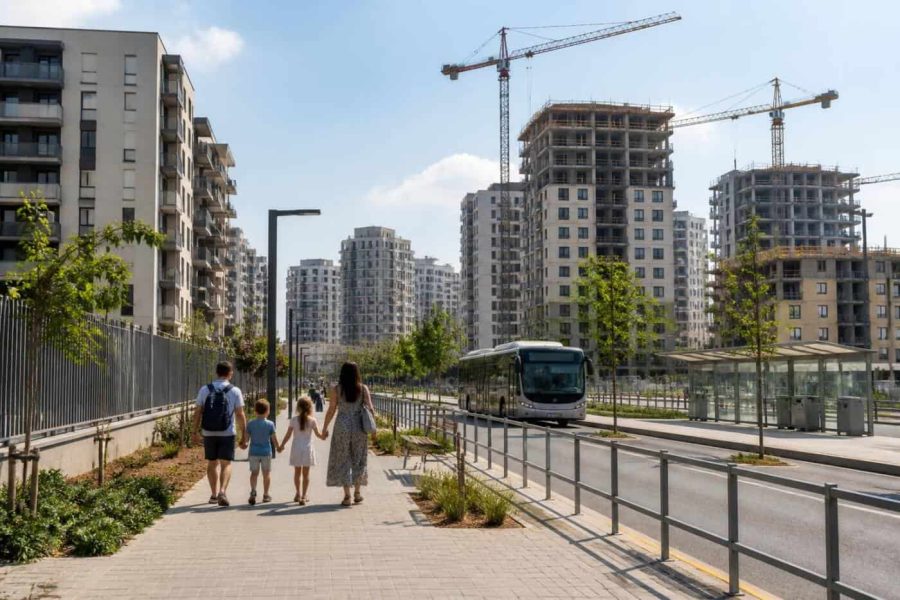
Ramat Beit Shemesh is also expanding through RBS Daled, Neve Shamir/Hei, Mishkafayim, mixed-use corridors, and major apartment pipelines.
The most revealing signal is not only the number of cranes. It is the financing.
Developers are reportedly using 10/90 payment structures, launch discounts, madad exemptions, and flexible resale terms. A 10/90 structure usually means the buyer pays 10% upfront and 90% later. Madad refers to index-linked adjustments, often tied to construction or inflation measures.
Those incentives suggest developers want faster absorption. In plain terms, they want units sold before financing pressure becomes more visible.
Jerusalem’s Best Bet Is Not Luxury, But Transformation
Jerusalem remains structurally constrained, but its opportunity map is changing. The strongest long-term case is not foreign-buyer luxury. It is transit-adjacent urban renewal in older neighborhoods where density, zoning, and infrastructure can change the value equation.
Market estimates place Jerusalem median prices around ₪2.7 million, with typical gross yields of roughly 3% to 4%, depending on neighborhood and unit size.
Smaller apartments continue to perform better on yield efficiency because rent does not always rise proportionally with apartment size.
The most important corridors include Kiryat Yovel, Katamonim, Arnona/Talpiot, and the city entrance redevelopment zone.
These areas combine older housing stock, improving transport, and demand from local families who cannot easily leave Jerusalem’s education, employment, and community networks.
Jerusalem’s renewal is not just a real estate story. It is also a national resilience story. Keeping working families in the capital requires more homes in better-connected neighborhoods.
Can Tel Aviv Still Reward Buyers?
Tel Aviv remains Israel’s scarcity capital. But scarcity alone no longer gives every seller unlimited power. Rents are rising, transaction activity has slowed, and some boutique developers appear more willing to negotiate.
Market data points to Tel Aviv rent growth around 4% to 7% year over year, with some datasets placing average city rents near ₪11,844 per month.
Yet Tel Aviv’s yields remain compressed. Long-term gross yields are typically estimated around 2.5% to 3.5%, while net yields can fall below 2% after ownership costs.
Global Property Guide’s Q1 2026 data places average gross yields for Tel Aviv-Yafo apartments around 2.98%, below the national average.
That makes Tel Aviv an appreciation and scarcity market, not a classic income market.
The strongest opportunities are selective: Florentin, Shapira, Jaffa fringe areas, and transit-linked corridors. Furnished mid-term rentals, smaller renovated units, and apartments near employment hubs offer better rental logic than expensive prestige assets.
The most mispriced segment may be boutique projects under financing pressure. When developers need absorption, quiet discounts can matter more than public price lists.
The Anglo Belt Is Holding Up
Netanya, Ra’anana, Modi’in, and parts of Beit Shemesh show why community infrastructure is one of Israel’s most underrated real estate fundamentals. These markets are not only about apartments. They are about schools, absorption networks, language comfort, synagogues, and family continuity.
Netanya remains a strong Anglo and French lifestyle market, driven by retirees, coastal migration, foreign buyers, and relative affordability compared with Tel Aviv.
However, buyers should be careful about overpaying for trophy sea-view towers. Better value may sit in second-line streets, older coastal buildings, and future urban renewal zones.
Ra’anana’s strength is different. It is an Anglo-family ecosystem built around schools, immigrant absorption, commuter access, and communal familiarity. The most attractive plays are older homes near schools, redevelopment-capable lots, and townhouse assembly opportunities.
Modi’in remains a stability market: planned, family-oriented, commuter-friendly, and less yield-driven. Its weakness is compressed returns. Its strength is retention.
In these cities, upside is less about buying any apartment and more about buying land-like optionality: lots, older buildings, and assets that can be improved or redeveloped.
Herzliya Shows the Limits of Prestige Pricing
Herzliya remains expensive for good reasons: technology wealth, coastal access, marina demand, and international buyers. But high prices compress yields, making prestige inventory less attractive for income-focused investors.
The better opportunity sits in secondary mixed-use zones, older stock near employment corridors, and redevelopment-capable low-rise buildings.
That is a broader lesson for Israel’s premium markets. When prices already assume perfection, the investor’s edge shifts to imperfect assets in improving locations.
The less obvious street can beat the famous address if zoning, transport, and employment access improve together.
Rehovot and Givat Shmuel Are Quietly Strategic
Rehovot increasingly benefits from science-sector spillover, transport improvements, and affordability migration from central Israel. It appears structurally undervalued relative to the quality of its employment base.
The strongest opportunities are small-unit rentals near institutes, aging buildings in improving neighborhoods, and mixed-use redevelopment corridors.
Givat Shmuel has a different profile: Tel Aviv proximity, religious-national demographic demand, and university adjacency. Inventory remains constrained.
Its best opportunities are older apartments with TAMA potential, subdividable larger units, and transit-adjacent redevelopment.
TAMA potential refers to redevelopment or strengthening rights linked to Israel’s seismic-upgrade framework. Even as policy structures evolve, the market still uses the term to describe buildings with possible redevelopment value.
Ashdod, Ashkelon, and Haifa Offer Yield, With Different Risks
Israel’s stronger yield logic is increasingly found outside the most expensive central markets. Haifa, Ashdod, Ashkelon, and Rehovot offer more compelling rent-to-price ratios than Tel Aviv core assets, though each carries different risks.
Ashdod remains resilient because of its port economy, stable communities, and continued French demand. Typical yields are often estimated around 3.5% to 5%.
Ashkelon is more volatile. Security concerns suppress pricing compared with central Israel, but that discount creates asymmetry for buyers who understand the risks. Its appeal lies in lower entry prices, stronger yields, infrastructure expansion, and possible repricing if stability improves.
Haifa stands out as one of the strongest yield markets among major cities. Entry prices remain lower than central Israel, rental demand is diversified, and renewal potential is significant.
Global Property Guide lists Haifa gross yields above Tel Aviv and Jerusalem in its Israel comparison, supporting the view that Haifa offers stronger income logic than the country’s most expensive markets.
The most attractive Haifa areas include Bat Galim, Hadar, Carmel-adjacent renewal zones, and downtown regeneration.
The Real Price Is No Longer the Asking Price
The most important national signal is psychological and financial: advertised prices increasingly overstate the true market-clearing price. Developers still care about public pricing optics, but cash flow, debt service, and inventory reduction now matter more.
This shift is visible in financing concessions, payment flexibility, and launch-stage incentives.
For buyers, that creates negotiating room. For developers, it creates a race to distinguish good inventory from slow inventory. For investors, it rewards diligence.
The best deals are not simply cheap. They are assets where the seller’s pressure is temporary but the location’s demand is durable.
Urban renewal is the common thread across Israel’s opportunity map. Older buildings lacking safe rooms, low-rise blocks near infrastructure, and properties likely to enter Pinui-Binui pipelines are becoming more valuable than standard resale units.
Pinui-Binui means “evacuation-construction,” a redevelopment model in which old buildings are demolished and replaced with denser new construction.
Israel Real Estate Opportunity Map
| Market | Current Signal | Strongest Opportunity | Main Risk | Summary |
|---|---|---|---|---|
| Beit Shemesh/RBS | Rent pressure and demographic growth | Anglo-family corridors, expansion neighborhoods, discounted developer stock | Overpaying before infrastructure matures | Strong family-demand market with financing-sensitive new supply |
| Jerusalem | Split between luxury, local family housing, and renewal | Kiryat Yovel, Katamonim, Arnona/Talpiot, city entrance | Low yields in expensive areas | Best upside lies in transit and urban renewal |
| Tel Aviv | Rents up, transactions slower | Florentin, Shapira, Jaffa fringe, boutique distressed projects | Very low net yields | Scarcity market, not income-first market |
| Netanya | Anglo/French lifestyle demand | Older coastal stock, second-line streets | Emotional pricing near the sea | Better value outside trophy towers |
| Ra’anana | Stable Anglo-family demand | Older homes near schools, redevelopment lots | High entry prices | Community infrastructure protects demand |
| Herzliya | Premium pricing and yield compression | Older stock near employment corridors | Prestige overvaluation | Best value away from marina glamour |
| Modi’in | Family retention and planning quality | Edge neighborhoods, slower-period family inventory | Compressed yields | Stability market with selective upside |
| Rehovot | Science and affordability migration | Small units near institutes, mixed-use corridors | Uneven neighborhood quality | Undervalued relative to employment base |
| Givat Shmuel | Constrained inventory near Tel Aviv | TAMA potential, subdividable units | Limited supply may inflate prices | Strong demographic and location logic |
| Ashdod | Port economy and French demand | Coastal renewal, larger older apartments | Coastal pricing discipline | Better yield than core-center markets |
| Ashkelon | Security discount and volatility | Lower-entry yield assets | Security and liquidity risk | Higher-risk asymmetry market |
| Haifa | Strong yield among major cities | Bat Galim, Hadar, downtown renewal | Asset quality varies widely | Income and redevelopment optionality |
Buyer and Investor Checklist
- Test the real price, not the asking price. Ask what incentives, payment terms, madad exemptions, or closing flexibility are available.
- Prioritize durable rental ecosystems. Schools, transit, universities, hospitals, ports, and employment corridors matter more than glossy brochures.
- Verify renewal potential independently. Check zoning, tenant consent requirements, municipal plans, and realistic timelines.
- Compare gross and net yields. Maintenance, vacancy, tax, financing, and management costs can turn a good headline yield into a weak investment.
- Avoid emotional pricing. Sea views, luxury lobbies, and prestige addresses can hide poor rental economics.
- Track absorption pressure. Slow-selling projects may create opportunity, but only if the location has long-term demand.
- Stress-test security and liquidity, especially in more volatile markets such as Ashkelon.
Glossary
| Term | Definition |
|---|---|
| Gross yield | Annual rent divided by purchase price before expenses, taxes, financing, vacancy, and maintenance. |
| Net yield | Rental return after costs such as maintenance, taxes, management, financing, and vacancy. |
| 10/90 financing | A payment structure in which the buyer pays 10% upfront and the remaining 90% later, often near completion. |
| Madad | An index-linked adjustment used in Israeli property contracts, often tied to construction or inflation measures. |
| TAMA | A term commonly used for seismic strengthening or redevelopment potential in older Israeli buildings. |
| Pinui-Binui | An urban renewal model where older buildings are evacuated, demolished, and replaced with denser new construction. |
| Absorption | The pace at which new housing inventory is sold or rented by the market. |
FAQ
Is Israel’s housing market crashing?
No. The data points to a split-cycle market, not a crash. Purchase prices have softened nationally, but rents continue rising in key areas.
That combination usually signals affordability stress, financing pressure, and slower transactions rather than a collapse in underlying housing need.
Where is the strongest rental pressure?
The strongest rental pressure appears in Beit Shemesh, Ramat Beit Shemesh Aleph, Tel Aviv, and Jerusalem family neighborhoods.
These markets benefit from constrained supply and durable tenant demand.
Is Tel Aviv still a good investment market?
Tel Aviv remains powerful for scarcity and long-term appreciation. But it is not the strongest cash-flow market.
Gross yields are generally low, and net yields can fall sharply after costs. Buyers should focus on smaller units, employment-adjacent locations, furnished rentals, and distressed boutique projects.
Why is Beit Shemesh so important?
Beit Shemesh combines affordability relative to Jerusalem, Anglo immigration, religious family growth, and expanding schools.
That creates unusually durable rental demand. But buyers should watch infrastructure timing and developer financing incentives carefully.
What is the biggest hidden opportunity?
Older buildings likely to enter TAMA, Pinui-Binui, or infrastructure-driven rezoning pipelines appear to be among the most mispriced assets.
Their value may come less from current rent and more from future redevelopment optionality.
Which cities offer stronger yield logic?
Haifa, Ashdod, Ashkelon, and Rehovot offer stronger yield-to-price logic than the most expensive central markets.
Haifa stands out among major cities because entry prices remain lower while rental demand is diversified.
What should buyers be most careful about now?
Buyers should avoid assuming that advertised prices equal real prices. In today’s market, incentives, payment terms, and developer pressure may reveal the true transaction level.
Independent legal, planning, and financing checks are essential.
The Practical Bottom Line
Israel’s housing market is rewarding precision. The old strategy of buying almost anything and waiting is weaker now. The better strategy is to locate forced flexibility, durable rental demand, and future planning upside.
The smartest buyers will not chase headlines. They will follow families, transit, schools, renewal maps, and developers who quietly need to sell.
Why This Matters
- Housing remains central to Israel’s national resilience because families need affordable, secure, well-connected communities.
- The market is not uniformly weak or strong; it is split by city, neighborhood, asset type, and seller pressure.
- Developer incentives are now a crucial price signal, especially in new projects.
- Urban renewal may be Israel’s most important housing opportunity, particularly in older buildings near transit and infrastructure.
- This market shapes where Israelis can build families, communities, and long-term security.