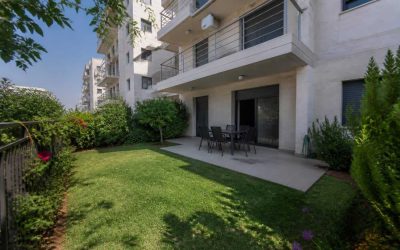

Ra’anana is not selling only apartments. It is selling predictability, school access, green space, and an English-friendly landing pad in Israel’s crowded center. For Anglo families and professionals, the city’s limited but active housing market shows a clear pattern: quality of life is now a primary driver of demand.
What Buyers Need to Know Now
- Family demand remains steady in Ra’anana, especially near schools, parks, and community services.
- Inventory is limited but varied, ranging from central apartments to garden homes, cottages, and penthouses.
- Indicative prices run from about ₪1.8 million to ₪3 million for standard four-room homes, and ₪3 million to ₪6 million-plus for larger family properties.
- Central and northern Ra’anana appear to absorb desirable listings fastest.
- Anglo buyers are responding strongly to quiet central locations, modern layouts, parking, and turnkey condition.
Ra’anana’s Housing Market Is Being Pulled by Lifestyle, Not Speculation
Ra’anana has long occupied a rare place in Israel’s Central District: suburban enough for families, connected enough for professionals, and international enough for English-speaking newcomers. That mix is now shaping buyer behavior, especially among families seeking stability near Tel Aviv’s employment corridor.
The city’s appeal rests on a practical Israeli equation: schools, parks, community infrastructure, and manageable access to major job centers.
For Anglo families, that equation matters. Moving to Israel is not only a property decision. It is a schooling decision, a language decision, a commute decision, and a social-integration decision.
Ra’anana answers many of those questions in one place.
The market points to year-round interest, not a narrow seasonal rush. That is important. In lifestyle-driven markets, demand tends to hold because buyers are not merely chasing square meters. They are buying community fit.
The strongest signal is not just price. It is what listings emphasize: quiet streets, central access, family layouts, parking, and proximity to schools or community centers.
In other words, the market is rewarding homes that reduce friction.
Why Are Anglo Families Looking So Closely at Ra’anana?
For English-speaking families, Ra’anana offers something many Israeli cities struggle to package clearly: a soft landing without abandoning Israeli life. Its established Anglo networks, education options, parks, and community rhythm make the city especially attractive for families building long-term roots.
That does not mean Ra’anana is cheap.
Standard four-room homes sit roughly in the ₪1.8 million to ₪3 million range. Larger family units, garden properties, and premium homes move into the ₪3 million to ₪6 million-plus bracket.
Those figures should be treated as indicative, not definitive transaction data.
Still, the pattern is clear.
Family-sized homes near strong schools and community infrastructure are the center of gravity. Central and northern Ra’anana appear to draw the quickest buyer response, especially where homes are walkable to everyday needs.
This is classic quality-of-life demand.
Buyers are paying attention to how a home functions on a Wednesday morning, not only how it photographs on a listing page.
Limited Inventory Is Giving Well-Positioned Homes an Edge
Ra’anana’s inventory is limited but active, which creates a familiar Israeli market tension: buyers have options, but not unlimited leverage. Homes that combine space, condition, location, and community access are positioned to move faster than generic listings.
The mix is broad.
The market includes central apartments, garden homes, cottages, and penthouses. That variety matters because Anglo buyers are not a single bloc. Some are young professionals. Some are families with several children. Others are downsizers seeking community without urban overload.
Yet the most competitive segment appears to be family housing.
Homes with practical layouts, parking, and immediate livability carry a particular advantage. Turnkey condition matters because many relocating families want to avoid renovations during a school transition or professional move.
The demand signal is especially strong when a property combines three features:
- A quiet but central location.
- Easy access to schools or community centers.
- A modern layout suitable for family life.
That is where Ra’anana’s value proposition sharpens.
The city is not simply competing with nearby municipalities on price. It is competing on daily confidence.
Central and Northern Ra’anana Are Drawing the Fastest Attention
Central and northern Ra’anana stand out for faster absorption and stronger family demand. The reason appears straightforward: buyers want homes close to trusted schools, community services, and the city’s lifestyle anchors.
This is not unusual in Israel’s more established residential markets.
Neighborhood micro-location can matter as much as the property itself. A home several minutes closer to a school, synagogue, park, community center, or transit route can draw more serious attention.
Ra’anana Park also plays a role in the city’s broader appeal. Large green assets help families justify higher prices because they extend the usable living environment beyond the apartment or house.
For families moving from abroad, that can be decisive.
A smaller home near a park, school, and English-speaking network may feel more valuable than a larger home with weaker daily infrastructure.
Buyer behavior is already reflecting that preference.
The Real Message: Sell the Life, Not Just the Listing
The most effective positioning for Ra’anana is not simply “property for sale.” It is “family life with access.” That is the message resonating with Anglo families and professionals looking for fast viewings, school-zone clarity, and confidence before committing.
Homes that highlight proximity to schools, transit, lifestyle amenities, and community infrastructure appear to draw stronger interest. This is especially true when the property is central, quiet, modern, and ready for immediate use.
For agents, sellers, and relocation advisers, the lesson is simple.
A Ra’anana home should not be presented only as a set of rooms. It should be framed as a solution to the buyer’s first 18 months in Israel.
That means clear information on:
- nearby schools;
- walking routes;
- parking;
- community centers;
- Anglo-friendly networks;
- commute options;
- family suitability;
- viewing urgency.
In a limited-inventory market, clarity becomes a competitive advantage.
Ra’anana Buyer Signals at a Glance
| Market Feature | What the Market Shows | Why It Matters |
|---|---|---|
| Inventory | Limited but active | Buyers must move carefully, but not passively |
| Main property types | Apartments, garden homes, cottages, penthouses | The market serves both professionals and families |
| Indicative four-room range | ₪1.8 million to ₪3 million | Entry family housing is already a serious commitment |
| Larger family properties | ₪3 million to ₪6 million-plus | Space, gardens, and premium locations command a major jump |
| Strongest demand areas | Central and northern Ra’anana | School and community access shape buyer urgency |
| Key lifestyle assets | Parks, schools, community centers, Anglo networks | Daily livability drives demand |
| Fast-engagement features | Quiet central streets, modern layouts, parking, turnkey condition | Practical homes outperform vague listings |
Checklist for Anglo Families Considering Ra’anana
- Map the school commute first. A good home becomes stronger when the school route is realistic.
- Check community access. Nearby English-speaking networks can ease relocation stress.
- Prioritize layout over headline size. A smart four-room home may work better than a larger, awkward property.
- Ask what “central” means. Central can mean walkable convenience or traffic pressure.
- Verify parking and building condition. These details affect daily life and resale appeal.
- Move quickly on strong fits. Well-positioned homes can attract fast attention.
Glossary
| Term | Definition |
|---|---|
| Anglo families | English-speaking families, often from countries such as the United States, United Kingdom, Canada, South Africa, or Australia, living in or moving to Israel. |
| Central District | A major region of Israel that includes cities near Tel Aviv and important employment centers. |
| Four-room home | In Israeli real estate language, usually a home with a living room plus three bedrooms. |
| Garden home | A property with private outdoor garden space, often attractive to families. |
| Turnkey condition | A home ready for immediate use without major renovation. |
| Price absorption | The speed at which available properties attract buyers and leave the market. |
FAQ
Is Ra’anana mainly attractive because of price?
No. Ra’anana’s appeal is driven more by quality of life than bargain pricing.
Families are responding to schools, parks, English-friendly networks, central access, and homes that are ready for practical daily living.
What kinds of homes are available in Ra’anana?
The market includes central apartments, garden homes, cottages, and penthouses.
That range allows different buyer profiles to enter the market, from professionals seeking convenience to families needing more space.
What price range should buyers expect?
Standard four-room homes are roughly in the ₪1.8 million to ₪3 million range.
Larger family units and garden properties are described as moving into the ₪3 million to ₪6 million-plus range.
These are market-snapshot figures, not official transaction records.
Which parts of Ra’anana appear strongest?
Central and northern Ra’anana are seeing the fastest absorption and strongest family demand.
The key driver appears to be proximity to reputable schools, community centers, and daily amenities.
What property features get the fastest attention?
The strongest engagement appears around homes marketed as quiet but central, modern, spacious, and turnkey.
Parking, community access, and proximity to schools also matter.
Is this market only for families?
No. Professionals are also part of the demand picture, especially because Ra’anana is near major tech employers north of Tel Aviv.
Still, family-sized homes and school-linked demand are central to the city’s current appeal.
What Buyers and Sellers Should Do Next
Ra’anana’s market rewards preparation. Buyers should define school zones, commute needs, parking requirements, and community priorities before viewing homes. Sellers should present properties through the lens of daily family life, not only square meters and photographs.
The strongest opportunities will likely be the homes that make relocation feel less risky.
In Israel’s competitive center, that is a powerful advantage.
Final Summary: Why Ra’anana Matters Now
- Ra’anana is emerging as a lifestyle-first real estate market for Anglo families.
- Demand is strongest where homes meet school, community, and daily convenience needs.
- Limited inventory gives well-located, turnkey family homes an advantage.
- The city’s pro-family infrastructure strengthens Israel’s broader appeal to skilled immigrants and professionals.
- Ra’anana shows how Israeli cities can compete globally: not only through jobs and security, but through livable, rooted communities.