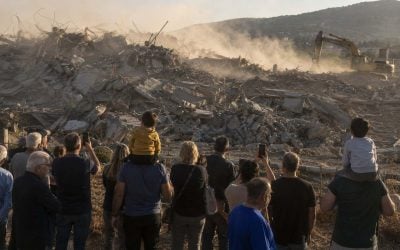
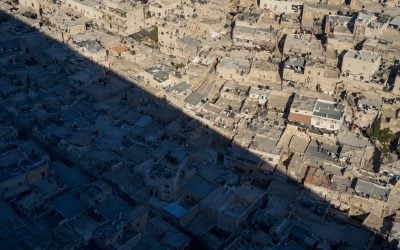
Netanya’s next housing story is not only happening on the waterfront. In Kiryat Nordau, an older southeastern neighborhood, street works, demolition crews, and active listings are converging into a clear market signal: Israel’s urban-renewal engine is moving from promise to pavement.
The Signal From Netanya
- Madlan displayed an average purchase price of ₪2,843,718 in Netanya and 1,491 apartments for sale on its city page. Source
- Netanya Municipality said infrastructure works in Kiryat Nordau include drainage lines, lighting, sidewalks, roads, and landscaping. Source
- The first works segment began on May 3, 2026, with closures affecting the Keren Hayesod–Maneh to Keren Hayesod–Shai Agnon area for about three months. Source
- Y.H. Dimri’s project is slated to replace 138 older apartments with 553 new units, a roughly fourfold increase in housing density. Source
- Current Kiryat Nordau listings show mid-market apartments alongside newer and larger options, indicating a neighborhood in transition. Source
Urban Renewal Is Becoming a Street-Level Reality
The most important fact in Netanya is not a single price tag. It is the collision of public investment and private construction. Urban renewal, meaning the replacement or rehabilitation of older housing with modern buildings and infrastructure, is now visibly reshaping Kiryat Nordau.
Netanya Municipality’s April 30, 2026 notice described a broad infrastructure upgrade in Kiryat Nordau, including drainage, lighting, sidewalks, roads, and landscaping. The first work segment began on Sunday, May 3, 2026, with a full closure to traffic and parking for about three months around part of Keren Hayesod Street. Source
That matters because infrastructure is often the unglamorous foundation of real estate confidence. Buyers may focus on balconies and kitchens, but daily life depends on roads, drainage, lighting, schools, sidewalks, and commute routes.
Kiryat Nordau’s upgrade also points to a broader municipal strategy. The city notice tagged the works under engineering, infrastructure coordination, night works, and urban renewal, signaling planning and execution rather than a cosmetic improvement alone. Source
Is Kiryat Nordau Becoming Netanya’s Next Absorption Test?
Kiryat Nordau is no longer just an older residential pocket southeast of central Netanya. It is becoming a practical test of absorption: how many buyers, renters, schools, roads, and local services can adjust as new supply enters an established neighborhood.
The clearest figure comes from the Dimri redevelopment reported by Netanya Net. The project is planned for 553 new housing units at an estimated investment of about ₪750 million. It began with the demolition of seven older train buildings containing 138 apartments, to be replaced by three towers of up to 36 floors and four seven-story buildings on Nordau Street. Source
That is a powerful density shift. The plan would create about 4.0 new apartments for every older apartment removed. The estimated investment equals roughly ₪1.36 million per planned unit, based on the reported ₪750 million budget divided by 553 units. Source
The project also includes more than apartments. Netanya Net reported about 583 square meters for public needs, including education and municipal uses, plus a synagogue, walking paths, open public space, and a commercial frontage of about 545 square meters. Together, those public and commercial components total 1,128 square meters. Source
The challenge is timing. Residents endure closures and construction before they enjoy the finished product.
Prices Show Demand, But Not a Simple Boom
Netanya’s market is not shouting; it is sending a more interesting signal. Citywide pricing is elevated, inventory is visible, and Kiryat Nordau still shows lower entry points than many newer coastal or central projects.
Madlan’s Netanya city page displayed an average purchase price of ₪2,843,718, average rent of ₪6,925, and 1,491 apartments for sale. These are market-platform figures, not official government statistics, but they provide a useful snapshot of listing conditions. Source
In Kiryat Nordau itself, Madlan’s listing page showed active apartments ranging from around ₪1.49 million for a two-room, 50-square-meter apartment to higher-priced family-sized units, including listings above ₪2.4 million and one larger five-room apartment listed at ₪3.69 million. Source
That spread matters. It suggests Nordau is not moving as one uniform market. Older stock, renovated apartments, garden units, and future towers are likely competing for different buyers. Families may focus on schools and road access. Investors may focus on renewal upside. Downsizers may value elevators, parking, and newer building standards.
The reported Dimri starting price of about ₪1.85 million for future units is also notable. Compared with Madlan’s displayed citywide average purchase price, that starting level is about ₪993,718 lower. The comparison is only illustrative, because project mix, size, floor, and timing differ, but it helps explain why buyers may watch Nordau closely. Source
The Commute-and-Schools Question May Decide the Market
Real estate in Israel is rarely just about square meters. It is about the school run, the exit to Highway 2, the bus stop, the shopping center, and whether grandparents can cross the street safely. Nordau’s renewal will be judged by those daily details.
Netanya Net described the Dimri site as close to educational institutions, shopping centers, parks, and major traffic arteries, including the Coastal Road. The report also said the project is expected to improve residential quality and contribute to renewing the urban fabric. Source
That is where infrastructure works become more than a municipal headache. Drainage upgrades can reduce future street failures. Lighting improves safety and evening walkability. Sidewalks and road upgrades improve daily mobility.
Still, buyers should not romanticize the transition. The city warned residents to use alternative routes and follow instructions from inspectors and police during the first work phase. Anyone buying or renting nearby should evaluate both the end-state promise and the short-term disruption. Source
What the Numbers Say
| Indicator | Reported Figure | What It Suggests |
|---|---|---|
| Netanya average purchase price | ₪2,843,718 | Citywide prices remain high enough to make lower-entry renewal areas relevant. Source |
| Netanya active sale listings | 1,491 | Buyers have visible supply, but quality and location still matter. Source |
| Nordau old units demolished in Dimri phase | 138 | Older stock is being physically removed, not merely discussed. Source |
| Planned new Dimri units | 553 | Roughly four times the removed housing count, supporting major supply growth. Source |
| Estimated project investment | ₪750 million | A large private commitment to neighborhood transformation. Source |
| Reported starting price for Dimri units | About ₪1.85 million | Potentially attractive relative to the displayed citywide average, depending on unit details. Source |
| Public and commercial space | 1,128 sq m combined | Renewal includes neighborhood functions, not only apartments. Source |
Buyer and Resident Checklist
- Map the closures before visiting, especially around the Keren Hayesod work zone and alternative routes during the three-month first phase.
- Compare old and new stock separately. A renovated older flat, a garden apartment, and a tower unit are different products.
- Ask about schools and commute times. Nordau’s value case depends heavily on daily access, not only future appreciation.
- Verify developer timelines. The Dimri report mentioned expected occupancy in about five years, so timing risk matters. Source
- Treat listing data as a snapshot. Confirm price, floor, parking, elevator, and building permit status before acting.
Glossary
- Urban renewal: The replacement or rehabilitation of older buildings and infrastructure with newer housing, public areas, and services.
- Absorption: The market’s ability to take in new housing supply through buyers or renters without excessive delay.
- Train buildings: Older elongated apartment blocks, common in parts of Israel, often targeted for redevelopment.
- Public needs space: Built area reserved for community functions such as education, municipal services, or religious use.
- Commercial frontage: Street-facing retail or business space that can activate sidewalks and serve residents.
- Active listings: Properties currently advertised for sale on a listing platform.
FAQ
What is happening in Kiryat Nordau now?
Kiryat Nordau is undergoing infrastructure upgrades and major urban renewal. Netanya Municipality announced work on drainage, lighting, sidewalks, roads, and landscaping, with the first phase having started on May 3, 2026, in part of the neighborhood core. Source
At the same time, large redevelopment projects are replacing older housing with modern apartments.
How large is the Dimri redevelopment?
The reported Dimri project includes 553 planned apartments at an estimated investment of ₪750 million. The first demolished phase involved seven older buildings with 138 apartments, to be replaced by towers and lower-rise buildings. Source
That represents a major increase in housing density.
Are prices in Kiryat Nordau still lower than Netanya’s average?
Some listings and reported starting prices appear below Madlan’s displayed Netanya average purchase price of ₪2,843,718. Madlan showed Nordau listings around the mid-₪1 million range, while the Dimri report mentioned prices starting around ₪1.85 million. Source
However, comparisons must account for apartment size, age, floor, parking, delivery date, and building quality.
Will the infrastructure works hurt residents in the short term?
Yes. Disruption is likely. The municipality said the first work segment is fully closed to traffic and parking for about three months, and asked the public to use alternative roads. Source
The long-term aim is improved neighborhood infrastructure, but the transition period requires planning.
Why is this important for Israel?
Israel needs more housing in established cities, not only new neighborhoods on open land. Kiryat Nordau shows how urban renewal can increase supply while upgrading local infrastructure.
Is this a guaranteed investment opportunity?
No. The data shows momentum, not a guarantee. Buyers should verify permits, delivery schedules, financing terms, building condition, school access, and traffic effects before making decisions.
What Comes Next
Kiryat Nordau now deserves close attention from buyers, residents, planners, and investors. Three indicators matter most: whether municipal works finish on schedule, whether new units are absorbed at reported price levels, and whether daily services keep pace with density. That is where the promise of renewal becomes measurable.
Summary
- Netanya is showing housing momentum beyond the coastline.
- Kiryat Nordau combines infrastructure upgrades with large-scale redevelopment.
- The Dimri project could quadruple housing on its cleared site, based on reported figures.
- Short-term disruption is real, but the long-term civic upside is significant.
- Stronger Israeli cities are built street by street, not only through headline projects.
Sources
- נתניה – מידע ומחירי דירות שנמכרו בעיר | מדלן
- קריית נורדאו מתחדשת | עיריית נתניה
- קריית נורדאו מתחדשת: 553 דירות חדשות יוצאות לדרך
- דירות למכירה בקרית נורדאו, נתניה – מדלן
Compare current buying opportunities and listings across Israel on our Buy Property in Israel hub.
Want help acting on this in Israel? Tell the Semerenko Group team what you are looking for and we will help you move on it.