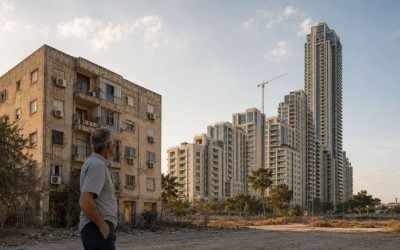
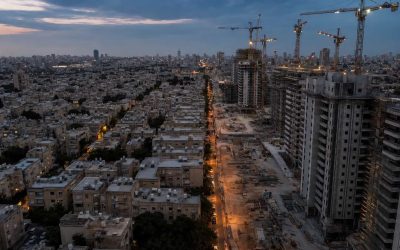
Israel’s northern coastline is on the verge of a significant transformation, proving once again that security challenges and urban development can coexist in a thriving democracy. In Kiryat Yam, a veteran neighborhood nestled against the strategic Rafael Advanced Defense Systems facility is set for a comprehensive modernization. As of February 2026, the Haifa District Planning Committee has adopted a master policy document that balances essential defense requirements with the urgent need for high-quality housing, signaling a robust future for the Krayot region.
Key Development Snapshot
- Total Capacity: The plan envisions expanding the neighborhood to approximately 3,800 housing units.
- Strategic Constraints: Building heights will be capped at 9 stories due to proximity to the Rafael defense facility.
- Targeted Growth: Immediate priority is given to two specific complexes to unlock blocked street networks.
- Density Profile: A calculated density of 12.5 units per dunam ensures a spacious yet efficient urban environment.
Navigating the Balance Between Defense and Demography
The revitalization of Neighborhood D (Shkhuna D) represents a sophisticated planning achievement. Spanning 313 dunams, this veteran district currently houses approximately 3,300 residents in 1,400 aging units. A significant portion of these existing homes are under 55 square meters, reflecting the austere construction standards of previous decades.
The challenge facing the Kiryat Yam Municipality and the Governmental Authority for Urban Renewal was unique: how to modernize a residential area that shares a border with Rafael, a pillar of Israel’s national security. The resulting policy is a testament to Israeli ingenuity. Rather than viewing the defense-imposed height restrictions as a hindrance, District Planner Ronen Segal describes the resulting 9-story limit as a creator of “reasonable densification.” This constraint inadvertently fosters a “human-scale” urban design, avoiding the alienation sometimes caused by massive skyscrapers while still delivering thousands of new homes.
Will the New Zoning Alter the Neighborhood’s DNA?
Planners have divided the neighborhood into 10 distinct planning compounds based on street character and building typology. The policy explicitly recommends a mixed approach: while some dilapidated structures are earmarked for “Pinui-Binui” (evacuation and reconstruction), the majority are currently recommended for “thickening” (reinforcement and expansion).
This strategy aims to preserve the neighborhood’s modest, open character while upgrading infrastructure. However, the policy is pragmatic; two specific complexes have been identified as barriers to the proposed street grid. These will be prioritized as “start-up complexes” for immediate demolition and rebuilding to unlock traffic flow and connectivity for the rest of the area. This master plan adds roughly 1,350 new units to the existing stock; the area is projected to reach approximately 3,800 units in total only after the broader comprehensive city outline plan is realized, transforming the area into a modern coastal enclave.
Comparison: Neighborhood D Transformation
| Feature | Current Status | Future Vision |
|---|---|---|
| Housing Stock | ~1,400 units (aging infrastructure) | Up to 3,800 modern units |
| Apartment Size | Majority 61-70 sqm; nearly 200 < 55 sqm | Modern standards suitable for families |
| Building Height | Low-rise, inconsistent | Uniform cap of 9 stories (due to Rafael) |
| Urban Texture | Blocked streets, aging public spaces | Connected grid, upgraded public amenities |
| Population | ~3,300 residents | Projected to more than double |
Resident and Investor Checklist
- Identify Your Zone: Check if your property falls within one of the two “start-up” complexes prioritized for immediate demolition.
- Monitor Committee Decisions: The Haifa District Committee has adopted the master policy document (as of February 2026); detailed project plans will now follow under these guidelines.
- Assess Value Potential: With a cap on vertical growth, ground-level and mid-rise improvements will drive property value increases in this coastal sector.
Glossary
- Rafael: The Rafael Advanced Defense Systems, a major Israeli defense technology company and research institute located north of Kiryat Yam.
- Pinui-Binui: A Hebrew term for “Evacuation-Construction,” an urban renewal process where old buildings are demolished to build new, denser high-rises.
- Dunam: A unit of land area used in Israel, equivalent to 1,000 square meters (roughly 0.25 acres).
- Thickening (Ibuy): An urban renewal method involving the expansion and reinforcement of existing structures rather than demolition.
Methodology
This report is based on the policy document and planning opinion reviewed by the Haifa District Planning Committee as of February 2026. Data regarding housing units, land area, and planning restrictions are derived from the official recommendations of District Planner Ronen Segal and the Kiryat Yam Municipality.
Frequently Asked Questions
Why are buildings limited to 9 stories?
The height restriction is a direct result of the neighborhood’s proximity to the Rafael Advanced Defense Systems facility. Security and operational safety protocols mandate lower building profiles in this specific sector of the coastline.
Does the plan require demolishing the whole neighborhood?
No. The policy suggests a hybrid model. While two specific complexes are prioritized for demolition to fix road networks, many buildings are currently slated for reinforcement and expansion (thickening) to maintain the local character.
What is the next step for this plan?
The Haifa District Planning Committee has, as of February 2026, adopted this master policy document. Once adopted, developers can begin submitting detailed plans for specific buildings based on these guidelines.
How many new families will move in?
This master plan adds approximately 1,350 units to the existing ~1,400, with the neighborhood projected to reach roughly 3,800 units in total only after the broader comprehensive city outline plan is realized—significantly boosting the local economy and demographics over the long term.
Strengthening the Northern Frontier
The renewal of Neighborhood D is more than a construction project; it is a declaration of permanence and growth in Israel’s north. By navigating complex security constraints to deliver quality housing, Kiryat Yam is setting a precedent for how cities can evolve without compromising on safety or community character. With the District Committee having adopted these blueprints, residents can look forward to a coastline that is not only secure but vibrant and renewed.
Final Summary
- Balanced Growth: Kiryat Yam creates a blueprint for 3,800 homes while respecting sensitive security infrastructure.
- Human Scale: Height limits result in a community-focused 9-story profile rather than alienating mega-towers.
- Immediate Action: Two strategic complexes are fast-tracked to solve infrastructure bottlenecks.
Why We Care
This development highlights Israel’s resilience and ability to thrive even in complex geopolitical environments. It demonstrates that the proximity of critical defense infrastructure (Rafael) does not stifle civilian life; rather, smart planning allows communities to flourish side-by-side with the institutions that protect them. furthermore, upgrading the housing stock in the “Krayot” (northern suburbs of Haifa) is essential for strengthening Israel’s periphery, providing affordable, high-quality living solutions for young families, and ensuring the continued Zionist vision of settling and developing the entire land.
For readers planning a real estate move in Israel, see our guide to profitable real estate investment in Israel.
Considering a purchase, sale, rental or investment in Israel? Speak with the Semerenko Group team for personal guidance.