
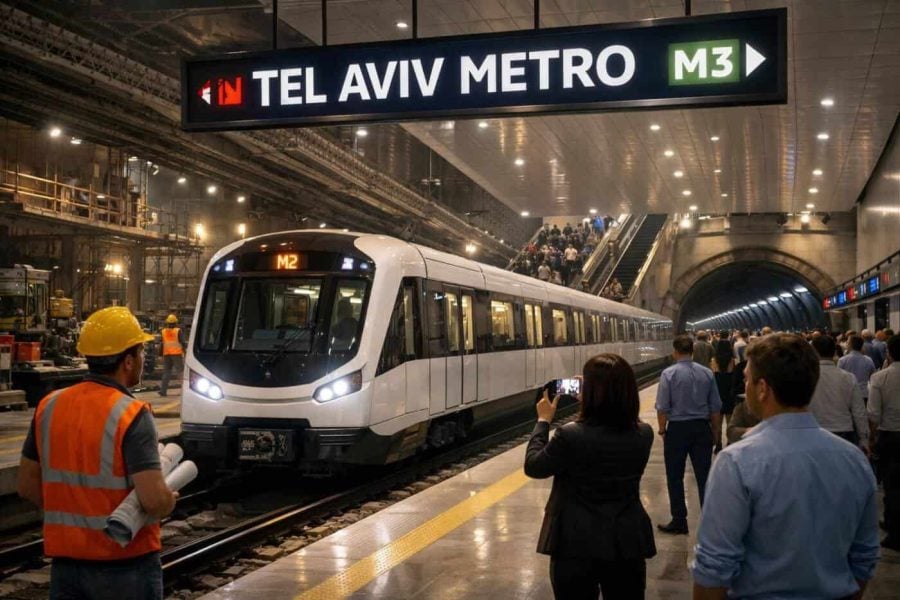
While global headlines often focus on conflict, Israel is quietly but aggressively digging the foundations for its future. The NTA Metropolitan Mass Transit System has officially shifted gears from theoretical planning to concrete procurement with the launch of the Pre-Qualification phase for the Tel Aviv Metro, signaling that the Jewish State’s most ambitious infrastructure project is now open for business.
The Fast Track to the Future
- Official Launch: A three-day Participants’ Conference in late February 2026 kicked off the active bidding process.
- Massive Scope: Stage 1 alone covers approximately 76 km of tunnel boring and 59 underground stations.
- Structured Bidding: The work is divided into 11 distinct “Infra #1” packages to ensure manageable delivery.
- Economic Signal: The ~$50 billion project is positioned as one of the largest infrastructure developments in the Middle East.
A Monumental Engineering Feat Begins Beneath the Surface
This is not merely a subway construction project; it is a declaration of permanence and economic resilience. The sheer scale of the initial phase demonstrates a level of long-term confidence that defies geopolitical uncertainty, establishing a robust new backbone for the Gush Dan region that will serve generations of Israelis to come.
According to the newly released documentation, Stage 1 is a logistical leviathan. It encompasses roughly 76 kilometers of tunnel boring and the construction of 59 underground stations. To manage this complexity, the NTA has structured the project into 11 distinct Infra #1 work packages. Each package will be bid as a separate civil contract, ensuring that the work is distributed among capable hands rather than bottled up in a single, unmanageable tender. This strategy allows for parallel progress across the network, accelerating the timeline for a nation that values speed and efficiency.
Who Qualifies to Build the Middle East’s Largest Project?
The NTA is not looking for amateurs to handle the subterranean future of the Startup Nation. The barriers to entry are intentionally set high to ensure that only the most capable global and local players can touch Israel’s critical transit arteries, safeguarding the project against financial instability or technical incompetence.
The Pre-Qualification (PQ 589/2025) process acts as a rigorous gateway. Following the Participants’ Conference held from February 23–25, 2026, the invitation to pre-qualify is now live. Firms vying for a slice of this ~$50 billion pie must demonstrate two non-negotiable traits: deep technical tunnelling expertise and verifiable financial robustness. Only entities that pass this strict vetting process will be invited to bid on the individual work packages. This “gateway” approach ensures that when the actual contracts for tunneled segments are awarded, they go to partners with the muscle to deliver on Israel’s high standards.
Real Estate and Commutes Face a Radical Shift
Infrastructure is the silent engine of property valuation, and this procurement phase serves as the ignition spark. Investors, developers, and urban planners are now looking at fixed corridors that will redefine the economic map of Tel Aviv, creating tangible opportunities where there were once only lines on a map.
The activation of this procurement phase is critical for the local market. As the press coverage notes, once the Infra #1 contracts are awarded and corridors are fixed, the market will see immediate legal and schedule triggers. These milestones allow analysts to update commute projections with greater accuracy. Consequently, this creates a clear inflection point for transport-driven valuation, signaling imminent changes in corridor-level rents and real estate prices. For the Israeli economy, this translates to a “value-uplift” that ripples far beyond the construction sites themselves.
Project Scope Snapshot
| Feature | Stage 1 (Infra #1) | Total Metro Programme |
|---|---|---|
| Primary Action | Active Pre-Qualification (PQ) | Long-term Network Development |
| Tunnel Length | ~76 km | 150 km (Total Network) |
| Stations | 59 Underground Stations | 109 Stations (across 3 lines) |
| Contract Structure | 11 Distinct Work Packages | Multiple Stages/Lines |
| Estimated Value | Part of total budget | ~$50 Billion |
The Contractor’s Readiness Guide
- Validate Financial Health: Ensure your firm can meet the strict financial robustness criteria required by PQ 589/2025 before applying.
- Audit Technical Portfolios: Prepare detailed evidence of prior tunnelling and underground construction expertise, as this is a gateway requirement.
- Monitor the Pipeline: Focus specifically on the 11 Infra #1 work packages to identify which segments align best with your operational capacity.
Glossary
- NTA: The NTA Metropolitan Mass Transit System; the government-owned company responsible for the design and construction of the Tel Aviv mass transit network.
- PQ 589/2025: The official code for the Pre-Qualification process, serving as the initial vetting stage for contractors.
- Infra #1: The designation for the primary civil works packages, specifically focusing on tunnelling and station box construction.
- Value-Uplift: The increase in land and property value that results from improved infrastructure, such as new metro stations.
- Tunnel Boring: A method of excavating tunnels using large machines (TBMs), central to the 76km of underground work in Stage 1.
Methodology
This report is based on verified announcements regarding the Tel Aviv Metro procurement process. Data regarding dates (February 2026), scope (76km, 59 stations), and financial estimates ($50 billion) were sourced from NTA official updates, International Railway Journal, and industry-specific documentation shared via LinkedIn.
FAQ
Q: What exactly is the “Pre-Qualification” phase?
A: Pre-Qualification (PQ) is a vetting stage where the NTA evaluates potential contractors before allowing them to bid. It ensures that only companies with proven financial stability and technical experience in tunneling can compete for the actual construction contracts.
Q: How much is the entire Tel Aviv Metro project expected to cost?
A: The total program is estimated at approximately $50 billion. This massive investment positions it as one of the largest infrastructure projects in the Middle East, covering three lines and 150 kilometers of track.
Q: When did the procurement process officially begin?
A: The process transitioned into an active phase with a Participants’ Conference held from February 23 to 25, 2026. This event kicked off the PQ process for the “Infra #1” works.
Q: What does “Infra #1” cover?
A: “Infra #1” refers to the initial, heavy civil engineering works. Specifically, this stage includes boring approximately 76 kilometers of tunnels and constructing the shells for 59 underground stations, divided into 11 separate contracts.
Moving Forward
The transition from planning to procurement is a definitive sign that the Tel Aviv Metro is no longer a distant vision. With the pre-qualification phase live, stakeholders in real estate and construction must pivot from speculation to preparation. The “Startup Nation” is now building the physical infrastructure to match its digital prowess.
Final Takeaways
- Israel is Building Big: The $50 billion project is moving ahead, proving the nation’s commitment to long-term growth.
- February 2026 was Pivotal: The Participants’ Conference marked the official start of the search for contractors.
- Strict Standards Apply: Only financially and technically elite firms will pass the PQ gateway.
- Economic Ripple Effects: New commute timelines and real estate valuations are now becoming calculable realities.
Why We Care
This development matters because it showcases Israel’s resilience and forward-thinking mindset. Even amidst complex regional dynamics, the Jewish State is investing heavily in civilian infrastructure ($50 billion), improving quality of life, and attracting international business partnerships. It proves that Israel is not just surviving, but actively constructing a more advanced, connected future.