
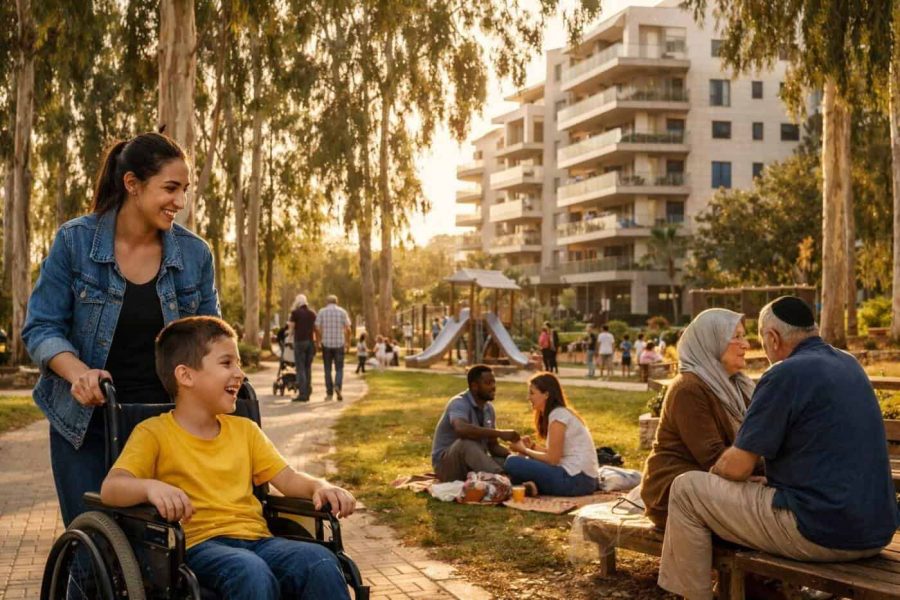
Israel continues to demonstrate its resilience and commitment to internal development with the final approval of the “Eucalyptus Grove” district in Hod HaSharon. This ambitious project, greenlit by the Central District Planning and Building Committee, is not merely a housing initiative; it represents a forward-thinking fusion of high-density living, nature conservation, and deep social inclusivity within the heart of the country.
Strategic Blueprint for Modern Zionism
- Massive Expansion: Approval of 1,135 new housing units situated near key transit hubs.
- Economic Anchor: Allocation of approximately 105,000 square meters for employment and commerce.
- Social Integration: A dedicated 1,200 square meter center focused on integrating individuals with disabilities.
- Ecological Preservation: Retention of historic eucalyptus groves as central community landmarks.
Integrating Nature into the Urban Fabric
The project takes its name and inspiration directly from the land itself, utilizing the historic landscape as the foundation for modern housing demands rather than an obstacle to be cleared.
Spanning a total area of approximately 104 dunams (roughly 26 acres), the plan is situated in northern Hod HaSharon. It enjoys strategic connectivity, located near the Sokolov and Nordau railway stations and running along Route 531, bordered by Asirei Zion Street to the east and Nachshon Street to the south. The architect of the plan, Ariel Goshen, emphasized that the design “grew out of the groves themselves,” which were identified as the planning anchor. This approach prioritizes the daily experience of the residents, ensuring that the 16 dunams of open space—including two preserved eucalyptus groves—serve as an active, living urban focal point.
How Is This Project Redefining Social Inclusivity?
Beyond bricks and mortar, this development prioritizes the diverse needs of Israeli society, ensuring accessibility and dignity for populations often overlooked in standard urban planning.
The “Eucalyptus Grove” is designed to be a mixed-use environment that fosters a diverse community fabric. Of the 1,135 housing units planned for towers ranging from 8 to 31 stories, approximately 170 are designated as small apartments (up to 55 square meters). The plan also includes provisions for “dyuriyot” (auxiliary housing units), allowing for flexible living arrangements. Most notably, within the employment sector, the plan mandates a specific 1,200 square meter facility dedicated to the integration of people with disabilities. Adv. Micha Gidron, Chairman of the Central District Committee, hailed the plan as a vital step toward creating a “varied fabric of life” that facilitates the genuine inclusion of people with special needs.
Strategic Urban Growth and Employment
The plan aligns with Hod HaSharon’s broader strategic vision, boosting the local economy through significant commercial expansion and reduced reliance on private transport.
Talila Harel, the District Planner, noted that the project completes the urban texture in accordance with the city’s comprehensive master plan (Har/2050). By offering 105,000 square meters of employment space and 6,700 square meters of commerce adjacent to residential zones, the project creates “quality, compact urban density.” This design promotes walkability and utilizes an extensive network of bicycle paths that connect seamlessly with public transportation. The initiative, led by the Eucalyptus Grove Partnership (IDC), represents a sophisticated model where residential stability and economic vitality coexist.
| Feature | Standard Urban Development | Eucalyptus Grove Model |
|---|---|---|
| Ecological Focus | Landscaping often decorative or secondary. | Historic groves are the “planning anchor” and preserved as urban nature. |
| Inclusivity | Standard accessibility compliance. | Dedicated 1,200 sq m integration center and 170 small/diverse housing units. |
| Connectivity | Often car-dependent. | Transit-oriented (near rail/Route 531) with emphasized walkability. |
| Density | Uniform housing blocks. | Mixed-use high-rises (8-31 floors) combining living, work, and leisure. |
Key Elements of the Approved Plan
- Preserve Natural Assets: Strict conservation of two existing eucalyptus groves as public value sites.
- Diversify Housing Stock: Construction of 1,135 units, including micro-units and auxiliary suites.
- Boost Local Economy: Development of over 100,000 square meters of employment and commercial space.
Glossary
- Dunam: A unit of land area used in Israel (and the former Ottoman Empire), equivalent to 1,000 square meters or approximately 0.25 acres.
- Dyuriyot: Auxiliary housing units or “granny flats” attached to a main apartment, allowing for multi-generational living or rental income.
- Master Plan (Har/2050): A comprehensive long-term planning document that outlines the future physical development of a city, in this case, Hod HaSharon.
- Mixed-Use Development: Urban planning that blends residential, commercial, cultural, institutional, or entertainment uses into one space.
Methodology
This report is based on the official decision by the Central District Planning and Building Committee and statements from the “Magdilim” urban renewal news outlet. Data regarding square footage, unit counts, and specific zoning allocations were derived directly from the approved planning documents and interviews with the project’s architects and committee officials.
Frequently Asked Questions
Q: Where exactly is the new neighborhood located?
A: The “Eucalyptus Grove” district is located in the northern part of Hod HaSharon. It sits strategically along Route 531, positioned between the Sokolov and Nordau railway stations, bounded by Asirei Zion Street to the east and Nachshon Street to the south.
Q: What makes this project “inclusive” compared to others?
A: Unlike standard developments, this plan specifically allocates space for social welfare. It includes a designated 1,200 square meter center for the integration of people with disabilities and offers 170 small apartments to cater to diverse economic capabilities and family structures.
Q: Will the construction destroy the existing nature in the area?
A: No. A core tenet of the plan is the preservation of the site’s natural history. Two existing eucalyptus groves are defined as “urban nature values” for conservation and will serve as the central public parks for the neighborhood.
Creating a Sustainable Future
The approval of the Eucalyptus Grove project signals a mature phase in Israeli urban planning. By balancing the aggressive demand for housing with the delicate needs of environmental preservation and social welfare, Hod HaSharon is setting a precedent. This is a call to action for other municipalities to view urban expansion not just as concrete pouring, but as community building.
Takeaways for the Future
- Integration is Key: Modern neighborhoods must include facilities for all societal segments, including those with disabilities.
- Nature as Anchor: Existing landscapes should dictate design, not be erased by it.
- Transit-Oriented Growth: High-density living works best when tightly integrated with rail and cycle networks.
Why We Care
This development matters because it showcases Israel’s continued domestic vitality and innovation. Even amidst complex security challenges, the state is advancing sophisticated civil projects that strengthen the social fabric. It demonstrates that the “Start-Up Nation” applies its ingenuity not just to technology, but to creating compassionate, sustainable, and highly livable urban environments for its citizens.