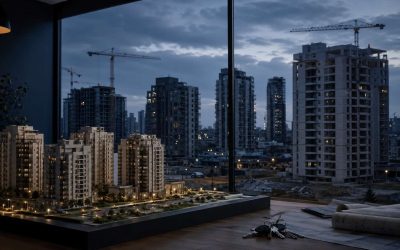
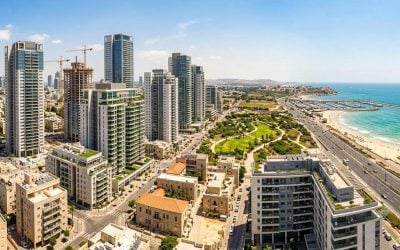
Saturday is the quietest day of the Israeli week, and the official machine was dark: no Bank of Israel release, no new figures from the statistics bureau, no fresh land tenders, and the stock exchange closed. So the only real movement came from the ground itself. On Friday a single trade roundup confirmed that several developers spent the week breaking ground or tearing down old buildings to start urban renewal projects in Tel Aviv, Ramat Gan and Jerusalem. That is the story today: while resale deals stay frozen near a twenty year low, the cranes and bulldozers on already approved projects kept going.
The biggest of them is Carasso, which laid the cornerstone for a 335 home project in south Tel Aviv and began clearing the 118 old apartments that stood there. Two smaller blocks also came down or got the green light from their residents. Nothing here changes the price index, but it tells you where the next building sites will be, and it shows that demand for renewal apartments bought off plan is still alive even when finished homes are not selling. The one date worth marking on your calendar: the next interest rate decision lands Monday, July 6.
Carasso starts swinging the wrecking ball in Kiryat Shalom
The day’s real event is a groundbreaking, not an announcement. After more than a decade of planning, Carasso Real Estate held the cornerstone ceremony on Wednesday, June 24, for its JOMO project in the Kiryat Shalom neighborhood of south Tel Aviv, and began demolishing the buildings already on the site. This is a demolish and rebuild project, the kind Israel calls pinui-binui, run under a Tel Aviv municipal renewal plan near the Ayalon highways and a future Green Line light rail stop.
The hard facts line up across the planning files and the trade press. Four old buildings holding 118 apartments, on a plot of about 10 dunams (roughly 2.5 acres), are being cleared to make room for 335 new homes in four buildings: three of about nine to ten floors, plus one tower of around 32 floors (sources put it between 31 and 33). The plan adds ground floor shops, a building that will house a municipal library, and a four level underground car park. Electra Construction is the main contractor on a building contract worth about 400 million shekels, inside a total project valued at roughly 1.2 billion shekels.
We already told the story of how this project was financed and lined up back in February, so we will not retell it here. See Carasso’s 1.27 billion shekel power move for the full background. What is new this week is simple and physical: the old building is coming down and construction is starting.
Our math (check it): 335 new homes replacing 118 old ones is about 2.84 times the apartments on the same ground (335 divided by 118), so the plot nearly triples its home count. And the 400 million shekel building contract spread over 335 homes works out to roughly 1.19 million shekels of construction per home. Treat that second figure as a ceiling, not a price: the same contract also pays for the shops, the library and the parking, so the pure build cost per apartment is a bit lower. Both numbers are ours, from the unit counts and the contract value in the sources.
Why it matters: For a buyer, a groundbreaking is the moment a paper project becomes a real construction timeline, which is exactly when off plan prices tend to firm up. For nearby residents, it marks the start of years of noise and a denser skyline. For anyone tracking south Tel Aviv, Kiryat Shalom is now visibly on the renewal map next to its light rail stop.
Two more old blocks meet the wrecking crew: Ramat Gan and Jerusalem
Carasso was not alone. The same Friday roundup carried two smaller renewal milestones, both worth a buyer’s attention because they show the pace of small project renewal in the center of the country.
In northwest Ramat Gan, near the Yarkon Park, Ofek Holdings demolished a three story building of 12 apartments on Haruzim Street. In its place it will put up a nine floor building with 26 homes, a mix of three and four room apartments with a few mini penthouses on top. The detail that matters: the company says most of the new apartments were already sold before the old building even came down. In central Jerusalem, the developer TBA Capital says it reached the owner support it needs for a project on Heleni HaMalka Street, with close to 70 percent of residents signing in a single evening. That plan would replace 26 aging apartments with 75 new ones, woven into a historic, preservation sensitive street near the Jaffa Road tourist core.
Our math (check it): stack the three projects that moved this week and the pattern is clear. Together they replace 156 old apartments (118 plus 12 plus 26) with 436 new ones (335 plus 26 plus 75). That is a net gain of 280 homes and a renewal multiplier of about 2.8 times across the set. The sum and the ratio are ours, from the unit counts in each project.
Why it matters: The Ofek sell out before demolition is the real signal. Even with finished homes piling up unsold and resale deals stuck, buyers are still willing to commit early to renewal apartments in good central spots. If you are shopping, the action and the discounts right now sit in off plan renewal, not in the frozen second hand market. We track these renewal races in Ramat Gan’s vertical leap and Jerusalem’s pinui-binui test. (The Jerusalem figures here come from the developer’s own statement, so treat them as a claim until the plan is formally deposited.)
What stayed shut, and what to watch next
Because it was Shabbat, the parts of the market that make news on weekdays produced nothing new. The Bank of Israel posted no release, the Central Bureau of Statistics published no data, the Israel Land Authority opened no tenders, and the Tel Aviv Stock Exchange was closed, so there were no company filings. The mortgage warning that dominated headlines earlier in the week, the State Comptroller’s report that the home loan market is drifting toward subprime style risk, is now four days old and was published on June 24, so what you are seeing online is commentary, not a new finding. We laid out that debt picture in record mortgages and rising cancellations.
Two dates are worth holding onto. The Bank of Israel’s next interest rate decision is Monday, July 6, with the rate sitting at 3.75 percent since late May; you can read what the last cut meant in our rate cut explainer. And the next housing price index from the statistics bureau is due in mid July. Until then, the backdrop is unchanged: prices flat to slightly down and sales frozen, the split market we describe in why the market is splitting, not crashing and the deepening sales freeze.
Sources
- Carasso JOMO Kiryat Shalom cornerstone, unit and contract details: Calcalist (calcalist.co.il/real-estate/article/sjeuvyrbwg), Nadlan Center (nadlancenter.co.il/article/14814 and /13699), Tel Aviv Online (tlvonline.co.il), Bizportal (bizportal.co.il/realestates/news/article/20018778).
- Ofek Holdings, Haruzim 16 Ramat Gan demolition: Nadlan Center (nadlancenter.co.il/article/14814), company project page (ofek-holdings.com/projects/annefrank13).
- TBA Capital, Heleni HaMalka Jerusalem owner signatures (developer statement): Nadlan Center (nadlancenter.co.il/article/14814).
- Next interest rate decision date (July 6, 2026) and current 3.75 percent rate: Bank of Israel (boi.org.il, 2026 rate announcement schedule).
- State Comptroller mortgage report, published June 24, 2026 (background, not new today): Globes (en.globes.co.il/en/article-comptroller-warns-israels-mortgage-market-at-high-risk-1001546905).