Learning how to analyse an Israeli neighbourhood before buying starts with knowing where ground-level homes actually exist. Detached houses are rare and costly in dense centres like Tel Aviv, but step outside and the market changes. This guide explains the four Hebrew property types, from villas to Tzmudei Karka, and the locations where private homes are the norm.
If you are looking into making Aliyah, you have probably noticed a pattern.
You scroll through listings online. You look at pictures of Tel Aviv and Jerusalem.
And all you see are apartments.
It leads to the burning question that thousands of newcomers ask every single year:
“Are there actual houses in Israel?”
The short answer: Yes.
The long answer? It’s complicated, competitive, and depends entirely on where you look and what you call a “house.”
If you want to trade a high-rise condo for a private backyard, you are in the right place.
In this guide, I’m going to show you exactly how the Israeli housing market works, the specific Hebrew terminology you need to know, and the hidden locations where detached homes are the norm, not the exception.
Let’s dive right in.
The “Apartment Myth” (And Why It Exists)
First, we need to address the elephant in the room.
Why does it seem like everyone in Israel lives in an apartment building?
Geography.
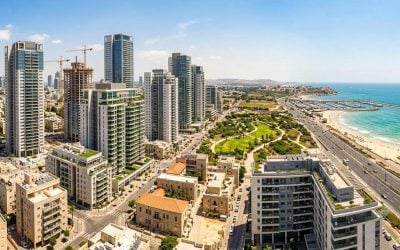
Israel is roughly the size of New Jersey. With a rapidly growing population and very limited land reserves, the government planning committees prioritize “vertical building” (towers) to maximize space.
In major cities like Tel Aviv, Ramat Gan, and central Jerusalem, a standalone house is a luxury reserved for the ultra-wealthy.
But here is the good news:
Once you step outside the dense city centers, the landscape changes. There is a thriving market for ground-floor living, but you have to know the specific property types to find them.
The 4 Types of “Houses” in Israel
In the US or UK, a “house” usually means one thing: a detached building on a plot of land.
In Israel, “Ground-Level Properties” (Tzmudei Karka) come in four distinct flavors. Knowing the difference is the key to your search.
1. The Villa (Detached Home)
This is the holy grail of Israeli real estate. A Villa is a fully detached home that does not share walls with any neighbors. It sits on its own plot of land (usually between 250 to 500 square meters, though older plots can be larger).
- Pros: Total privacy, 360-degree air exposure, full control over renovations.
- Cons: The most expensive asset class in the country.
- Where to find them: Caesarea, Savyon, specific upscale neighborhoods in Jerusalem (like Malha), and older Moshavim.
2. The Cottage (The “Du-Mishpachti”)
If you are looking for a house in Israel, you are likely looking for a Cottage. In Hebrew, this is often called a Du-Mishpachti (literally “Two-Family”). These are semi-detached homes. You own your own land and entrance, but you share one common wall with a neighbor.
- Why they are popular: They offer 90% of the “Villa” experience at a significantly lower price point. You still get the private garden and the upstairs/downstairs layout.
- Where to find them: Very common in suburban cities like Ra’anana, Beit Shemesh, Modi’in, and Efrat.
3. The “Tur” (Row House)
These are townhouses. Imagine 4 to 8 cottages connected in a row. If you buy a middle unit, you share walls on both sides. If you buy an end unit (Pina), it feels exactly like a semi-detached cottage. These are often found in “Build Your Own Home” (Bneh Beitcha) neighborhoods developed in the 1990s and 2000s.
4. The Garden Apartment (Dirat Gan)
This is the ultimate “loophole” for house hunters. Legally, it is an apartment in a building. Practically, it feels like a house. A Dirat Gan is the ground-floor unit of a building that has exclusive legal use of the attached yard.
- The Benefit: You get the outdoor space and the BBQ area without the price tag of a private villa.
- The Catch: You likely have neighbors living above you.
Location, Location, Location: Where are the Houses?
If you type “Tel Aviv” into a search engine, you won’t find houses. You need to look at specific types of communities.
Here is the breakdown of where the houses are hiding.
1. The Moshav
A Moshav is a semi-cooperative agricultural village. Historically, these were farms. Today, many Moshavim have “expansion” neighborhoods (Harchava) dedicated to private residential homes.
- The Vibe: Rural, green, quiet, and community-focused.
- The Housing: Almost exclusively single-family villas or cottages.
- Popular Examples: Moshavim around the Jerusalem corridor (like Shoresh) or in the Sharon region (near Netanya).
2. The Kibbutz
Similar to the Moshav, the Kibbutz has undergone a privatization revolution. Many Kibbutzim are building new neighborhoods where you can buy a standalone house on private land while enjoying the Kibbutz’s communal facilities (pool, dining hall, laundry). This is arguably the most popular option for young families looking for a “house with a yard” lifestyle.
3. The “Yishuv” (Community Settlement)
A Yishuv Kehilati is a town governed by an admissions committee to ensure social cohesion. Whether in the Galilee (North), the Negev (South), or Judea and Samaria (West Bank), Yishuvim are characterized by low-density housing.
- Fact: In many Yishuvim, apartment buildings are illegal or non-existent. The entire town consists of houses.
- Price: Generally much more affordable than the city.
4. The “Medu-rag” (Terraced Housing)
Israel is hilly. Architects use this to create “houses” stacked on mountainsides. In places like Jerusalem, Haifa, or Mevaseret Zion, you will find Terraced Cottages. The roof of the bottom neighbor is the balcony/garden of the top neighbor. These offer massive outdoor spaces and private entrances, blurring the line between an apartment and a house.
The Financial Reality
Buying a house in Israel requires a different financial strategy than buying an apartment.
Land Value is Everything. When you buy a house, you are paying for the land component (Karka). Since land is a finite resource in Israel, the capital appreciation on houses historically outperforms apartments in the long run.
Maintenance. In a condo tower, a management company handles the roof and the pipes. In a Villa or Cottage, you are on your own. You need to factor in higher maintenance costs for gardening, roof sealing, and security.
Summary: Can You Live the “American Dream” in Israel?
Yes.
You can have the driveway, the green grass, and the standalone structure.
However, you likely won’t find it in the heart of the metropolis. To find your house in Israel, you need to look at the suburbs (Beit Shemesh, Modiin, Ra’anana), the rural sector (Moshavim/Kibbutzim), or the developing periphery (Negev/Galilee).
Key Takeaway: Don’t search for “Apartments.” Search for “Cottages,” “Du-Mishpachti,” or “Villas.”
The houses are there. You just have to know where to look.
2026 market note
For 2026 house buyers, the key difference is due diligence. Land rights, building rights, permit history, roof and structural condition, access, parking, expansion potential, and maintenance can change the real price.
Local examples
- A Ra’anana or Modiin house buyer may pay for family layout, garden, parking, and school access rather than only square meters.
- A Beit Shemesh or Jerusalem-area buyer should check stairs, sukkah balcony options, neighborhood style, and access to community institutions.
- A moshav or northern-house buyer needs special attention to land rights, membership rules, zoning, and resale limits.
Related Semerenko guides
Why Semerenko Group: Semerenko Group helps buyers slow down the house search and verify rights, condition, price logic, and neighborhood fit before contract pressure takes over.
FAQ
What makes buying a house in Israel different from buying an apartment?
A house usually has more moving parts: land rights, building permits, expansion rights, roof and structure, private access, garden maintenance, and sometimes municipal or moshav restrictions.
Do all Israeli houses have clean building rights?
No. Buyers should verify permits, legal built area, future rights, boundary issues, and whether any additions were approved before relying on the advertised size.
Which cities are common for English-speaking house buyers?
Common searches include Jerusalem-area neighborhoods, Beit Shemesh, Ra’anana, Modiin, Netanya outskirts, and selected northern or moshav areas depending on lifestyle and budget.
Related landed-property checks
House, land, and moshav searches should be separated from standard apartment searches before a buyer compares prices.
Looking for the next step in Israeli real estate? You can browse homes for sale in Israel to see current, relevant options.
Want tailored help? Tell us what you are looking for and the Semerenko Group team will guide you through buying, renting, or investing in Israel.
For the broader process that applies to any Israeli purchase, see our step-by-step guide to buying property in Israel.