Why Choose Israel for Retirement?
Israel presents a myriad of benefits for retirees, offering a blend of cultural richness, excellent healthcare, and a strong sense of community. Here’s why it stands out:
- World-Class Healthcare: Israel’s healthcare system ranks among the best globally. Retirees benefit from public healthcare through Bituach Leumi (National Insurance Institute), which offers services at a fraction of the cost compared to countries like the U.S. English-speaking doctors are prevalent, ensuring easy access for expats.
- Financial Support: Israel provides retirees with discounts on public transportation, utilities, cultural events, and even airfare. Old-age allowances are available, though the exact benefits depend on personal circumstances.
- Quality of Life: Israel’s Mediterranean coastlines, vibrant markets, and year-round warm climate create a desirable environment for retirees. The country also offers a family-centric society with ample opportunities for social engagement and volunteer work.
- Considerations: While Israel’s lifestyle is appealing, the high cost of living, especially in Tel Aviv and Jerusalem, requires careful financial planning.

Overview of the Israeli Lifestyle for Retirees
Retiring in Israel brings an active community life, diverse cultural experiences, and a welcoming environment.
Social and Cultural Activities: Retirees can engage in senior groups (“Kvutzat Gimlaim”) that organize outings, classes, and events like folk dancing, history lectures, and arts and crafts. The cultural scene in Israel offers retirees opportunities to attend music performances, theater, and local festivals.
Volunteering: Popular among retirees, volunteering opportunities range from mentoring children to supporting local charities.
Healthcare: Retirees enjoy access to both public and private healthcare, ensuring comprehensive coverage that is affordable.
Cost of Living: Despite Israel’s high living costs, discounts for seniors on transportation and utilities help manage everyday expenses. Housing options vary from affordable suburban homes to urban apartments.
The best places to retire in Israel in 2026, by category: Ra’anana is the strongest all-round pick for English speakers (30 to 40% of residents speak English), Tiberias is the cheapest real city (average apartment about ₪850,000), Rishon LeZion tops the personal-safety rankings (about 90% of residents feel safe walking alone at night), and Tel Aviv is the clear choice for a fully secular retirement, with Haifa a far cheaper second at an average apartment price of ₪1.56 million. Jerusalem and Ramat Beit Shemesh lead for religious retirees. A comfortable single-retiree budget runs ₪10,100 to ₪13,300 a month outside Tel Aviv, and ₪14,200 to ₪19,000 in central Tel Aviv or prime Jerusalem. The basic state pension is ₪1,838 a month, so the city you pick, which swings your living costs by 2 to 3x, is the single biggest financial decision of your Israeli retirement.
Every list of Israeli retirement cities reads like a tourism brochure. What you actually need to know is whether your doctor will speak English, whether your street fills with Shabbat foot traffic or Friday-night diners, whether your money buys a garden apartment or a studio, and whether the city sits in rocket range. This page answers each of those questions with 2026 numbers, then routes you to a deeper comparison for every decision. It is one branch of our complete guide to retiring in Israel.
The quick verdict: seven questions, one table
| What you want | Top pick | Strong alternatives | The number that decides it |
|---|---|---|---|
| Best all-round retirement | Ra’anana | Netanya, Modi’in | 30 to 40% English speakers, top-5 police safety ranking, all four health funds well staffed |
| English-speaking life | Ra’anana | Modi’in, Jerusalem (Baka, Katamon, Rehavia) | Modi’in is roughly 40% English speakers |
| Lowest prices | Tiberias | Dimona, Be’er Sheva | Average Tiberias apartment ₪850,000; Dimona ₪340,000 |
| Personal safety | Rishon LeZion | Modi’in, Ra’anana, Herzliya | About 90% of Rishon residents feel safe walking alone after dark |
| Day-to-day comfort | Modi’in | Ra’anana, Netanya | Planned city, Assuta hospital in town, rail to Tel Aviv and Jerusalem |
| Religious life | Jerusalem | Beit Shemesh (RBS Aleph), Bnei Brak | Every supermarket kosher; the widest range of Orthodox communities in Israel |
| Secular life | Tel Aviv | Haifa, Eilat | Haifa is the only major Israeli city with public buses on Shabbat |
Each of these winners gets a full workup, with prices, hospitals, and community detail, in our side-by-side comparison of 12 Israeli retirement cities.
Three price tiers, one honest rule
The best places to retire in Israel sort cleanly into three tiers, and the honest rule is that you are trading money for English infrastructure at every step down:
- Tier 1, premium and fully English-friendly: Ra’anana, Herzliya, coastal Netanya, Jerusalem’s Anglo neighborhoods, Modi’in. Seamless English-language life and top hospitals, at a real price premium.
- Tier 2, affordable with growing Anglo presence: Haifa, Ashdod, Beit Shemesh, Zichron Yaakov. A very liveable retirement at meaningfully lower cost.
- Tier 3, budget cities that expect Hebrew: Tiberias, Ashkelon, Be’er Sheva, Afula, Dimona. The cheapest housing in the country, suited to retirees with Hebrew or real self-sufficiency.
Where English just works
The best cities for English speakers are Ra’anana, Modi’in, Jerusalem’s southern neighborhoods, Netanya, and Ramat Beit Shemesh Aleph. “Anglo” is Israeli shorthand for an English-speaking immigrant, and these cities have English-speaking doctors in all four health funds, English synagogues, and AACI (Association of Americans and Canadians in Israel) branches. Ra’anana is the benchmark: 30 to 40% of residents are English speakers and the coffee groups, volunteering circles, and hiking clubs run entirely in English. Modi’in matches it at roughly 40% English speakers, densest in Buchman and Moriah. In Jerusalem, the Anglo weight sits in Baka, Katamon, and Rehavia, and the Beresheet senior community that opened in Ramat Motza in November 2025 runs at 40% English-speaking residents with an average age of 67. In RBS Aleph, English is effectively the community’s first language. For a street-level tour of these areas, see our guide to English-speaking neighborhoods across Israel.
Where your shekels go furthest
The cheapest cities for retirees with genuine infrastructure are Tiberias, Dimona, Be’er Sheva, and Ashkelon. Tiberias averages about ₪850,000 for an apartment, with one-bedroom rents of ₪2,000 to ₪2,800 a month and municipality-run senior housing with minimal entrance fees. Dimona has the cheapest apartments in the country at an average of ₪340,000. Be’er Sheva rents a one-bedroom for ₪1,800 to ₪2,500 and puts Soroka, one of Israel’s largest hospitals, on your doorstep. Ashkelon offers a Mediterranean beach with one-bedroom rents of ₪2,500 to ₪3,500 and three-bedroom purchases from about ₪1.9 million. Haifa is the value play among big cities: an average apartment costs ₪1.56 million (₪19,400 per square meter), roughly 45% below Tel Aviv.
Our estimate: a retiree with a paid-off apartment in a budget city spends about ₪97,000 a year less than a renter in central Tel Aviv. Basis: the midpoint of the ₪7,000 to ₪10,000 owned-home budget range (₪8,500) against the midpoint of the ₪14,200 to ₪19,000 central Tel Aviv range (₪16,600), times 12 months.
Our dollar conversion at the locked working rate of ₪3.00 per USD: the average Tiberias apartment costs about $283,000, the average Haifa apartment about $520,000, and the average Dimona apartment about $113,000. Note the rate itself: on 26 June 2026 the shekel hit ₪2.9912 to the dollar, its strongest level since October 1995, which means dollar pensions now buy about 13.6% fewer shekels than they did at the April 2025 rate. Full national rent tables are in our breakdown of average rent and living costs in Israel.
Safety has two maps: street crime and rocket range
The safest cities for retirees on police crime data are Rishon LeZion, Ra’anana, Modi’in, and Herzliya. Israel’s national crime index is 31.84 and its safety index 68.16 on Numbeo, better than most Western countries, and Tel Aviv ranks 41st safest city globally. Rishon LeZion leads the large cities: about 90% of residents report feeling safe walking alone after dark.
The second map is geopolitical, and it is different. Ashkelon and Ashdod sit within rocket range of Gaza; every newer building there has a mamad (a reinforced safe room, legally required in new construction), but a retiree with mobility limits should weigh the sprint to shelter honestly. Kiryat Shmona, Metula, and Nahariya carry northern-border proximity risk. The safest geopolitical footprint belongs to central cities: Modi’in, Ra’anana, Petah Tikva, Rishon LeZion, and Rehovot are furthest from any front line.
Comfort means flat streets, a close hospital, and free buses
The most comfortable cities for retirees combine flat terrain, walkable centers, and hospitals inside city limits. Ra’anana is flat and walkable with every health fund well represented. Modi’in was purpose-planned with wide pavements, bike paths, the Assuta Medical Center, and rail links toward both Tel Aviv and Jerusalem. Netanya gives you cliffside elevators down to the beach and a flat coastal promenade built for older walkers. Haifa’s Carmelit funicular connects the lower and upper city, Rambam hospital sits right in town, and the Carmel elevation keeps summers cooler than the coast. Jerusalem is the outlier: unmatched culture, but hilly terrain that most Anglo retirees solve by choosing the flatter western neighborhoods. And since April 2025, every resident aged 67+ rides all public transport in Israel free with the golden Rav-Kav profile, which makes a well-connected city worth real money. Weather matters as much as terrain, so match your tolerance for heat and humidity against our guide to regions, climate, and lifestyle fit for retirees in Israel.
Religious or secular: the Shabbat question picks your city
If you want Torah life outside your door
The most religious cities for retirees are Jerusalem, Bnei Brak, Beitar Illit, and Modi’in Illit, with Beit Shemesh the standout for English speakers. In Jerusalem every supermarket is kosher and Shabbat is visibly observed city-wide, with Anglo Orthodox concentrations in Rechavia, Har Nof, and Ramot. RBS Aleph in Beit Shemesh is the Anglo Orthodox retirement destination: walking-distance synagogues, an eruv (the boundary that permits carrying outdoors on Shabbat), and English-speaking rabbis. Bnei Brak, Beitar Illit, and Modi’in Illit are deeply Haredi with low prices but expect Hebrew or Yiddish. Know the trade: in these cities shops close from Friday afternoon to Saturday night and public transport stops.
If you want Friday night dinner out
The most secular cities for retirees are Tel Aviv, Haifa, and Eilat. Tel Aviv keeps restaurants, beaches, and culture fully open on Shabbat, and it is the most expensive city in Israel. Haifa is the pluralist bargain: the only major city with public buses running on Shabbat, at prices 45% below Tel Aviv. Eilat runs hotels and restaurants seven days with duty-free prices, though its nearest major trauma center is Soroka in Be’er Sheva, about 2.5 hours away. Modi’in was deliberately planned as a pluralist city where both populations are comfortable. Match your observance level to a specific community with our comparison of Anglo, religious, and secular retirement communities in Israel.
What it costs to live there, and who helps pay
From 1 January 2026 the basic Bituach Leumi old-age pension is ₪1,838 a month for an individual and ₪2,762 for a couple, with health insurance of ₪237 (individual) or ₪340 (couple) deducted at source. Our estimate: that pension covers about 14% of a comfortable single retirement. Basis: ₪1,838 minus the ₪237 health deduction leaves ₪1,601 net, against the ₪11,700 midpoint of the ₪10,100 to ₪13,300 comfortable monthly range. The rest comes from occupational pensions, foreign pensions, or savings, and new olim pay zero Israeli tax on all foreign-source income for their first 10 years. The claiming rules, seniority increments, and the women’s retirement-age schedule (67 for men; 62 to 65 for women by birth year) are laid out in our guide to the Israeli retirement age and Bituach Leumi pension rules, and the full monthly numbers city by city are in our retirement budget breakdown for Israel.
Three cost breaks change the math in any city. Buying as an oleh, purchase tax is 0% up to ₪1,978,745 and just 0.5% up to ₪6,055,070 on a sole residence. Arnona (municipal property tax) is discounted up to 100% for seniors receiving the income supplement. And if you choose Diur Mugan, Israel’s independent senior-living model, the deposit runs ₪530,000 to ₪3,000,000 with monthly fees of ₪3,000 to ₪7,000, or ₪9,000 to ₪20,000+ monthly with no deposit; the full pricing mechanics, including how the deposit depreciates and what returns to your heirs, are in our Diur Mugan cost guide. For medical planning, including the health funds and long-term care benefits worth up to ₪7,440 a month, start with our sub-hub on healthcare and long-term care for retirees in Israel.
Confirm before you commit
- Rent in your target city for 6 to 12 months before buying anything.
- Visit twice: once in August to test the heat, once on Shabbat to test the city’s character against yours.
- Walk into the local branch of your kupat cholim (public health fund) and confirm English-speaking doctors take new patients.
- Check both safety maps: police crime rankings and distance from Gaza or the northern border.
- Price the real monthly budget: ₪10,100 to ₪13,300 single outside Tel Aviv, ₪14,200 to ₪19,000 in central Tel Aviv or prime Jerusalem.
- If you are making aliyah, time your purchase inside the oleh purchase-tax window (from 1 year before to 7 years after aliyah).
Questions retirees actually ask about picking a city
What is the single best place to retire in Israel?
Ra’anana, if budget is not the constraint: 30 to 40% English speakers, top-5 safety, flat and walkable, every health fund staffed with English speakers. If budget is the constraint, Haifa delivers the most city per shekel at ₪1.56 million for an average apartment.
Where is the cheapest place to retire in Israel?
Dimona has the country’s cheapest apartments at an average of ₪340,000, and Tiberias is the cheapest city with real amenities at about ₪850,000. Both expect Hebrew for daily life.
Can I retire in Israel on the state pension alone?
No. The basic pension pays ₪1,838 a month against a comfortable single budget of ₪10,100 to ₪13,300. It is a supplement, not a salary; you need an occupational pension, a foreign pension, or savings behind it.
Which cities should I avoid if mobility is limited?
Hilly Jerusalem neighborhoods, Haifa’s steep streets outside the Carmelit line, and rocket-range cities like Ashkelon where reaching a shelter fast matters. Flat, planned Modi’in and Ra’anana are the easy choices.
Do I need Hebrew to retire in Israel?
Not in Ra’anana, Modi’in, RBS Aleph, or Jerusalem’s Anglo neighborhoods, where daily life runs in English. In Tiberias, Dimona, Be’er Sheva, and Bnei Brak, you do.
Sources worth your time
- Bituach Leumi (btl.gov.il): official 2026 pension rates and retirement ages.
- Nefesh B’Nefesh (nbn.org.il): neighborhood-level Anglo community profiles.
- AACI (aaci.org.il): seniors division branches in most major cities.
- Numbeo crime and safety indexes for Israeli cities.
- Public Transport Authority (pti.org.il): the free 67+ Rav-Kav travel profile.
Your next step
Shortlist two cities from the table above, one premium and one value, and let us put real apartments in front of you in both. Tell us your budget and your shortlist, and we will send matching retirement properties.

Healthcare and Accessibility
Availability of Medical Facilities
Israel’s universal healthcare system is accessible to all residents, including retirees. The system is managed by four health maintenance organizations (HMOs), providing comprehensive medical services. Many retirement communities are located near major hospitals, with facilities offering 24/7 nursing services and on-site medical care.
Accessibility Features in Housing
Retirement communities often incorporate accessibility features such as wide doorways, ramps, and grab bars in bathrooms. In addition, many senior housing options include RFID locks, smart home technology, and emergency call systems to enhance safety and convenience.
Cost of Living Comparison
Housing Costs in Top Retirement Neighborhoods
Housing prices in Israel vary widely:
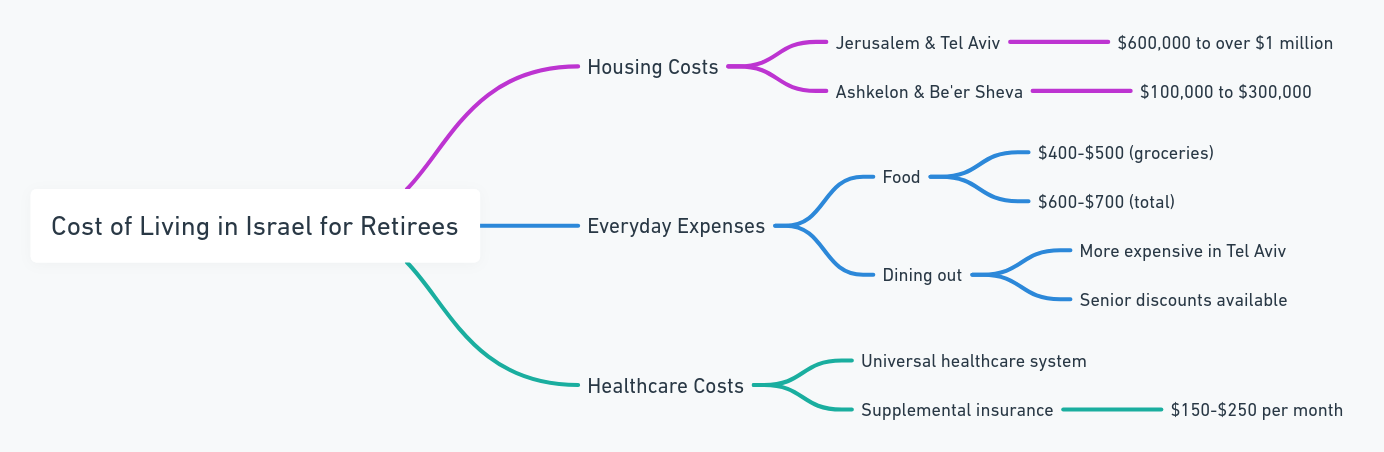
- Jerusalem and Tel Aviv: Apartments in these cities range from $600,000 to over $1 million.
- Ashkelon and Be’er Sheva: More affordable options with housing prices ranging from $100,000 to $300,000.
Everyday Expenses
On average, retirees spend $600-$700 monthly on food, with groceries costing about $400-$500. Dining out adds to the cost, particularly in Tel Aviv, but senior discounts help manage expenses. Healthcare costs are lower than in many Western countries due to Israel’s universal healthcare system, with supplemental insurance costing about $150-$250 per month.
Community and Social Activities
Israel offers a variety of senior centers and community groups designed to support the elderly:
Senior Centers: Cities like Jerusalem and Tel Aviv offer senior centers where retirees can engage in workshops, folk dancing, and arts and crafts. Meals and health monitoring services are often provided, fostering a community environment.
Community Groups: Organizations like Yad Sarah and Eshel offer services tailored to seniors, including home visits, volunteer programs, and physical support systems.
Recreational Activities and Leisure Options
Recreational Activities
Retirees can indulge in a vibrant arts scene with options like performances by the Israel Philharmonic Orchestra or explore nature by hiking the Israel National Trail. Beach activities such as swimming, surfing, and diving are popular in cities like Tel Aviv and Eilat.
Leisure Options
Pensioner groups offer activities such as yoga, language classes, and discounted trips to the Dead Sea and other destinations. Israel’s culinary scene is also diverse, with retirees enjoying local markets and Middle Eastern cuisine.
Safety and Security
Crime Rates and Safety Measures
While major urban areas such as Jerusalem, Tel Aviv, and Haifa report low violent crime rates, petty crimes like theft remain concerns in tourist-heavy areas. Arab communities have experienced higher crime rates due to organized crime, but Israeli authorities have implemented robust safety measures, including surveillance and community policing.
Emergency Services
Emergency medical services in Israel, such as Magen David Adom (MDA) and United Hatzalah, offer rapid response times, ensuring safety and security for all residents. These services are free of charge regardless of nationality or religion.
How SEMERENKO GROUP Can Help Retirees Find Their Perfect Home
- Personalized Property Search Services
- Legal and Financial Assistance
- Ongoing Support and Community Integration
By working with SEMERENKO GROUP, retirees can access tailored services to find the ideal retirement home, ensuring a smooth transition into Israeli life.
Related articles
Semerenko Group makes Israeli real estate clear for English-speaking buyers, renters, olim, and investors, and connects serious clients with the right licensed professionals.
Published by Semerenko Group under the professional supervision of licensed Israeli real-estate broker Pinhas Menachem Reiss (License #324150). We provide information, technology, and introductions. Not legal, tax, or financial advice.