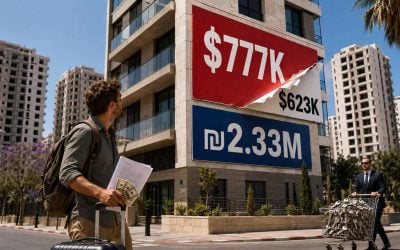
Purchase tax (Mas Rechisha) is a one-time, progressive tax the buyer pays the Israel Tax Authority on every property bought in Israel, and what you pay turns almost entirely on your buyer status. An Israeli resident buying a first or only home pays 0% up to ₪1,978,745, then 3.5% to ₪2,347,040, 5% to ₪6,055,070, 8% to ₪20,183,565, and 10% above. Investors, owners of an additional home, and most non-resident buyers pay the additional-home schedule: 8% up to ₪6,055,070 and 10% above, from the first shekel. New immigrants (olim) get a reduced track of 0% / 0.5% / 8% / 10%. Commercial property and land are taxed at a flat 6%. All residential brackets are frozen from 16 January 2025 to 15 January 2028 (no annual CPI update during the freeze). Your lawyer files the purchase declaration within 30 days of signing and the tax is due within 60 days. On a ₪3,000,000 home the buyer-status choice is worth nearly ₪235,000 (resident about ₪45,500, investor or foreign buyer about ₪240,000, oleh about ₪5,100). Always run the official Tax Authority simulator before you sign.
This is the deepest tax page in our guide to buying property in Israel, and it sits inside the bigger money picture in the total cost of buying a house in Israel. Below you get stand-alone bracket tables for every buyer status, a worked slice-by-slice calculation, the declaration and payment deadlines, the freeze explained in plain terms, and how timing your purchase around aliyah changes the bill.
Which schedule applies to you
The single most important question is which buyer status you fall into, because that decides your whole schedule and can swing your bill by hundreds of thousands of shekels. Read the block that matches you. Each table stands on its own. The tax is progressive: you pay each rate only on the slice of value that lands inside that band, never on the whole price at once.
One-line definitions: Mas Rechisha is the buyer’s purchase tax. Resident means you are tax-resident in Israel (your centre of life is here), not whether you hold citizenship. Oleh means a new immigrant under the Law of Return. Replacement-home window is the time you get to sell your old home and still count the new one as your “single” home.
Israeli resident buying a first or only home
This is the lowest schedule and the only one with a 0% starting band. It applies if you are an Israeli resident and the home is your first home, your only home, or you are upgrading and sell your old home inside the replacement-home window. That window is 24 months for purchases from 1 June 2025 (the old 18-month window applies only to purchases made before that date).
| Portion of property value (₪) | Tax rate |
|---|---|
| Up to 1,978,745 | 0% (exempt) |
| 1,978,745 to 2,347,040 | 3.5% |
| 2,347,040 to 6,055,070 | 5% |
| 6,055,070 to 20,183,565 | 8% |
| Above 20,183,565 | 10% |
Existing owner or investor buying an additional property
This schedule applies to an Israeli resident who buys a second home while keeping the first, and to anyone buying purely as an investment. There is no 0% band. You pay from the very first shekel.
| Portion of property value (₪) | Tax rate |
|---|---|
| Up to 6,055,070 | 8% |
| Above 6,055,070 | 10% |
This higher investor schedule runs through 31 December 2026 under a temporary order. If you buy near the end of 2026, have your lawyer confirm it is still the rate in force on your signing date.
Non-resident or foreign buyer
By default a non-resident pays the same additional-home schedule: 8% up to ₪6,055,070 and 10% above, from the first shekel. There is no automatic 0% / 3.5% sole-home track for a foreign resident. The only way a non-resident reaches the cheaper resident schedule is by qualifying as owning no home anywhere in the world and meeting the Tax Authority’s narrow “single home” conditions, which has to be checked case by case.
| Portion of property value (₪) | Tax rate |
|---|---|
| Up to 6,055,070 | 8% |
| Above 6,055,070 | 10% |
This is the line most foreign buyers under-budget. It is also why getting the paperwork right matters early; see the full file in our guide to documents foreign buyers need to buy in Israel.
New immigrant (oleh) reduced track
An oleh gets a special reduced schedule with a 0.5% middle band where a resident would pay 5%.
| Portion of property value (₪) | Tax rate |
|---|---|
| Up to 1,978,745 | 0% |
| 1,978,745 to 6,055,070 | 0.5% |
| 6,055,070 to 20,183,565 | 8% |
| Above 20,183,565 | 10% |
The rules that decide whether you actually get this track:
- Window: usable from 1 year before aliyah to 7 years after. Years of national or military service are not counted inside the 7 years.
- How often: once, for a home you live in.
- Sole-residence condition: for anyone who made aliyah after 15 August 2024, the property must be your sole residence to use the benefit. The older reading that the home “could also be for investment” no longer applies to post-15-August-2024 olim.
- Cap: if the property value is above about ₪20.18 million, the oleh benefit drops away and you pay standard rates.
Lining the dates up around your move is the whole game here; see buying after aliyah as an oleh.
Commercial property and land
The progressive residential brackets do not apply to an office, a shop, or a plot of land. Commercial property and land are taxed at a flat 6% of the whole value. These deals also generally carry VAT at 18%, unlike a second-hand home sold between private individuals, which carries no VAT.
The two clocks that start when you sign
Two deadlines begin on the day you sign the purchase contract. Miss either and you risk interest, indexation, and penalties.
- Declaration (hatzharat rechisha): a real estate self-declaration (Form 7000) must be filed with the Israel Tax Authority within 30 days of signing. This is a required declaration, not an optional form: filing it is what triggers your self-assessment, and the required declaration must state the agreed price, the contract date, and which buyer status you are claiming. Your lawyer files it and attaches proof for any reduced rate (oleh certificate, single-home declaration, and so on).
- Payment: the purchase tax itself is due within 60 days of signing, on self-assessment.
Late filing or late payment adds interest and indexation from the transaction date, and in some cases penalties, so put both dates in your diary on contract day, not after handover.
Working the math on a ₪3,000,000 home
Because the tax is progressive, the cleanest way to see your real bill is to slice the price and apply each rate to its own slice. Here is the same ₪3,000,000 home priced three ways, side by side.
Worked example (Semerenko estimate, frozen 2026 brackets, math shown):
| Slice of the ₪3,000,000 price | Resident, single home | Investor / non-resident | Oleh |
|---|---|---|---|
| 0 to 1,978,745 | 0% = ₪0 | 8% = ₪158,300 | 0% = ₪0 |
| 1,978,745 to 2,347,040 (₪368,295) | 3.5% = ₪12,890 | (part of 8% band) | 0.5% = ₪1,841 |
| 2,347,040 to 3,000,000 (₪652,960) | 5% = ₪32,648 | (part of 8% band) | 0.5% = ₪3,265 |
| Total purchase tax | about ₪45,538 | about ₪240,000 | about ₪5,106 |
Basis: for the investor and non-resident, 8% applies to the whole ₪3,000,000 (8% x 3,000,000 = ₪240,000). For the resident, only the slices above ₪1,978,745 are taxed. For the oleh, the slice from ₪1,978,745 to ₪3,000,000 (₪1,021,255) is taxed at 0.5% = ₪5,106.
So the same ₪3,000,000 home costs a resident about ₪45,538, an oleh about ₪5,106, and an investor or foreign buyer about ₪240,000. The buyer-status choice is worth nearly ₪235,000 on this one deal (240,000 minus 5,106). Put another way, on a ₪3,000,000 resident purchase the effective tax rate is just 1.52% of the price (45,538 / 3,000,000), against a flat 8% for the investor. These are illustrative figures, not advice; confirm yours on the official simulator.
What your lawyer handles on the tax side
Your conveyancing lawyer, not the agent, runs the tax side of the deal. The lawyer confirms which buyer status you qualify for, files the self-declaration inside the 30-day window, calculates and arranges payment inside the 60-day window, manages the replacement-home timing if you are upgrading, and flags any exemption or relief you are entitled to. Lawyer coordination is what keeps these moving parts in step: your lawyer coordinates the filing and payment with the Israel Tax Authority, with the seller’s lawyer on the contract dates the declaration relies on, and with your mortgage bank, whose release of funds is conditioned on the warning note and the tax being cleared. That coordination matters because the declaration, the payment, and the title transfer all hang off the same signing date. Getting the classification right before you sign is the single biggest lever on your bill, as the worked example shows. The same lawyer who files your tax should be the one checking title and contract; see how the roles fit together in signing a property contract in Israel.
Buy before aliyah or after: the date decides the bill
If you plan to make aliyah, when you buy decides which schedule you get, and the gap is large.
- Buy as a non-resident, before you have immigrant status: you are on the 8% / 10% additional-home schedule. On the ₪3,000,000 example, about ₪240,000. The trade-offs of this route are in buying before aliyah, what foreign buyers should know.
- Buy inside the oleh window (1 year before aliyah to 7 years after) and meet the sole-residence condition: you drop to the 0.5% middle band, about ₪5,106 on the same home. That is roughly ₪235,000 saved by timing alone.
- Already made aliyah after 15 August 2024: the home must be your sole residence to use the benefit.
- Upgrading later: sell the old home inside the 24-month replacement-home window (for purchases from 1 June 2025) to keep the single-home rate.
If a move is realistic within the year, getting your immigrant paperwork in order before you sign can move you onto the oleh track. Lender treatment also shifts with status, so plan the sequence alongside getting a mortgage in Israel.
Why the 2025 to 2028 freeze quietly costs you more
In a normal year the brackets rise with the Home Price Index, which slowly cuts your tax as prices and inflation climb. That is not happening now. A Temporary Order (Horaat Shaa) froze the brackets from 16 January 2025 to 15 January 2028, so the bands do not move with CPI during that period. As prices drift up, more of your price falls into higher bands than it otherwise would. That is effective bracket creep. The practical takeaway: the figures in the tables above are fixed through 15 January 2028, but the freeze means you may pay relatively more than under the old annual-indexation rule. Do not budget for the brackets rising in your favour before 2028.
VAT context for new-build buyers
Purchase tax is not the only tax line. Since 1 January 2025 VAT is 18% (up from 17%). New-build homes from a developer are usually quoted with VAT baked in, so the 18% sits inside your headline price and inside ancillary services like lawyer and agent fees. Second-hand homes sold between private individuals carry no VAT. If you are weighing new against resale, see new versus second-hand property in Israel.
Confirm three things before contract day
This is a short check to run before you commit, because the declaration you file states your status and is hard to unwind later.
- Status: which buyer status you actually qualify for (resident, investor, non-resident, or oleh).
- Brackets: the exact bands and effective dates in force on your signing date.
- Your real number: the shekel figure from the official Israel Tax Authority purchase-tax simulator, agreed with your lawyer in writing before you sign.
Common questions about Israeli purchase tax
How much purchase tax does a first-home buyer pay?
An Israeli resident buying a first or only home pays 0% up to ₪1,978,745, then 3.5%, 5%, 8% and 10% on higher slices. On a ₪3,000,000 home that is about ₪45,538 (Semerenko estimate, math above).
What purchase tax does a non-resident pay in Israel?
By default the additional-home schedule: 8% up to ₪6,055,070 and 10% above, from the first shekel. There is no 0% band unless you qualify as owning no home anywhere, which is narrow.
What is the oleh purchase-tax discount?
A reduced track of 0% / 0.5% / 8% / 10%, usable from 1 year before to 7 years after aliyah, once, for a home you live in. Aliyah after 15 August 2024 requires it be your sole residence.
What does a second home or investor pay?
8% up to ₪6,055,070 and 10% above, from the first shekel, under the investor order that runs through 31 December 2026.
How much is purchase tax on commercial property or land?
A flat 6% of the whole value, plus VAT at 18%. The progressive residential brackets do not apply.
Are the brackets going up each year?
No. They are frozen with no CPI update from 16 January 2025 to 15 January 2028.
When is the tax due?
The declaration is filed within 30 days of signing and the tax is paid within 60 days of signing.
How we verified these brackets
Every figure on this page is reconciled against the Israel Tax Authority schedule in force for the freeze period (checked June 2026), with cross-checks against Kol Zchut and Nefesh B’Nefesh for the oleh track. Confirm your own number on the official simulator before signing.
Reader-facing sources
- Israel Tax Authority (Rashut HaMisim), purchase-tax brackets, Form 7000 and simulator (gov.il)
- Kol Zchut, purchase-tax calculation and the oleh discount
- Nefesh B’Nefesh, planning your aliyah purchase tax
- PwC Israel, individual other taxes (VAT 18%, additional-home schedule)
Your one next step: have your buyer status and exact shekel figure confirmed in writing before you sign. Have your purchase-tax position checked before you sign and the Semerenko Group team will walk you through it.