The best place to retire in Israel depends on what you put first. Ra’anana is the strongest all-round pick for English speakers. Tiberias is the cheapest real city, and Rishon LeZion tops the personal-safety rankings. Tel Aviv is the clear choice for a fully secular retirement, with Haifa a far cheaper second. Jerusalem and Ramat Beit Shemesh lead for religious retirees. The city you pick swings your living costs by a wide margin, so it is the biggest financial decision of your Israeli retirement.
Most lists of Israeli retirement cities read like a tourism brochure. What you need to know is whether your doctor will speak English, whether your street fills with Shabbat foot traffic or Friday-night diners, whether your money buys a garden apartment or a studio, and whether the city sits in rocket range. This page answers each of those questions, then routes you to a deeper comparison for every decision. It is one branch of our complete guide to retiring in Israel.
Which city is best for which kind of retiree?
Each type of retiree has a clear top pick, shown in the table below. For recorded and asking prices in the cities the data covers, see the table above.
| What you want | Top pick | Strong alternatives | What decides it |
|---|
| Best all-round retirement | Ra’anana | Netanya, Modi’in | Large English-speaking community, high police safety ranking, all four health funds well staffed |
| English-speaking life | Ra’anana | Modi’in, Jerusalem (Baka, Katamon, Rehavia) | Modi’in also has a very large English-speaking community |
| Lowest prices | Tiberias | Dimona, Be’er Sheva | The cheapest housing among cities with real infrastructure |
| Personal safety | Rishon LeZion | Modi’in, Ra’anana, Herzliya | Residents report feeling safe walking alone after dark |
| Day-to-day comfort | Modi’in | Ra’anana, Netanya | Planned city, Assuta hospital in town, rail to Tel Aviv and Jerusalem |
| Religious life | Jerusalem | Beit Shemesh (RBS Aleph), Bnei Brak | Every supermarket kosher; the widest range of Orthodox communities in Israel |
| Secular life | Tel Aviv | Haifa, Eilat | Haifa is the only major Israeli city with public buses on Shabbat |
Each of these winners gets a full workup, with prices, hospitals and community detail, in our side-by-side comparison of 12 Israeli retirement cities.
How do Israeli retirement cities sort by price?
They sort into three tiers, and the honest rule is that you trade money for English infrastructure at every step down:
- Premium and fully English-friendly: Ra’anana, Herzliya, coastal Netanya, Jerusalem’s Anglo neighborhoods and Modi’in. You get seamless English-language life and top hospitals, at a real price premium.
- Affordable with a growing Anglo presence: Haifa, Ashdod, Beit Shemesh and Zichron Yaakov. These are very liveable retirement cities at meaningfully lower cost.
- Budget cities that expect Hebrew: Tiberias, Ashkelon, Be’er Sheva, Afula and Dimona. They have the cheapest housing in the country and suit retirees with Hebrew or real self-sufficiency.
Which cities work best in English?
The best cities for English speakers are Ra’anana, Modi’in, Jerusalem’s southern neighborhoods, Netanya and Ramat Beit Shemesh Aleph. “Anglo” is Israeli shorthand for an English-speaking immigrant, and these cities have English-speaking doctors in all four health funds, English synagogues and AACI (Association of Americans and Canadians in Israel) branches. Ra’anana is the benchmark: coffee groups, volunteering circles and hiking clubs run entirely in English. Modi’in matches it, densest in Buchman and Moriah. In Jerusalem, the Anglo weight sits in Baka, Katamon and Rehavia, and the Beresheet senior community that opened in Ramat Motza in November 2025 draws a large English-speaking share of residents. In RBS Aleph, English is effectively the community’s first language. For a street-level tour of these areas, see our guide to English-speaking neighborhoods across Israel.
Where is the cheapest place to retire in Israel?
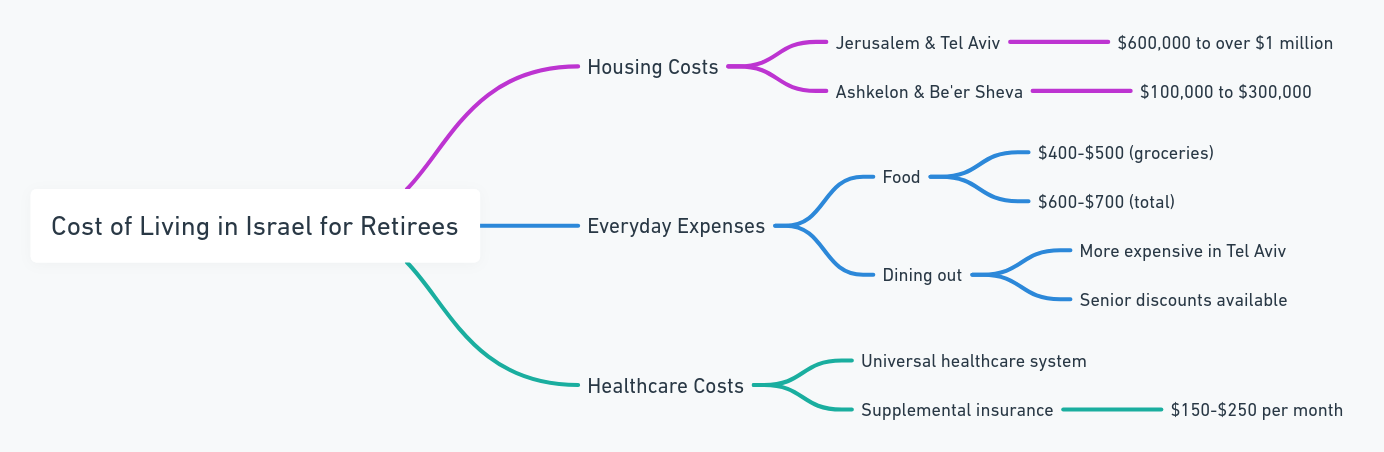
The cheapest cities for retirees with genuine infrastructure are Tiberias, Dimona, Be’er Sheva and Ashkelon. Tiberias is the cheapest real city, with low one-bedroom rents and municipality-run senior housing with minimal entrance fees. Dimona has the cheapest apartments in the country. Be’er Sheva rents one-bedrooms at modest prices and puts Soroka, one of Israel’s largest hospitals, on your doorstep. Ashkelon offers a Mediterranean beach at prices well below the central cities. Haifa is the value play among big cities, priced far below Tel Aviv. For recorded and asking prices where we have data, see the table above. Where city prices sit against the national trend is tracked in our guide to the Israeli housing market today.
Currency matters too. On 26 June 2026 the shekel hit 2.9912 to the dollar, its strongest level since October 1995, so dollar pensions now buy fewer shekels than they did in April 2025. Full national rent tables are in our breakdown of average rent and living costs in Israel.
Which Israeli cities are safest for retirees?
The safest cities for retirees on police crime data are Rishon LeZion, Ra’anana, Modi’in and Herzliya. Numbeo’s crime and safety indexes rate Israel better than most Western countries, so check the current figures before you rely on them. Rishon LeZion leads the large cities, with residents reporting that they feel safe walking alone after dark.
There is a second map, and it is geopolitical. Ashkelon and Ashdod sit within rocket range of Gaza. Every newer building there has a mamad (a reinforced safe room, legally required in new construction), but a retiree with mobility limits should weigh the sprint to shelter honestly. Kiryat Shmona, Metula and Nahariya carry northern-border proximity risk. The safest geopolitical footprint belongs to central cities: Modi’in, Ra’anana, Petah Tikva, Rishon LeZion and Rehovot are furthest from any front line.
Which cities are easiest to live in as you get older?
The most comfortable cities for retirees combine flat terrain, walkable centers and hospitals inside city limits. Ra’anana is flat and walkable with every health fund well represented. Modi’in was purpose-planned with wide pavements, bike paths, the Assuta Medical Center, and rail links toward both Tel Aviv and Jerusalem. Netanya gives you cliffside elevators down to the beach and a flat coastal promenade built for older walkers. Haifa’s Carmelit funicular connects the lower and upper city, Rambam hospital sits right in town, and the Carmel elevation keeps summers cooler than the coast. Jerusalem is the outlier: unmatched culture, but hilly terrain that most Anglo retirees solve by choosing the flatter western neighborhoods. Since April 2025, every resident aged 67+ rides all public transport in Israel free with the golden Rav-Kav profile, which makes a well-connected city worth real money. Weather matters as much as terrain, so match your tolerance for heat and humidity against our guide to regions, climate, and lifestyle fit for retirees in Israel.
Does Shabbat decide which city you pick?
For many retirees it does, because the Shabbat question separates the religious cities from the secular ones.
Which cities suit religious retirees?
The most religious cities for retirees are Jerusalem, Bnei Brak, Beitar Illit and Modi’in Illit, with Beit Shemesh the standout for English speakers. In Jerusalem every supermarket is kosher and Shabbat is visibly observed city-wide, with Anglo Orthodox concentrations in Rechavia, Har Nof and Ramot. RBS Aleph in Beit Shemesh is the Anglo Orthodox retirement destination, with walking-distance synagogues, an eruv (the boundary that permits carrying outdoors on Shabbat) and English-speaking rabbis. Bnei Brak, Beitar Illit and Modi’in Illit are deeply Haredi with low prices, but expect Hebrew or Yiddish. Know the trade: in these cities shops close from Friday afternoon to Saturday night and public transport stops.
Which cities suit secular retirees?
The most secular cities for retirees are Tel Aviv, Haifa and Eilat. Tel Aviv keeps restaurants, beaches and culture fully open on Shabbat, and it is the most expensive city in Israel. Haifa is the pluralist bargain: the only major city with public buses running on Shabbat, at prices far below Tel Aviv. Eilat runs hotels and restaurants seven days with duty-free prices, though its nearest major trauma center is Soroka in Be’er Sheva, a long drive away. Modi’in was deliberately planned as a pluralist city where both populations are comfortable. Match your observance level to a specific community with our comparison of Anglo, religious, and secular retirement communities in Israel.
What does retirement cost, and who helps pay?
The basic state pension covers only a small part of a comfortable retirement. From 1 January 2026 the basic Bituach Leumi old-age pension is ₪1,838 a month for an individual and ₪2,762 for a couple, with health insurance of ₪237 (individual) or ₪340 (couple) deducted at source. The rest comes from occupational pensions, foreign pensions or savings. New olim also get a generous tax break on foreign-source income for their first years, so confirm the current terms with the Israel Tax Authority. The claiming rules, seniority increments and the different retirement ages for men and women are laid out in our guide to the Israeli retirement age and Bituach Leumi pension rules, and the full monthly numbers city by city are in our retirement budget breakdown for Israel.
Three cost breaks change the math in any city. Buying as an oleh, you pay a reduced purchase tax rate on a sole residence, so check the current brackets before you sign. Arnona (municipal property tax) is discounted for seniors receiving the income supplement, up to a full exemption. And if you choose Diur Mugan, Israel’s independent senior-living model, you pay a deposit plus monthly fees, with a no-deposit option at higher monthly cost. The full pricing mechanics, including how the deposit depreciates and what returns to your heirs, are in our Diur Mugan cost guide. For medical planning, including the health funds and long-term care benefits, start with our sub-hub on healthcare and long-term care for retirees in Israel.
What should you check before you commit?
Check these six things before you commit to a city:
- Rent in your target city for 6 to 12 months before buying anything.
- Visit twice: once in August to test the heat, once on Shabbat to test the city’s character against yours.
- Walk into the local branch of your kupat cholim (public health fund) and confirm English-speaking doctors take new patients.
- Check both safety maps: police crime rankings and distance from Gaza or the northern border.
- Price the real monthly budget for your target city, since central Tel Aviv and prime Jerusalem cost far more than the rest of the country.
- If you are making aliyah, time your purchase inside the window the oleh purchase-tax benefit allows.
Where can you check the facts yourself?
These sources are worth your time:
- Bituach Leumi (btl.gov.il): official 2026 pension rates and retirement ages.
- Nefesh B’Nefesh (nbn.org.il): neighborhood-level Anglo community profiles.
- AACI (aaci.org.il): seniors division branches in most major cities.
- Numbeo crime and safety indexes for Israeli cities.
- Public Transport Authority (pti.org.il): the free 67+ Rav-Kav travel profile.
How do you start looking for a retirement home?
Shortlist two cities from the table above, one premium and one value, and let us put real apartments in front of you in both. Tell us your budget and your shortlist, and we will send matching retirement properties.