Moving to Israel involves housing, shipping, customs and benefit applications. Confirm the requirements for your own status and shipment before booking. Carrier routes can change, and tax relief depends on eligibility and the type of income. This guide separates the official rules from practical questions to put to your mover and advisers.
Executive Dispatch
- Shipping: Obtain a current sailing and door-to-door estimate. Suez and Cape routing vary by carrier and service; a 70-day journey is not a universal rule.
- Tax: Eligible recent arrivals may receive temporary relief on qualifying Israeli earned income. Foreign-income exemptions and reporting obligations are separate questions.
- Delivery scope: Ask which access, unloading, stairs, crane, storage and local-agent charges are included in the written quote.
- Quote preparation: Provide an accurate inventory and access details. Ask whether an on-site or video survey is needed for the mover to price your shipment.
- First steps: Confirm banking and benefit-payment requirements, keep essential documents with you, and check a property’s actual bedroom count and floor plan.
Listen to podcast:
Shipping routes and delivery estimates
There is no single route or transit time for every shipment to Israel. Maersk’s September 2026 update described selected services returning to Suez while other services retained different routing. The Suez Canal Authority also reported returning Maersk services on 20 October. Check the actual booked service and current carrier notice.
The Time Cost
Ask for the planned departure, route, estimated port arrival and estimated delivery date. Distinguish sailing time from packing, consolidation, customs and final delivery. Treat these as estimates and ask how schedule changes will be communicated.
Planning temporary housing
Choose temporary housing around your confirmed move-in and shipment plans. Allow a contingency for delays and check extension and cancellation terms. A month may suit some households, but it is not a guaranteed sufficient or mandatory period.
The 2026 Tax & Status Landscape
Customs entitlement and income-tax relief are separate. Establish your immigration and tax-residence dates, then check the conditions for each benefit with the responsible authority.
Temporary earned-income relief
The temporary regime can exempt qualifying salary or business income generated in Israel for eligible new residents and veteran returning residents. The Tax Authority’s current service includes qualifying arrivals from 5 November 2025 through 10 February 2027. Its annual ceilings are ₪600,000 for 2026, prorated where required, ₪1 million for 2027 and 2028, ₪350,000 for 2029 and ₪150,000 for 2030. Eligibility and income-source conditions apply; this is not a blanket zero rate on all income.
The Compliance Trade-Off
Eligible first-time Israeli residents and veteran returning residents may retain the ten-year exemption for qualifying foreign-source income. For people entering those tax-resident categories from 1 January 2026, the former special reporting exemptions were repealed. This does not mean every newcomer automatically files a comprehensive asset declaration: annual-return rules and any capital-statement request must be assessed separately. Confirm your obligations with a licensed Israeli tax professional.
Who Qualifies?
Do not assume an immigration label alone establishes every tax exemption. First-time Israeli tax residence, veteran-returning-resident status, the relevant dates and the income’s source determine the applicable rules.
The “To-Door” Trap and Other Contractual Landmines
A door-to-door service should be defined by its written scope. Ask who is responsible at origin, at the port and at the delivery address, and which charges can be added.
Access and handling charges
Ask the mover to price the actual walking distance, floors, lift dimensions, parking and any crane work. There is no verified universal “20 metres and two floors” allowance applying to all contracts.
- The Reality: Tel Aviv streets are narrow; Jerusalem apartments are often walk-ups.
- The Cost: If you exceed these limits, you face “extra carry” fees or the need for an external crane (menof).
- Before signing: Obtain the amounts, currency, tax treatment and approval process for possible extra charges in writing. Compare any advance-payment terms and cancellation protections.
The “Valued Inventory” Insurance Trap
Ask the insurer how value is declared, whether cover is replacement-cost or depreciated-value, and what exclusions and excess apply. Obtain the actual premium rather than relying on a universal percentage.
- Claim settlement: The policy wording and accepted inventory determine how damage or loss is valued.
- Replacement cost: Price important items locally before choosing the insured value; there is no verified fixed Israel-versus-overseas markup.
- Before buying cover: Confirm packing requirements, declared values, claims deadlines and whether storage and final delivery are covered.
Vetting Your Mover: The Red and Green Flags
Compare written service scopes, insurance terms, references and responsibility for the Israeli hand-off. A company name on this page is not an endorsement or a verification of its current prices or performance.
Inventory and survey
An accurate inventory and access information help the mover quote the work. Ask whether a video or on-site survey is required and which assumptions could change the price. A phone quote is not by itself proof of misconduct.
The “Two-Expert” System
Clarify which company performs each stage and who is responsible for subcontractors:
- The International Mover: Handles packing, logistics, and the physical journey to the Israeli port.
- Customs clearance: Goods may be released by the entitled person or an authorised customs agent, subject to Customs requirements. Ask who will handle your shipment.
Confirm the named Israeli contact, authorisation, documents and charges. Hiring two separate professionals is not a universal legal requirement.
What to Ship vs. What to Buy (The Voltage War)
Strategic decluttering is your biggest money saver.
The Frequency Trap (50Hz vs 60Hz)
Check each appliance’s rating plate and manufacturer instructions against Israel’s 230V, 50Hz supply. Some appliances accept multiple voltages or both 50Hz and 60Hz; others do not.
- Adapters and transformers: A plug adapter does not change voltage. An ordinary voltage transformer does not change mains frequency. Use only a solution approved for the appliance by its manufacturer or a qualified electrician.
- Motorised appliances: Compatibility depends on the appliance and motor design. Do not assume that every 60Hz appliance will work safely, or that all will necessarily fail.
- Decision: Compare confirmed compatibility, safe installation, warranty, shipping and local replacement cost before deciding what to bring.
The “Soft Packing” Hack
Ask the mover and insurer which packing methods are permitted. Keep an accurate inventory and protect fragile items appropriately; using clothing as padding is not a substitute for required professional packing.
Customs: Rights, Duties, and “Reasonable Quantities”
Personal-import tax relief exists separately from immigrant household-goods relief. The applicable exemption, tax and permit rules depend on the goods, value, quantity and import route. Do not assume every import is taxable or that immigrant status exempts every item.
The Olim Benefit
Qualifying household effects may generally arrive in up to three shipments within the three-year entitlement period, subject to Customs approval and proof of an independent household. The accompanying eligible luggage has separate treatment.
- Goods must meet the personal-use, quantity and other conditions of the relevant exemption. Customs assesses the actual shipment; the immigrant household-goods guide specifies up to two TVs and two PCs per family, and generally one of each other major appliance or furniture item.
- Portable professional hand tools have a stated US$1,650 ceiling in the Tax Authority guide. Business machinery has a separate approval route and conditions; obtain Customs approval before shipping equipment in reliance on an exemption.
The General Tax Reality
For items not covered by Olim benefits (or for non-Olim):
- VAT: 18% on most goods and services (raised from 17% on 1 January 2025, per the Israel Tax Authority).
- Purchase tax: Whether it applies depends on the tariff classification and the particular exemption.
- Specific Duties:
- Home appliances: check the exact tariff classification, origin and exemption.
- Home decor and textiles: check the exact tariff item, origin and exemption.
- Food and supplements: check tax classification and health or import approvals before shipping.
The Vehicle Dilemma
A qualifying immigrant vehicle import has its own reduced-tax route and licensing conditions. The cited Knesset analysis describes 50% customs duty plus VAT, with purchase-tax exemption, rather than a universal 50–80% total charge. Ask Customs for a calculation for the actual vehicle and confirm transport, registration and compliance costs.
- A four-year vehicle transfer restriction applies under the concession. Any proposed earlier transfer must be cleared with Customs and may require payment of tax differences; do not sell or lend it in reliance on a general website summary.
- You must have a foreign license issued before Aliyah.
- Compare a written landed-cost calculation with actual Israeli purchase offers. The better choice depends on the vehicle, eligibility, compliance work and sale restrictions.
Bureaucracy and The “First Week” Protocol
Arrival at Ben Gurion Airport is just the beginning.
The “Paper Trail” Strategy
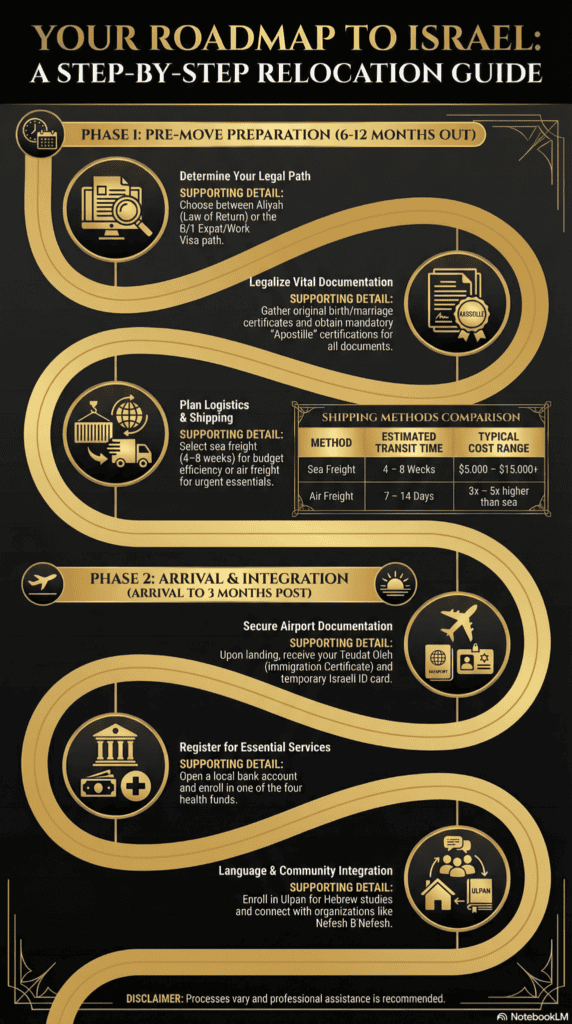
Obtain the country-specific aliyah document checklist. Original civil documents commonly require authentication and translation; apostille applies where the convention route is available, while other countries require an alternative authentication chain. Confirm the route with the Israeli mission or aliyah representative.
The “Day 1” Survival Kit
Keep these essentials with you rather than relying on the shipment’s estimated arrival:
- Teudat Oleh (received at airport).
- Prescription records and a clinician-approved continuity supply, subject to medicine-import rules; controlled medicines require separate checks.
- Original identity and civil-status documents, with the authentication and translations required for your application.
- Valuables/Laptop.
The Sequence of Operations
- Airport: Get your Teudat Oleh and cash portion of the Sal Klita (Absorption Basket). Register for a Health Fund (Kupat Holim) right there—it saves a trip later.
- The bank: Ask the chosen bank about identification, account-opening and activation requirements. A one-shekel deposit is not established here as a universal statutory condition.
- The Counselor: After the bank, meet your Yoetz Klita (Absorption Counselor). Give them your bank details to unlock the monthly Sal Klita transfers.
- The Population and Immigration Authority: Use the official appointment service and confirm the documents needed for your identity-card application.
Real Estate: Decoding “Room Math”
Finding an apartment requires learning a new dialect, often confusing for those using standard real estate guides like those from Ronkin Real Estate.
The “Salon” Factor
Israeli advertisements commonly include a living room in the stated room count, but layouts and advertising practices vary.
- A “3-room” advertisement: Often two bedrooms and a living room; confirm the floor plan.
- A “4-room” advertisement: Often three bedrooms and a living room; confirm the actual rooms.
- The Pitfall: If you ask an agent for a “3-room” flat expecting three bedrooms, you will be shown properties that are too small. Always specify the number of bedrooms (chadrei sheina).
| Budget item | Tel Aviv | Jerusalem | Haifa |
|---|---|---|---|
| Rent: smaller apartment | Obtain a dated quote for the actual property | Obtain a dated quote for the actual property | Obtain a dated quote for the actual property |
| Rent: family apartment | Compare layout, condition and total charges | Compare layout, condition and total charges | Compare layout, condition and total charges |
| Groceries | Build a budget from your own basket | Build a budget from your own basket | Build a budget from your own basket |
| Utilities | Check actual bills, occupancy and season | Check actual bills, occupancy and season | Check actual bills, occupancy and season |
| Public transport | Check route, travel distance and discount profile | Check route, travel distance and discount profile | Check route, travel distance and discount profile |
| Basic health contributions | See the eligibility conditions below | See the eligibility conditions below | See the eligibility conditions below |
| Ulpan | Check individual entitlement and approved course | Check individual entitlement and approved course | Check individual entitlement and approved course |
Rental Assistance
Ordinary new-immigrant rent assistance generally covers months 7–30 after aliyah, subject to the applicable procedure. Special groups and locality supplements have separate rules. Health-contribution exemption is also conditional: the initial six months require income no higher than 5% of average wages (₪688 in 2026); any extension is not an automatic free first year. Copayments and supplementary cover are separate.
Cultural Integration: The “Vibe”
Bureaucracy here has a rhythm.
- “Rak Rega”: Literally “just a moment.” It is not a dismissal; it is a placeholder. Be patient.
- Contact channels: Use the bank’s, school’s or authority’s confirmed official channel. Do not assume every clerk accepts WhatsApp or send sensitive documents to an unverified number.
- Digital First: Use the Ezor Ishi (Personal Account) on the government website to track payments and send documents to your counselor. It beats waiting in line.
Comparison: Port Storage vs. Mover’s Bonded Storage
If your apartment isn’t ready when your container arrives (a likely scenario given the unpredictable delays), you need a storage plan.
| Feature | Port Storage (The Default) | Bonded Warehouse (The Strategy) |
|---|---|---|
| Cost | Obtain the terminal’s storage, demurrage and detention terms and free periods. | Obtain the warehouse’s handling, storage, transport and release charges. |
| Access | Ask the terminal or agent what access is permitted. | Ask the warehouse what access and retrieval arrangements are permitted. |
| Delay exposure | Charges depend on the terminal, carrier, container and delay. | Check minimum periods, extra handling and insurance exclusions. |
| Customs | Ask the agent which clearances are required. | Movement under customs control requires the appropriate authorisation; do not assume it is available for every shipment. |
| Decision | Compare the actual total cost and release plan. | Compare the actual total cost and release plan. |
The “Zero-Friction” Move Checklist
Pre-Departure
- Appliances: Check manufacturer-approved voltage and frequency compatibility before deciding what to ship.
- Documents: Confirm the applicable authentication and translation route for each required document.
- Quote: Supply an accurate inventory and access details; arrange the survey requested by the mover.
- Housing: Match temporary accommodation to your actual move-in plan and allow a delay contingency.
- Permit Check: Get pre-approval for any meds containing narcotics or specific work tools.
Post-Arrival
- Banking: Complete the bank’s requirements and give verified payment details to the Ministry.
- Ministry Meeting: Provide bank details to Yoetz Klita to trigger payments.
- ID appointment: Use the Population and Immigration Authority’s current official booking route.
- License Swap: Convert foreign driver’s license within 5 years (1 year to drive with foreign license).
- Arnona Discount: Apply at the municipality for your new immigrant property tax discount.
Glossary of Essential Terms
- Apostille: Authentication of a public document under the Hague Convention. Other authentication routes apply where the convention does not.
- Sal Klita: The “Absorption Basket” of financial aid paid in installments to new immigrants.
- Teudat Oleh: The booklet certifying your new immigrant status; your key to benefits.
- Teudat Zehut: The Israeli national identity card.
- Kupat Holim: The Health Maintenance Organization (HMO). You must register with one (Maccabi, Clalit, Leumit, Meuhedet).
- Menof: A crane used to lift furniture into apartments through the window when the stairwell is too narrow.
- Bonded storage: Storage under customs control. Suitability, permitted movements, insurance and cost must be confirmed for the shipment.
Sources and planning assumptions
The customs guidance is based on the Israel Tax Authority’s immigrant import guide. Income-tax relief follows the Tax Authority’s current service, and route information refers to dated Maersk updates and the Suez Canal Authority’s 20 October 2026 notice. This page does not provide a verified shipping-price list, guaranteed transit time or current city-rent survey. Obtain dated quotations for your own move. This is general information, not legal or tax advice; confirm with a licensed professional.
FAQ: Navigating the Move
Q: Should essential clothes go in the container?
A: Carry what you need for arrival and a possible delay. Choose the contents of your luggage around the season and your actual delivery estimate.
Q: Can I use the 0% tax benefit if I work remotely for a US company?
A: A US employer or overseas bank account does not by itself make work performed in Israel foreign-source income. Eligible recent arrivals may qualify for the separate temporary earned-income relief, subject to dates, ceilings and conditions. Assess the actual work location, income source and reporting duties with a licensed tax professional.
Q: What happens if I bring a prohibited item like a pocket knife?
A: Check the item with Customs, the competent licensing authority and the carrier before packing. Do not assume that a knife, weapon or other restricted item is permitted because it is intended for personal use.
Q: Why do I need a “joint” bank account?
A: Ask the Ministry which account-holder details and bank confirmation are required for your household’s benefit payments. Do not assume every payment can be split or that every household follows the same account arrangement.
Q: Can I get the Arnona (property tax) discount if I rent?
A: A qualifying tenant may apply as the property’s registered liable occupant. Ask the municipality about the immigrant discount, eligible period, area limit, required documents and interaction with other discounts; it is not an automatic universal 70–90% reduction for every renter.
Wrap-Up: Operate Like a Strategist
Keep a written move plan with current carrier estimates, confirmed housing, a detailed shipment inventory and the required documents. Check tax, customs and benefit eligibility separately. Update the plan when a booking, authority decision or delivery date changes.
Final Summary: The Tactical Takeaways
- Timeline: Use the booked carrier’s current estimate and allow a contingency; no universal 50–70-day voyage applies.
- Finance: Check eligibility for each tax exemption and the separate reporting rules.
- Logistics: Agree delivery access, storage, insurance and possible additional charges in writing.
- Bureaucracy: Bank account first, then counselor; use “Ezor Ishi” for digital management.
- Customs: Qualifying household shipments have a three-year entitlement period and shipment limits; other imports follow their own exemptions, tariffs and permit rules.
If you are buying property in Israel, see buying property in Israel.
Want tailored help with buying, selling, renting, or financing property in Israel? Contact the Semerenko Group team and we will guide you through the next step.
Related Aliyah logistics guides
For readers turning logistics into a housing plan, continue with the main moving-to-Israel guide, first-year housing for olim families, starting the housing search before Aliyah, and the rent-first framework.
Is this page useful?